ZoomInfo Workbounce: A Closed-Lost Deal Pilot for Kenyan B2B Teams
ZoomInfo’s 14 October Workbounce update brings internal sales knowledge into GTM.AI. Use this closed-lost deal pilot for Kenyan B2B teams.
UniqueTechCamp Editorial
Lead Systems Architect • UniqueTechCamp Engineering Unit
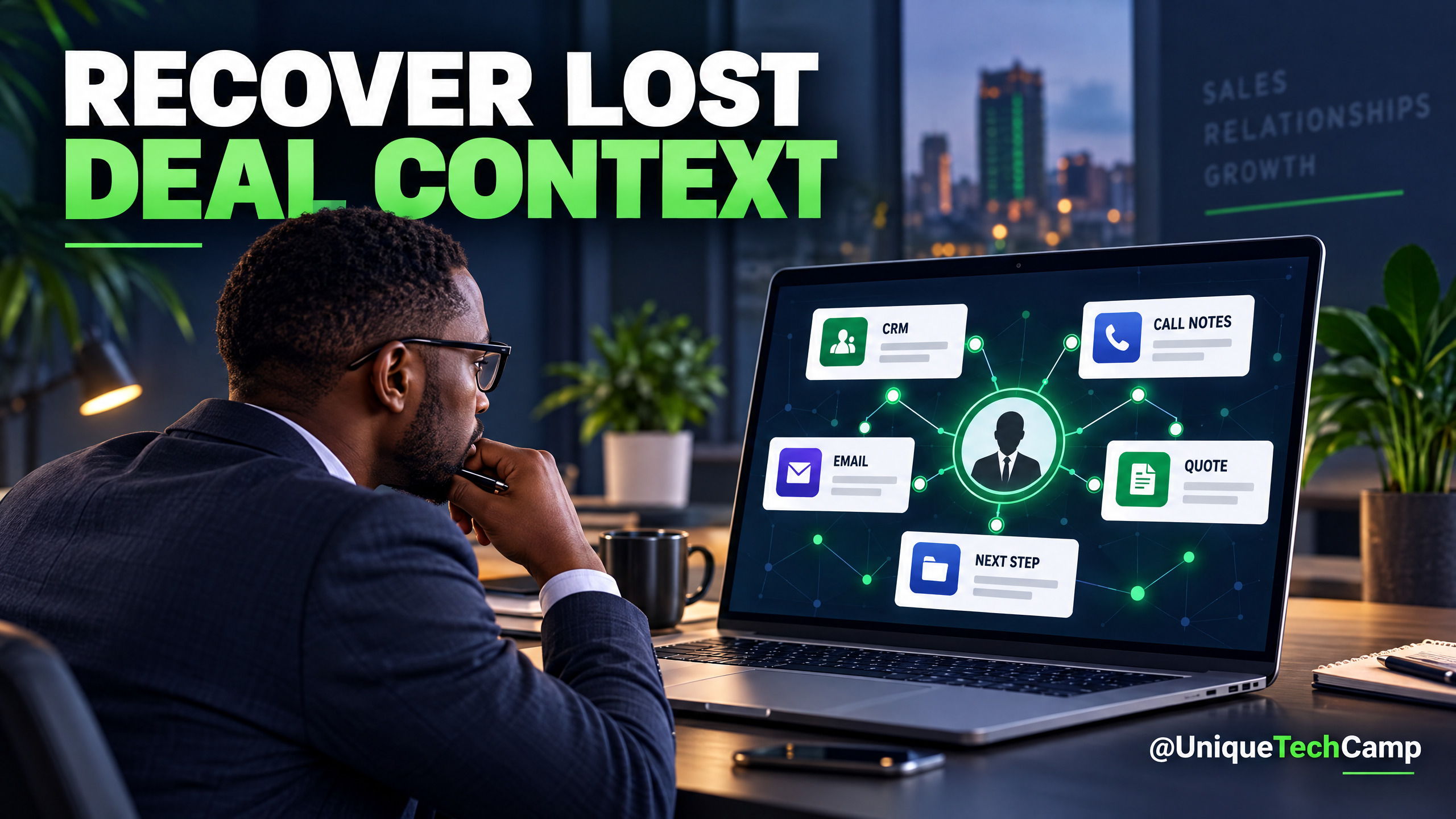
A deal marked “lost” in a customer-relationship management system rarely tells the next salesperson enough. The reason may be in a call recording, a revised quote in a shared folder, a delivery concern in email and a colleague’s account note. When a Nairobi distributor, technology reseller or professional-services firm revisits that customer, the visible status may be accurate but the story behind it can be scattered, stale or incomplete.
On 14 October 2026, ZoomInfo announced that Workbounce’s enterprise knowledge layer is being integrated into its GTM.AI context graph. The idea is to connect structured company and contact data with internal knowledge such as account notes, calls and documents, then make that context easier for a revenue team to find and use. This is a new integration announcement, not the launch of Workbounce itself: ZoomInfo says it acquired Workbounce in 2024. The release describes product capabilities, but does not establish a Kenyan availability date, Workbounce-specific price or proven sales results. ZoomInfo’s 14 October announcement
For a small or mid-sized B2B team, the practical question is not whether an AI layer can “win back” every lost deal. It is whether a representative can prepare a better-sourced account review, spot a missing commitment and choose a sensible next question without trawling through folders or guessing. A narrow, human-reviewed pilot can test that workflow; it cannot guarantee that a buyer will return.
The problem: customer knowledge is spread across tools
Sales teams collect useful context as they work: a customer’s stated priorities, a technical constraint, a promised delivery window, an objection to a previous proposal or a reason that procurement paused. That context may sit across a CRM, email, call transcript, presentation, product document, Slack thread, Google Drive or Notion page. The tools are not necessarily connected, and their contents may have different owners, permissions and levels of freshness.
A salesperson may repeat discovery, search several systems, ask a colleague to reconstruct a meeting or send a follow-up that ignores an earlier objection. A stale quote or misremembered promise can undermine trust. Yet an AI summary can create its own risk if it blends facts, guesses and outdated files without showing which source supports each statement.
A useful knowledge layer should therefore do more than retrieve a plausible paragraph. For a customer-facing decision, the team needs the source, date, owner and uncertainty behind each material claim. If the system cannot surface those details, treat its answer as a lead for checking, not as the account record.
What ZoomInfo announced—and what remains unconfirmed
ZoomInfo describes Workbounce as a semantic knowledge layer that can connect internal go-to-market information with the broader GTM Context Graph. In ordinary language, semantic search tries to find material by meaning as well as exact keywords. A search for “delivery delay”, for example, might surface a note phrased as “shipment arrived late”. That concept is useful, but it does not guarantee that every record will be found or interpreted correctly.
The release names source types including call transcripts and recordings, email, presentation decks, product documents, account notes, Slack threads, Google Drive and Notion pages. ZoomInfo says the integrated experience can support semantic search and reasoning, retrieve answers and assets, reduce manual seller preparation, suggest next actions and provide collaborative customer spaces. These are vendor-described functions, not independent tests of accuracy, adoption or commercial impact.
The official GTM.AI overview describes its context agents as combining ZoomInfo company, contact and signal data with a customer’s CRM and conversations. Connected sources matter: a product description does not prove that a particular CRM, file store or conversation tool is configured for a specific account. The release does not say all ZoomInfo customers can enable Workbounce, list a Kenya-specific rollout or specify the required tier. Confirm those details with ZoomInfo before planning a live process. GTM.AI’s product overview
A practical first use: review one closed-lost account
Start with a closed-lost or paused opportunity that the sales owner already has permission to review. Ask the assistant for a source-backed briefing for an internal account meeting, not to contact the customer or change the opportunity stage.
The briefing should answer a limited set of questions: what did the customer say they needed; what proposal or scope did the team share; which concerns were recorded; what commitments did the seller make; what has changed since the last interaction; and what is the most useful question to ask before any follow-up? It should identify a source and date for each answer, separate direct evidence from interpretation, and say when records are silent or contradictory.
This is different from asking an AI system to “find revenue” or “reactivate all lost deals”. A broad instruction can encourage it to infer intent, rank accounts using unclear criteria or turn weak signals into confident recommendations. A bounded account review gives a manager something concrete to inspect—and a reason to stop when the evidence is thin.
For business owners and revenue teams that need help mapping records, account workflows and review boundaries before connecting a tool, the UniqueTechCamp AI Solutions Desk can help scope a supervised pilot. Begin with a workflow map and acceptance checklist, not a forecast of extra sales.
Build a permission-aware pilot
1. Choose the decision, not the technology. Define the moment the briefing should support: for example, a weekly review of a paused proposal before the account owner decides whether to ask a question, update the offer or leave the opportunity closed. Name the account owner and approver. Do not let the pilot reopen records automatically.
2. Record the current process. Note how the team prepares today: time spent searching, systems consulted, missing or conflicting facts and corrections made. Use the same measures during the pilot. This baseline helps the business compare workflows; it is not a claim about what Workbounce will save.
3. Select a small, reviewed sample. Start with a handful of accounts whose owners agree to the test. Prepare a short reference sheet with known facts, relevant sources and unresolved questions. Avoid bulk-importing an entire customer database just to see what appears.
4. Confirm exact sources and permissions. Ask which connectors are available now, what each can read, whether file-level permissions are honoured and how updates or deletions propagate. The release lists calls, email, Google Drive and Notion as examples; it does not confirm every Kenyan team’s CRM, accounting system or WhatsApp workflow. Ask specifically about channels the team relies on rather than assuming they are connected.
Agree which accounts and folders are in scope, who can query them, what must be excluded and how a source can be corrected or removed. Keep the test away from highly sensitive records until the organisation has reviewed the vendor’s written data-handling and access terms. Do not paste credentials, private keys or unrelated personal information into a prompt.
5. Request a source-led briefing. Give the assistant the account name, review purpose and approved source scope. Ask for a timeline, customer-stated needs, recorded objections, proposal and commitment history, changes since the last contact, open questions and possible next steps. Require a source title and date for each material fact. Ask it to label inference, flag conflicting versions and write “not found” rather than fill a gap with a guess.
6. Review before contacting the customer. The account owner should open each important source, compare proposal versions and dates, correct the briefing and decide whether a follow-up is appropriate. Keep sending, price changes, discounts, contract terms and CRM-stage changes outside the assistant’s authority in the first test. If it cannot show sources or repeatedly confuses accounts, pause.
7. Keep a short test log. Record the question, sources returned, facts verified, corrections, missing evidence, review time and decision taken. An interesting summary is not a customer outcome; the log helps decide whether to repeat, narrow or stop the experiment.
Measure the work separately from revenue
Measure process quality first. Compare the pilot with the baseline: time to assemble a useful briefing, systems searched, unsupported statements, unresolved links, contradictions, manual corrections and review time. Ask account owners whether the source trail reduced or increased effort.
Track customer-facing steps separately: whether the team sent a relevant follow-up, received a reply, agreed a meeting, progressed an opportunity or addressed the customer’s stated needs. These measures describe what happened; by themselves, they do not show that the AI integration caused it. A response may reflect timing, a revised offer, a new stakeholder or work by the salesperson outside the tool.
Do not treat a reopened opportunity, one email reply or a single sale as proof of an earnings lift. If the team later compares approaches, define a fair comparison, keep the offer and follow-up rules as steady as practical, and include licences, credit use, integration, source cleanup and human review in the decision. If the sample is too small or the process changed, report observations and limits rather than causation.
A pilot can end with “not ready”. If quotes are mixed with superseded versions, owners disagree about why a deal was lost or reviewers spend longer correcting the briefing than assembling it, those are useful process findings. Fix record ownership or versioning before widening access.
Pricing, availability and what to ask the vendor
ZoomInfo’s 14 October release does not publish a Workbounce-specific price, required tier, Kenya availability statement or general rollout date. Its wording announces integration into GTM.AI but does not establish that every existing customer can use it. Ask ZoomInfo whether Workbounce is available to your account, which sources and connectors are included, what setup is needed, how permissions are inherited and what support is provided.
There is public pricing for GTM.AI more broadly, but it is not a Workbounce quote. ZoomInfo’s general page lists 1,000 data credits and 1,000 AI credits at signup, with no card required; subsequent credit top-ups start from $20. That figure describes the general credit model, not a Workbounce subscription or a Kenyan business’s total cost. The documentation distinguishes data credits for enrichment from AI credits for research and analysis. Ask for expected use, applicable credits, tax and payment terms, and whether Workbounce is separately licensed. GTM.AI pricing and credit details The credits and billing guide
The public GTM.AI documentation describes sign-in for free accounts and existing ZoomInfo customers, but it does not confirm that Workbounce is included in the free allocation or enabled in Kenya. Verify account eligibility and commercial terms before budgeting or promising the workflow to customers. No public Workbounce price is not evidence that the tool is free.
Limits, data quality and user trust
An AI layer cannot make an incomplete account history complete. A transcript may mishear a name; an old deck may contain a superseded offer; an email may describe a proposal that was never approved. The team still needs owners for customer facts, current quote versions and the record that prevails when sources disagree. Test retrieval against a reference sheet, not against how fluent the answer sounds.
A 2026 qualitative study based on 18 semi-structured interviews with B2B sales professionals identified perceived usefulness and fit with routine as factors in adoption. Participants also described administrative duplication, poor integration, lack of transparency and threats to autonomy as reasons for resistance. The authors link perceived performance effects to CRM integration, shared customer memory and follow-up discipline, but the interviews are not a quantified ROI test or Kenya-specific evidence. They support careful workflow design, not a promise that this product will improve a particular team’s sales. The 2026 B2B sales-process study
ZoomInfo’s general GTM.AI security guide says MCP calls are checked against a signed-in user’s entitlements and that data sent through an AI provider is subject to that provider’s retention agreement. It advises reviewing retention settings and disabling training on data where possible. That is relevant background for GTM.AI, but the Workbounce announcement does not spell out connector-level permission inheritance or retention behaviour. Get answers for the specific setup and keep access limited. ZoomInfo’s GTM.AI security and data guide
The commercial limit matters too: context retrieval may help a seller prepare, but it does not create a budget, resolve a product mismatch or earn buyer trust by itself. A recommendation is a prompt for the account owner to investigate, not proof of customer intent.
Frequently asked questions
Is Workbounce a new product announced in October 2026?
No. ZoomInfo says it acquired Workbounce in 2024. The 14 October 2026 announcement describes integrating Workbounce’s knowledge layer into GTM.AI. The update is new; the acquired product is not.
Does the update guarantee that a lost deal will return?
No. ZoomInfo’s release describes intended capabilities, not independently measured recovery rates or guaranteed revenue. This pilot tests whether a team can prepare a more useful, source-backed account review; the customer still decides whether to respond or buy.
How much does Workbounce cost?
The public announcement does not give a Workbounce-specific price or subscription requirement. GTM.AI’s general page describes free credits and top-ups from $20, but that is not a confirmed Workbounce price. Ask ZoomInfo for a written account-specific quote and usage terms.
Can a Kenyan SME use the integration now?
The public sources checked do not provide a Kenya-specific availability date or confirm Workbounce access for every GTM.AI tier. Ask ZoomInfo to verify your organisation’s eligibility, rollout status, connector coverage and support before planning around it.
Conclusion
ZoomInfo’s Workbounce update addresses a familiar operating problem: the CRM record may be structured, while the reasons and commitments that matter are buried in conversations and documents. For Kenyan B2B teams, the sensible response is a small test around one closed-lost account review, with named sources, limited permissions and a human owner for every customer-facing action.
Treat the release as a prompt to ask better questions, not as proof of an immediate revenue opportunity. If the briefing is traceable, reduces unproductive searching and helps a salesperson prepare a more relevant conversation, the team has evidence to consider a broader test. If it is inaccurate, expensive to review or unavailable to the account, stopping is the right result.
Need this built for your business?
If you own a business or lead a revenue team, start by mapping where customer commitments, quote versions and follow-up decisions currently live. The UniqueTechCamp AI Solutions Desk can help scope a source-aware pilot and its review boundaries. For a practical scoping conversation, book an appointment or explore Marketing & Email Studio as a related service route. Define the workflow, data access and success measures before choosing a tool, and make no earnings assumptions until your own results support them.
oposal or a reason that procurement paused. That context may sit across a CRM, email, call transcript, presentation, product document, Slack thread, Google Drive or Notion page. The tools are not necessarily connected, and their contents may have different owners, permissions and levels of freshness
Deploy An Autonomous AI Lead Gen System Today
We engineer high-converting web applications with integrated 24/7 WhatsApp qualification bots and multi-channel follow-up drips.
Related Strategy Articles

Gemini Small-Business Tools: A Safe Growth Pilot for Kenyan SMEs
Google's Gemini business page brings brand, finance and app tools together. A cautious pilot for Kenyan SMEs, with privacy and review checks.
Google Docs Captions and Cross-References for Kenyan SMEs
Use Google Docs captions, cross-references and caption tables to keep Kenyan SME reports and tender documents easier to navigate after edits.

ChatGPT for Sales: A Human-Reviewed CRM Pilot for Kenyan SMEs
OpenAI's new ChatGPT for Sales adds sales workflows. Learn how Kenyan SMEs can pilot CRM connections with human review, privacy checks and clear measures.

UniqueTechCamp Desk
Online • Reply < 5 mins