ChatGPT for Sales: A Human-Reviewed CRM Pilot for Kenyan SMEs
OpenAI's new ChatGPT for Sales adds sales workflows. Learn how Kenyan SMEs can pilot CRM connections with human review, privacy checks and clear measures.
UniqueTechCamp
Digital Solutions Team • UniqueTechCamp Engineering Unit

For a Kenyan small or medium-sized enterprise, a sales assistant is only useful if it improves preparation and follow-through without quietly changing customer records, exposing personal data or creating a false sense of certainty. OpenAI’s new Sales plugin creates an opportunity to test that balance. It also creates a reason to be precise: the product is not a replacement for accountable sales people, a complete CRM implementation or local privacy governance.
What OpenAI has launched
In its official launch announcement ↗ dated 17 November 2026, OpenAI describes a Sales plugin for ChatGPT with dedicated seller skills and more than 30 new or expanded partner plugins. The announcement names practical sales work such as selecting accounts, preparing for calls, drafting proposals, sending follow-ups, identifying pipeline risk and updating CRM activity. Examples of connectors include Salesforce, HubSpot, Close and monday CRM, among others.
The launch is best understood as an expansion of what ChatGPT can do when an organisation deliberately connects approved business tools. It is not evidence that every CRM, every feature or every Kenyan workspace is enabled. Business and Enterprise administrators need to enable the Sales plugin and any relevant partner plugins. OpenAI says availability varies by plan, region and workspace settings. A sensible buyer therefore starts with the organisation’s own ChatGPT directory, administrator controls and connected-app permissions rather than relying on a general product description.
The Sales plugin page ↗ describes Interactive, Read and Write capabilities. It presents account plans, meeting briefs, outreach, follow-ups and pipeline summaries as possible sales workflows. The page also lists a broad set of included apps, including Slack, Teams, Zoom, Granola, Fireflies, Otter, Salesforce and HubSpot. The wording is important: availability varies by plan, plugin and workspace. Treat the page as a capability map, not as a promise that a particular Kenyan business can switch on every connector.
What it could mean for a Kenyan sales team
Many SMEs sell through a mixture of WhatsApp conversations, email, calls, spreadsheets and a CRM that is not always updated at the moment a deal moves. A connected assistant may help a team assemble information into a usable brief, turn approved notes into a draft and highlight missing or inconsistent pipeline information. Those are support tasks. The commercial judgement remains with the person who knows the customer, the product, the territory and the consequences of an error.
Consider a Nairobi-based distributor, a professional-services firm serving several counties or a growing online business. A sales lead could ask for a pre-call brief based on permitted CRM and meeting information, then check the source records before using it. After the call, the representative could ask for a follow-up draft that reflects the agreed next step. A manager might request a pipeline summary that flags deals with stale activity or unclear ownership. These examples describe a possible workflow, not a claimed result or benchmark.
The value is likely to be highest where the team already has reasonably structured records and a clear review habit. If contact names, consent status, deal stages and next actions are routinely incomplete, an assistant can make the information easier to read without making it more reliable. It can also produce a fluent draft from a weak source. Fluency is not verification. AI-generated outputs still require verification: a human must check facts, tone, recipients, commitments and the proposed CRM change before anything consequential happens.
For practical guidance on shaping an AI-enabled workflow rather than simply adding another tool, UniqueTechCamp ↗ can be a relevant starting point for a business discussion. The operating principle remains simple: let the system reduce repetitive preparation, while a named employee owns the decision and the customer relationship.
A bounded human-approved pilot
A cautious pilot should answer one business question: can the team prepare and follow up more consistently while preserving review, access and privacy controls? It should not begin with unrestricted write access across the CRM. Define a narrow workflow, a small group of authorised users and a short list of approved data sources. An example pilot could cover pre-call briefs, follow-up drafts and a proposed next-action field for a selected sales process. The example is a test design only; it does not imply that the business will save time, increase conversion or improve revenue.
Step one: define the approved task
Write down what the assistant may read, what it may draft and what it may never decide. For example, it may read selected account and activity fields, summarise a meeting and draft an email for a human to approve. It may not invent a discount, promise a delivery date, change a customer’s consent status or send a message without an accountable reviewer. Decide what counts as a source of truth when CRM data conflicts with a meeting note.
Step two: start with read-only work
Use read access and drafts first. If the relevant control is offered, require approval before writes and keep the first operating mode read-only. A reviewer should compare every brief or draft with the underlying record, remove unsupported claims and confirm the intended recipient. Only after the team has demonstrated a repeatable review process should it consider a tightly scoped write action, and then only for fields with a clear owner and an auditable purpose.
Step three: document the human checkpoint
Assign a role, not an abstract team, to review outputs. The reviewer checks identity, account, date, figures, product terms, personal details, sentiment and next step. The CRM owner checks that any approved update is placed in the correct record and does not overwrite a more authoritative source. Keep a simple log of the prompt or task, the source records used, the reviewer, the decision and any correction. This makes the pilot inspectable without claiming that a log eliminates risk.
Step four: set a stop rule
Pause the pilot if it exposes information to the wrong user, drafts a materially misleading customer statement, writes to the wrong account, produces repeated unsupported details or cannot show who approved a change. A stop rule is useful because a polished interface can encourage people to normalise an unsafe shortcut. Restart only after the administrator, process owner and relevant privacy or security lead agree on the correction.
Tools, data and permissions
Before connecting an app, map the intended data flow. List the CRM objects, meeting systems, messaging tools and document stores involved. Identify which fields are necessary for the task and which are merely convenient. A pre-call brief may need account history and approved meeting notes, but not every internal conversation, full contact directory or unrelated employee record. Least privilege means selecting the smallest practical set of users, apps, records and actions.
Read OpenAI’s admin controls, security and compliance guidance ↗ alongside the app permissions guidance ↗. Also check the plugin availability guidance ↗. These are the documents to use when deciding what an administrator can enable and what a connected app can do. Permissions vary by app, plan and workspace. Changing a ChatGPT setting does not change the rights already granted to the connected provider.
That last point deserves emphasis. A CRM’s own user, role and API permissions remain relevant. A user who can edit a record in the provider may still have that underlying provider authority even if the ChatGPT workflow is restricted. Review provider-side roles, tokens, scopes, audit logs, retention settings and offboarding. Remove access when a staff member changes role or leaves. Confirm whether the connector is a native app, a partner service or another integration layer, and read the applicable provider terms before sharing customer information.
Kenyan privacy and governance checklist
The Kenya Data Protection Act, 2019 is a general governance reference for this planning exercise, not legal advice. The ODPC-hosted Data Protection Act PDF ↗ covers themes that should inform a connected-sales review, including lawful and specific purposes, notices, data-subject rights, security, data protection impact assessments for processing likely to result in high risk, and safeguards for cross-border transfers.
Translate those themes into practical questions. What is the lawful, specific purpose for using each category of customer or prospect data? Has the organisation given an appropriate notice, and does it explain the relevant processing clearly? Can a person exercise applicable rights through a known contact? Who is responsible for responding? Is the data accurate and limited to what the task needs? What security measures, access restrictions and incident procedures apply?
Check whether the proposed processing is likely to create high risk and whether a data protection impact assessment is appropriate. Consider sensitive personal data, vulnerable people, profiling, large-scale contact lists and information moving outside Kenya or through overseas providers. Confirm the cross-border safeguards and contractual position rather than assuming that a business subscription answers every local requirement. For high-risk or uncertain processing, use proportionate advice from local counsel or the organisation’s data protection officer.
Keep governance proportional but real. Name the business owner, system administrator, CRM owner and privacy contact. Maintain an app inventory, a data map, an access review schedule and an incident route. Train users not to paste unnecessary personal information into prompts or copy a generated message without checking it. A short, plain-language internal policy can state approved use, prohibited use, review duties, escalation and deletion or retention expectations.
Cost, measurement and the go/no-go decision
Do not build a business case around an invented Kenyan price. OpenAI’s public business pricing page ↗ does not establish a precise Kenya amount in its publicly readable content, and the launch does not establish a separately billed Sales plugin price. Ask for the price shown at checkout or in a quote for the actual plan and workspace. Do not imply that the plugin is free.
Make a total-cost checklist before approval. Include the seat price from the relevant checkout or quote; existing CRM and provider subscriptions; implementation and integration work; setup and administrator time; user training; data cleanup; review time; monitoring and access reviews; support; any required security or legal review; and any foreign-exchange or tax amount shown to the buyer. The cost of a human checking outputs is part of the control design, not an optional afterthought.
Measure the pilot with baseline observations, not unsupported promises. An example scorecard could record the time a representative spends preparing a brief, the proportion of drafts requiring substantive correction, the number of CRM updates returned for clarification, the percentage of tasks reviewed before use, permission exceptions, incidents and user-reported trust. If the business chooses commercial measures, define them before the test and interpret them cautiously because a small pilot cannot establish causation. Do not count a faster draft as a successful customer outcome by itself.
Go only if the selected connector is available in the organisation’s region, plan and workspace; the provider permissions are understood; the data purpose and notice are acceptable; a named reviewer can approve every consequential output; the total cost is visible; and the team can stop or revoke access. No-go, or pause, if availability is uncertain, data is too messy for the intended task, review becomes a rubber stamp, write access cannot be bounded, or the business cannot explain who is accountable. A modest read-only pilot is a valid outcome. So is deciding not to connect the system.
Frequently asked questions
Is the Sales plugin guaranteed to work with my Kenyan CRM?
No. OpenAI’s launch and Sales plugin information describe examples and say availability varies by plan, region, plugin and workspace settings. Inspect the directory, administrator controls and provider permissions in your own workspace. Do not assume that Salesforce, HubSpot, Close, monday CRM or another named service is enabled for your particular account.
Should a small business allow ChatGPT to update the CRM?
Start with read-only tasks and drafts. If the available controls support it, require approval before writes and allow only narrowly defined fields after the review process is working. A person should verify the account, facts, recipient and intended change before a CRM update is made. The underlying CRM role and provider permissions still matter.
Does business data not being used for training solve privacy obligations?
It does not solve every obligation. OpenAI’s Business information ↗ says business data is not used for training, but that statement should not be extended into a guarantee about every connected app, provider or legal requirement. Review the connected vendors’ terms, the data flow, notices, rights, security, retention and any cross-border safeguards. Use local counsel or a data protection officer where risk is high.
How should we decide whether the pilot worked?
Set a baseline and measure both usefulness and control quality. Track preparation effort, correction rates, approved-review coverage, access issues, incidents and user confidence, alongside any carefully defined commercial indicators. Decide in advance what would trigger a pause. A go decision requires reliable review, understood permissions, acceptable governance and a cost the business can justify; a faster draft alone is not enough.
Conclusion
ChatGPT for Sales may be worth testing when a Kenyan SME has a defined sales process, reasonably trustworthy records and the discipline to keep humans accountable. The responsible path is narrow: verify availability, minimise data, start read-only, review every consequential output, understand provider-side permissions and apply Kenyan privacy governance proportionately. The result of a pilot should be an evidence-led go or no-go decision, not enthusiasm based on a product page.
Need this built for your business?
Business owners can begin with the UniqueTechCamp AI Solutions Desk ↗ to scope a human-reviewed assistant, use appointments ↗ to discuss the workflow and controls, or explore the sales dashboards service ↗ if the immediate need is cleaner pipeline visibility. Start with the business problem, the data you can govern and the approval step you are prepared to own.
Deploy An Autonomous AI Lead Gen System Today
We engineer high-converting web applications with integrated 24/7 WhatsApp qualification bots and multi-channel follow-up drips.
Related Strategy Articles

Gemini Small-Business Tools: A Safe Growth Pilot for Kenyan SMEs
Google's Gemini business page brings brand, finance and app tools together. A cautious pilot for Kenyan SMEs, with privacy and review checks.
Google Docs Captions and Cross-References for Kenyan SMEs
Use Google Docs captions, cross-references and caption tables to keep Kenyan SME reports and tender documents easier to navigate after edits.
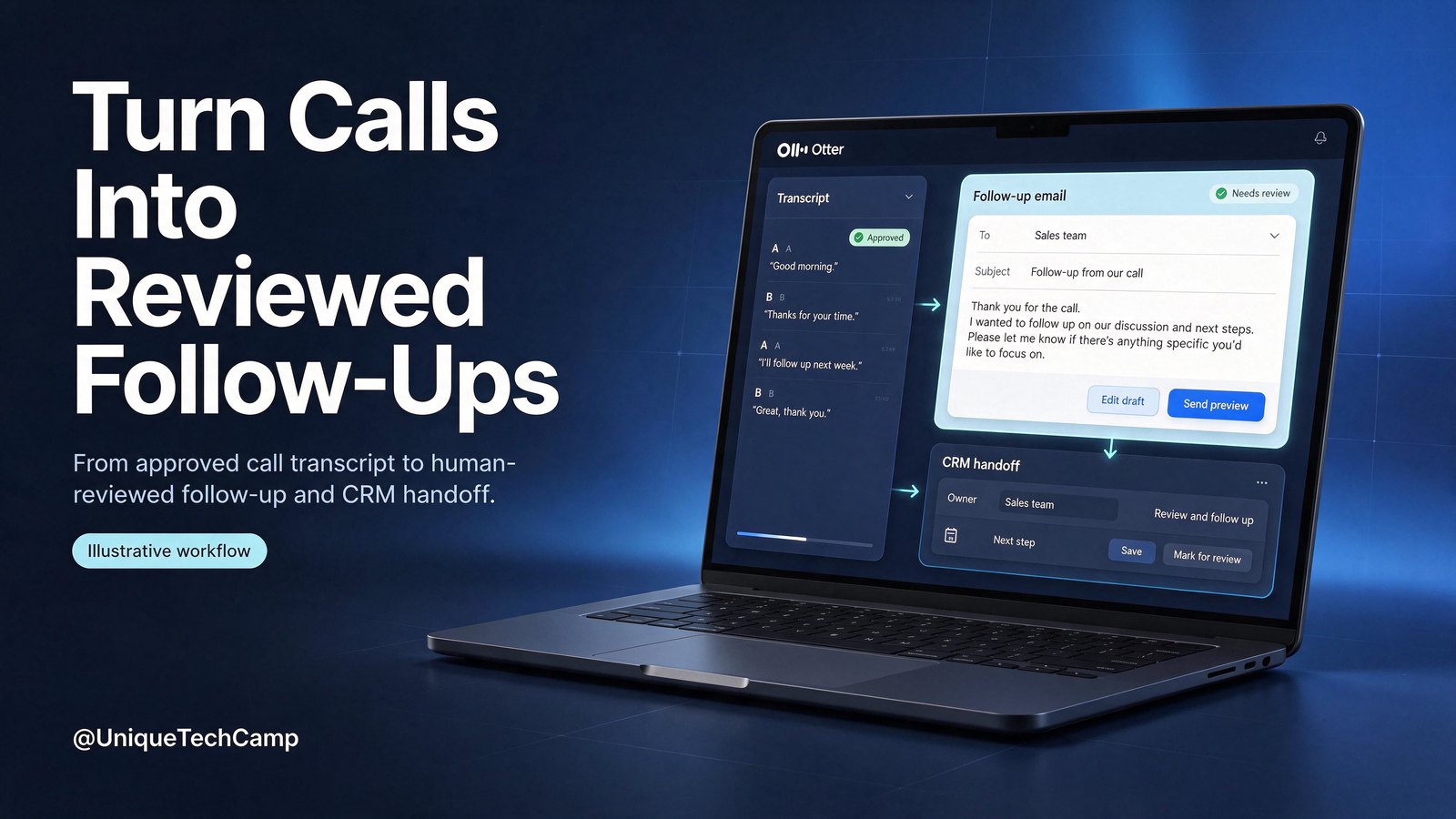
Otter Work Mode: Reviewed Sales Follow-Ups for Kenyan SMEs
A practical Kenyan SME workflow for reviewing Otter Work Mode follow-ups before CRM updates, with pricing, access limits, safeguards and measures.
UniqueTechCamp Desk
Online • Reply < 5 mins