
TimeH2O for Kenyan Retailers: A Demand-Forecasting Readiness Guide
A practical guide for Kenyan retailers assessing TimeH2O: prepare data, benchmark demand forecasts, check licensing, and measure readiness.
UniqueTechCamp Editorial
Lead Systems Architect • UniqueTechCamp Engineering Unit
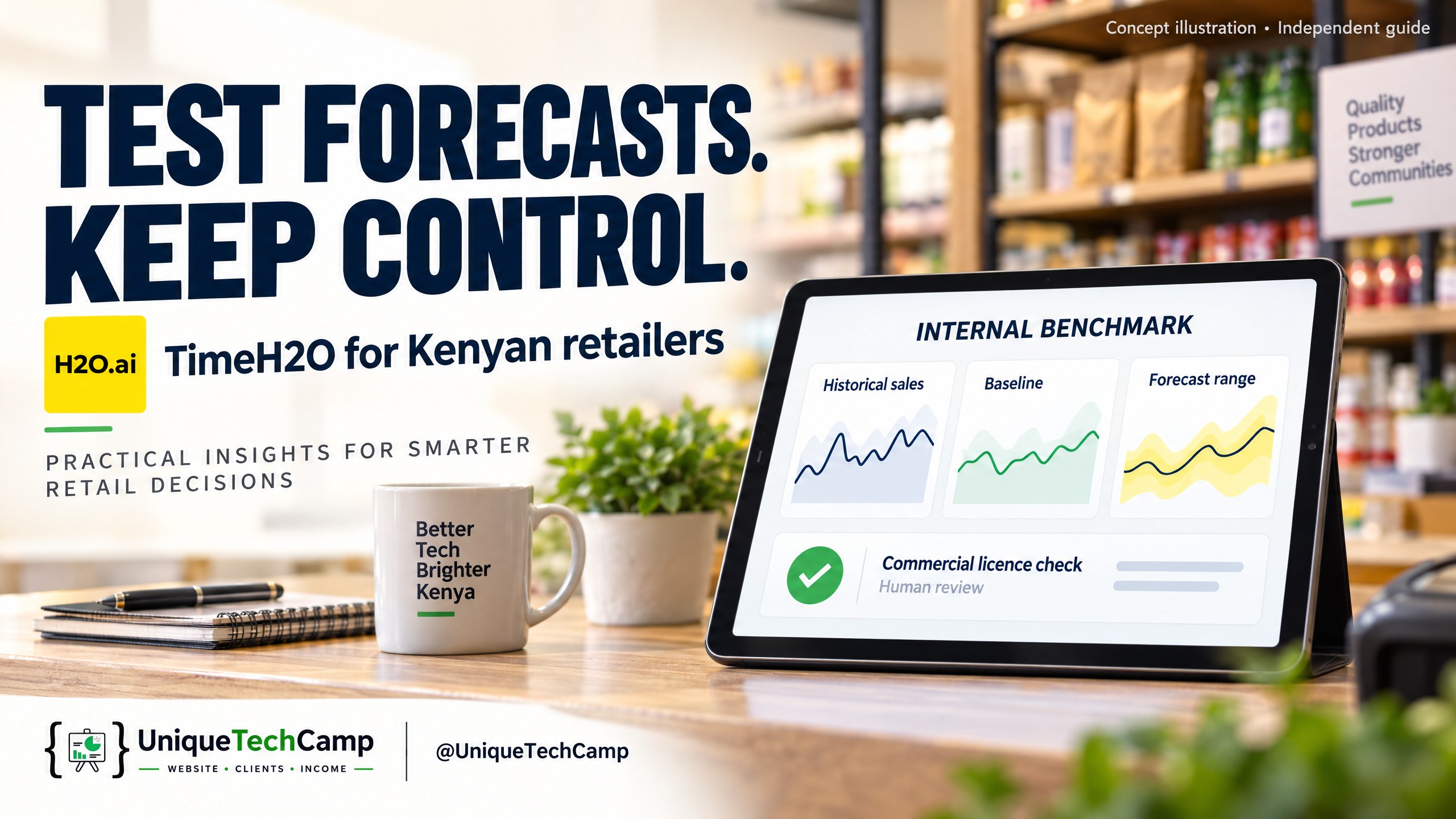
Cover concept: a retail forecasting-review workspace, not an actual product interface or a real dataset or forecast result.
A retailer can have a busy till, a capable buying team, and years of sales history yet still struggle with a deceptively simple question: how many units of each item should be available next week? In Kenya, that question may be affected by school terms, pay cycles, weather, promotions, delivery timing, regional demand, and stock arriving late. A forecast that looks impressive in a demonstration is not automatically useful for a shop, distributor, pharmacy retailer, mini-supermarket, or multi-branch chain.
The customer problem is decision risk. Too much stock ties up working capital and creates markdowns or waste. Too little stock creates missed sales and frustrated customers. The first responsible step is not to install a model. It is to establish whether your data, process, licence position, and measurement plan are ready for a controlled test.
On 26 October 2026, H2O.ai released TimeH2O-v1, a time-series foundation model rather than a chatbot or a spreadsheet button. The official H2O release describes a 108-million-parameter model for univariate series and covariates such as price, promotion, and weather. It reads series history in a zero-shot forecast workflow, meaning no training or fine-tuning is required at forecast time; optional fine-tuning can be considered later. Those capabilities make it a candidate for a disciplined experiment, not a guarantee of a commercial result.
What the current release actually tells you
The release reports that TimeH2O-v1 ranked first among 32 models on fev-bench, with a 91.9% head-to-head win rate across 100 forecasting tasks and a skill score of 50.8, using the default leaderboard view as of 23 October 2026. These are vendor-reported benchmark claims. The 91.9% figure is not 91.9% forecast accuracy, and neither benchmark position nor skill score is a promised improvement in Kenyan retail sales, availability, waste, or cash flow.
The official Hugging Face model card says the model can be used through the Python h2ofm package with TimeH2O.from_pretrained. Its point forecast is the median, and it supports quantiles, with default levels from 0.1 through 0.9. That matters for inventory conversations: a point forecast is one estimate, while quantiles can help a team discuss lower and higher demand scenarios. It does not remove the need to choose a service level, account for lead time, or decide how much uncertainty the business can absorb.
The same model card states that the model is not deployed by any Hugging Face Inference Provider. Read that narrowly: it is not available through that listed hosted-provider route. This does not establish that no hosted service exists anywhere; check any deployment route for data handling, access control, reliability, integration, and commercial terms.
An eight-step preparation and internal benchmark workflow
Before running the model, review the licence boundary explained below. Keep any permitted internal evaluation isolated from live purchasing and client deliverables; calling a trial a benchmark does not itself establish permission.
1. Start with one decision, not every SKU
Write down the decision the forecast is meant to improve. For example: “Every Monday, the buyer proposes replenishment quantities for the top 40 packaged grocery SKUs at two Nairobi branches, covering the next seven days.” This is better than “forecast the business.” Define the horizon, review cadence, locations, and the person who can accept, adjust, or reject the recommendation.
Begin with a manageable slice: one category, one branch group, or a short list of consistently stocked items. Include a few high-volume products and a few products with seasonal or promotional patterns. Exclude items whose sales history is too sparse to interpret until you have a separate plan for them.
2. Build a trustworthy daily table
Create a row for each date and SKU-location combination. At minimum, record units sold, date, SKU, location, selling price, and whether a promotion was active. Add stock-on-hand or stock-availability information if it exists, purchase orders, receipt dates, closures, and relevant weather variables where they are available and legitimately usable.
Use a consistent unit such as units per day per SKU per branch. Do not mix cartons, packs, and individual units without a documented conversion. Keep a data dictionary that explains each field, its source, its time zone, and its update schedule. A model cannot infer whether a blank means zero sales, missing data, a closed shop, or an unavailable item.
The most important warning is stockouts. Observed sales during a stockout are not the same as unconstrained customer demand: they may be zero because the product was unavailable. Label stockout periods instead of silently treating every zero as genuine demand. Do not promise that TimeH2O will automatically reconstruct lost demand from a sales column.
3. Freeze the information boundary
For every forecast date, list what information would truly have been known at that moment. Historical sales and a confirmed promotion calendar may be available. Realised future weather, an order that had not yet been placed, or a later correction to stock records would not be.
Future covariates must be values that are known or legitimately forecast at the time the decision is made. If you feed a model the realised weather for a future week during testing, you create leakage and make the experiment look better than the live process can be. Record the source and availability timestamp for each covariate.
4. Keep a simple benchmark beside TimeH2O
A useful model must beat a reasonable alternative on the same task. Start with a recent average and a seasonal-naive series where appropriate: for instance, use the most recent comparable day or week as the forecast. The Forecasting: Principles and Practice guidance on simple methods explains why these baselines are valuable. They are transparent, cheap to run, and sometimes difficult to beat.
Document the buyer’s existing spreadsheet rule too. The comparison should test the current process, not a deliberately weak guess.
5. Use a chronological backtest
Never randomly split a time series into training and test rows. Random splitting can let information from the future influence the past. Instead, use an equal-horizon holdout: choose historical forecast dates, hide the future values that would not have been known, generate predictions, and compare them with what later happened.
For stronger evidence, use rolling-origin evaluation. The rolling-origin time-series cross-validation method repeatedly moves the forecast origin forward while preserving time order. Keep the horizon fixed: a seven-day purchasing decision should be tested at seven days, not only one day ahead.
Keep each test reproducible. Save the input snapshot, model version, forecast output, baseline output, and actual outcome. Freeze the comparison dates before reviewing results. Do not remove difficult weeks simply because the model performed poorly during a promotion, delivery disruption, or unusual weather event; those events may be precisely why the retailer needs a robust process.
6. Measure more than one error number
Use metrics that the team can explain. Mean absolute error, or MAE, expresses the average absolute unit difference and is often easy to translate into operational terms. Percentage metrics can become unstable or misleading when actual demand is zero or close to zero. The forecast accuracy guidance on MAE and percentage errors is a useful reference for selecting and interpreting measures.
Report results by SKU, branch, category, and horizon, not only as one overall average. A high-volume product can dominate an aggregate score while hiding poor performance on smaller strategic lines. Include bias: does the system regularly overforecast or underforecast? If using prediction intervals, check quantile coverage against actual outcomes rather than accepting a range because it looks reassuring.
7. Add the human and operational review
A forecast is only useful if the buying process can act on it. Create a review sheet with the recommended quantity, recent sales, stock status, incoming stock, lead time, promotion flag, and an override reason. Ask a buyer to review historical cases without being told which forecast came from which system, where practical. Record when the human decision differs and why.
This is where the UniqueTechCamp AI Solutions Desk can help frame an AI workflow around evidence and controls rather than around a novelty demo. The goal is not to make a buyer surrender judgement. It is to make assumptions visible, reduce repetitive analysis, and create a traceable path from data to decision.
8. Define the go/no-go gate before a live trial
Set acceptance rules before looking at the final score. A rule might require TimeH2O to outperform the selected baseline on MAE across a defined majority of SKU-location series, show no unacceptable systematic underforecasting on priority items, and produce outputs by the purchasing deadline. The exact threshold should be set by the owner with the buying and finance teams; do not invent a universal business outcome or imply a guaranteed saving.
Also define failure conditions. Stop or revise the test if inputs arrive late, stockout labels are unreliable, the forecast is unavailable when needed, the team cannot explain overrides, or the model performs well only on a narrow historical slice. A disciplined “not ready” decision is a successful result because it prevents an expensive operational mistake.
Pricing, availability, and the business-licence gate
Do not plan around an invented price. No official commercial price for TimeH2O-v1 is established in the release and model-card material above. The model card describes gated files and conditions, and it points users towards sharing Hugging Face information. Files, package access, infrastructure, support, integration, and any hosted service can have separate requirements. Confirm current availability and commercial options directly with H2O’s official contact team .
The licence check must happen before benchmarking, not after a team has built a dependency. The published TimeH2O-v1 licence states that it is free of charge for non-commercial and non-production use. Clause 1.4 expressly includes internal evaluation and benchmarking by a commercial organisation when outputs are not used in live business decisions, client deliverables, or paid products or services. Clause 5.1 restricts commercial or production use of outputs.
That is the provider’s stated boundary, not a legal interpretation. Ask the owner, procurement lead, or qualified adviser to review the licence and obtain permission or a suitable commercial arrangement before moving beyond the permitted boundary. In particular, do not assume that a “shadow” pilot is automatically allowed merely because a human still approves the final order. If the output influences live purchasing, replenishment, client work, or a paid service, treat it as a permission gate requiring explicit review.
Separate H2O API or other hosted services may have separate terms. Do not infer their pricing or rights from the open model licence. Keep the internal benchmark isolated from live decisions until the licence position, data controls, and business approval are clear.
Limits an owner should plan for
TimeH2O does not know your catalogue semantics, supplier reliability, branch constraints, minimum order quantities, shelf life, cash limits, or customer priorities unless those are represented in a surrounding process. Forecasting demand is not the same as optimising an order. The final replenishment quantity may need a policy layer that accounts for stock on hand, stock in transit, lead time, safety stock, pack size, and a manager’s documented override.
Historical data can also be misleading. A new branch has limited history. A product may have been unavailable for weeks. A price change may have altered demand. A promotion may have been poorly recorded. A sudden currency, weather, transport, or supplier disruption may not resemble the past. Treat these as reasons to segment, annotate, or exclude a test case—not as evidence that a model can predict every shock.
Quantiles are not certainty. A 0.9 forecast is not a promise that demand will stay below that number, and an interval does not know whether a supplier will deliver. Do not use forecasts as the sole basis for high-consequence decisions. Maintain access controls, protect customer or commercially sensitive data, log model versions, and provide a manual fallback when the data pipeline or forecast service fails.
Frequently asked questions
1. Can a small retailer use TimeH2O without a data-science team?
A small team can run a focused evaluation if it has consistent historical data, a clearly defined decision, and someone responsible for checking the result. The technical setup may still require Python, package management, data preparation, and secure execution. Start with a narrow internal benchmark and a transparent baseline. If the data cannot be made trustworthy, adding a sophisticated model will not solve the underlying process problem.
2. Does zero-shot mean the model needs no business data?
No. Zero-shot means the model can forecast a supplied series without training or fine-tuning at forecast time. Your business still needs to provide a coherent history and any covariates you want to use. It also needs to define the units, horizon, locations, stockout treatment, and decision rules. Zero-shot removes one modelling step; it does not remove data governance or operational design.
3. Should I include promotions and weather?
Include them only when they are relevant, consistently recorded, and available at the time of the forecast. A promotion calendar known in advance may be useful. Realised future weather inserted into a historical test would be leakage. Start with an auditable set of inputs and compare the result with and without each covariate. Keep the simplest version that improves the decision without creating an unreliable dependency.
4. Can a benchmark be used to place real orders?
Not until the licence and business approval allow that use, and not until the benchmark has passed your predefined operational checks. A benchmark is evidence about a test setup, not permission to deploy. Even after approval, use a controlled rollout with human review, monitoring, a fallback, and a clear way to stop the process when data or forecasts are unreliable.
Conclusion
TimeH2O-v1 is a credible candidate for a structured demand-forecasting experiment, especially for teams interested in combining sales history with price, promotion, or weather covariates. Its reported benchmark position is not a Kenyan retail outcome, and its zero-shot workflow does not eliminate the need for clean data, chronological testing, stockout awareness, and buyer accountability.
Need this built for your business?
If you own a retail business, start with a bounded data and process review rather than a promise of savings. The UniqueTechCamp AI Solutions Desk can help you turn the readiness questions into an auditable workflow, and you can book a consultation to discuss scope, controls, and next steps. If your immediate need is to clean, reconcile, and benchmark spreadsheet-based retail data, compare the matching Excel Data Analysis service before selecting a forecasting route.
Deploy An Autonomous AI Lead Gen System Today
We engineer high-converting web applications with integrated 24/7 WhatsApp qualification bots and multi-channel follow-up drips.
Related Strategy Articles

CrowdStrike AI Kill Switch: SME Team Reviewing an Agent Safety Dashboard
A practical SME playbook for reviewing CrowdStrike’s AI Kill Switch, testing agent containment safely, measuring trade-offs and checking Kenya eligibility.

Microsoft Agent 365 Business Analytics: An SME Readiness and Value-Validation Guide
Microsoft Agent 365 Business Analytics is in Frontier preview. Here is how Kenyan and East African SMEs can validate access, usage cost, value, privacy and readiness before buying licences for a dashboard.

Canva AI Controls: SME Design Review and Human Approval on a Laptop
A practical Canva AI Controls workflow for Kenyan and global SMEs: control settings, human review, asset provenance, measurements, costs and limitations.

UniqueTechCamp Desk
Online • Reply < 5 mins