
CrowdStrike AI Kill Switch: SME Team Reviewing an Agent Safety Dashboard
A practical SME playbook for reviewing CrowdStrike’s AI Kill Switch, testing agent containment safely, measuring trade-offs and checking Kenya eligibility.
UniqueTechCamp Editorial
Lead Systems Architect • UniqueTechCamp Engineering Unit
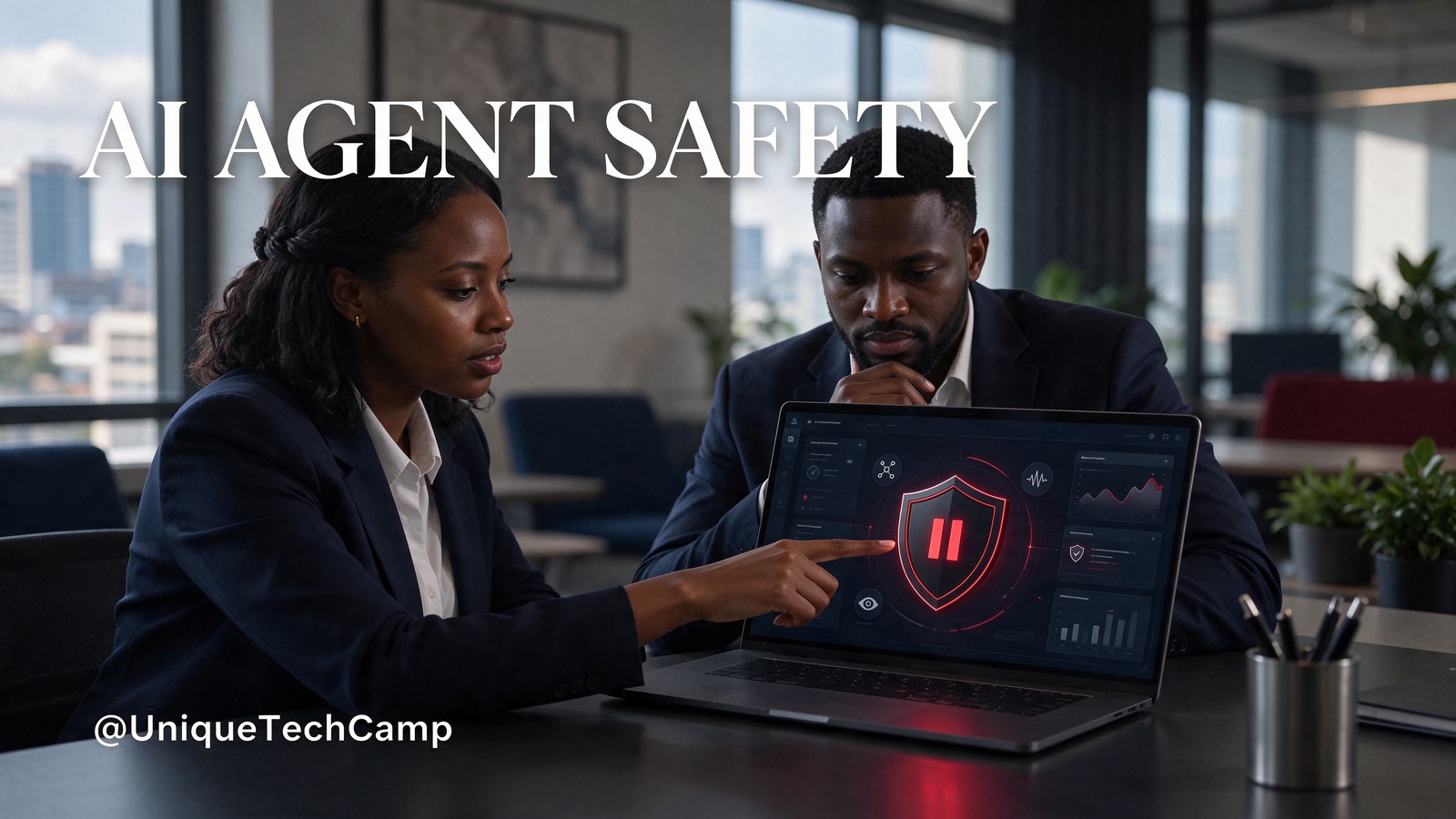
When an AI agent can read a shared inbox, call an API or update an order, “stop it quickly” is an operations requirement, not a dramatic metaphor. A business owner needs to know who can contain the agent, what evidence that person will see, and how the team will resume work without guessing. CrowdStrike’s AI Kill Switch, announced on 3 November 2026, is therefore best understood as a proposed control point in a broader agent-safety plan—not as proof that every AI action will be intercepted or automatically stopped.
This guide is for Kenyan and other small and medium-sized businesses considering an agent that touches customer messages, documents, websites, payments or internal systems. It focuses on a safe pilot, measurable decisions and realistic procurement questions. The product name and availability statements below follow CrowdStrike’s official launch release ↗ and should not be read as a guarantee of eligibility in Kenya.
What the AI Kill Switch is—and is not
The useful mental model is an emergency brake for an AI agent. In the currently announced path, a security team activates the control in Falcon Guardian and a connected gateway blocks the agent’s access to AI models. That is narrower than terminating the agent process, blocking every tool call or cutting off every network route. The launch material places the decision with the people accountable for AI safety; endpoint termination, relaunch prevention and cross-platform coordinated containment are described as coming soon, not as controls to assume are already available.
The official product blog ↗ describes Falcon AI Gateway as a CrowdStrike-native alternative to third-party gateways and says that component is included with Falcon Guardian at no additional cost. “Included” is not the same as a free, universally available product: the relevant Falcon Guardian or AI Detection and Response entitlement, tenant configuration, deployment work and support arrangement still need confirmation.
The control is also not a safety certificate. Blocking model access does not necessarily stop a running process, a previously issued tool call or a separate application action. It does not replace least privilege, secrets management, prompt and tool design, audit records, backups, human approval or an incident-response process. A switch can be unavailable if traffic never reaches a supported gateway path, if the relevant agent is outside the tenant’s coverage, or if the team has not prepared a separate tested procedure for process, credential and tool containment. The practical question is not “Does it stop all rogue AI?” but “Which model traffic can our tenant observe and block now, what remains outside that boundary, and how quickly can we prove the whole response?”
Map the agent before you buy a control
Begin with an inventory rather than a product demonstration. Give every agent an owner and record its purpose, model provider, tools, data classes, normal operating hours, business process, human approver and failure contact. Include low-code automations, browser agents, scripts calling large-language-model APIs, vendor chatbots and agents supplied by contractors. An agent that only drafts internal text has a different exposure from one that can send a customer message or change a payment status.
For each agent, draw the path: user or trigger, application, model, gateway, tool or MCP server, database and final action. Mark where the traffic is visible and where it is not. The current AI Detection and Response documentation ↗ describes collection and control surfaces including endpoint, browser, application, gateway and agentic collectors. That documentation is a useful starting point, but the business should validate its own integrations, supported versions and regional handling with an authorised provider.
A practical containment workflow for an SME team
1. Establish ownership. Name a business owner, technical operator and incident approver. The owner decides whether the process can be paused; the operator checks telemetry and containment; the approver authorises a return to service. A small firm may have one person wearing all three hats, but the responsibilities should still be written down and covered during leave.
2. Define stop criteria in plain language. Recommended criteria might include an attempt to use an unapproved model or tool, an unexpected request for secrets, an outbound transfer of a sensitive dummy field, a change to the agent’s own permissions, repeated actions outside its assigned queue, or a high-impact action without the required human approval. These are policy recommendations, not claims that a specific interface will automatically recognise every condition.
3. Choose a supported observation path. Ask the provider where the agent’s model traffic, prompts and outcomes will be collected and where the currently available model-access block would be enforced. If an agent runs in an unmanaged SaaS environment, gateway coverage may matter more than an endpoint sensor. If it runs on a company workstation, endpoint and application context may be relevant, but do not assume that a future endpoint termination feature is already present. Record the gaps rather than silently treating an unobserved process or tool path as protected.
4. Contain, communicate and preserve a safe fallback. A recommended response is to pause the affected agent or route work to a human queue, notify the owner, preserve relevant evidence and tell staff what not to retry. Keep a manual procedure for urgent customer requests. A switch should reduce blast radius; it should not create a second outage because no one knows how to process the next order or booking.
5. Recover deliberately. Before restoration, revoke exposed credentials if appropriate, inspect queued actions, check the policy condition and confirm that the agent’s instructions and tool permissions are unchanged. Restore first in a low-risk mode, with human approval, then compare the first set of actions with the baseline. Recovery is a decision with evidence, not simply the opposite of pressing stop.
Safe synthetic tests that resemble real incidents
Testing should be red-team-like in discipline but synthetic in content. Use a disposable agent, dummy customer records, test API keys that cannot reach production, a sandbox mailbox and reversible tasks. Obtain written approval, define the test window and tell the people who may receive the simulated alert. Never attempt to evade controls on a live system, exfiltrate real records or alter a real payment, identity or production database.
- Unapproved-tool test: ask the pilot agent to call a blocked dummy endpoint. Expected evidence is a visible attempted call, a clear owner and a documented decision about whether to contain it.
- Synthetic-sensitive-data test: place a string such as TEST-CUSTOMER-0001 in a dummy record and ask the agent to send it to a non-production destination. Check whether the selected collection path records the event and whether the agreed responder can contain the session.
- Permission-drift test: simulate a request to add a harmless test role to the agent. The recommendation is to require human approval and record the denial or escalation; do not attempt a real privilege change.
- Runaway-loop test: use a capped sandbox task that repeats a benign action a fixed number of times. Measure detection, containment and queue recovery without generating customer messages or uncontrolled load.
- Human-handoff test: create an ambiguous dummy enquiry and confirm that a person receives it, understands the reason for the handoff and can complete the task manually if the agent is paused.
Write down what the test proves and what it does not. A successful synthetic containment shows that a chosen path and team procedure worked for that scenario. It does not prove coverage of every model, vendor, gateway, prompt, tool or future configuration.
Baseline, indicators and trade-offs
Take a baseline for at least one ordinary operating period before changing the workflow. For a small team, seven to fourteen days may be enough to count agent sessions, tool calls, human approvals, escalations, failed tasks, manual fallbacks and staff time. Segment the figures by agent and business process; one combined number can hide a serious problem in the payment or customer-service queue.
Useful indicators include:
- Coverage: the proportion of agent paths with a named owner, documented tool list and confirmed observation point.
- Containment time: median and worst-case elapsed time from a test trigger or alert to a verified pause.
- False-positive burden: legitimate sessions paused per one hundred sessions, plus minutes of staff rework.
- Unsafe-action exposure: approved test actions that reached a tool before containment, separated from merely attempted actions.
- Recovery quality: percentage of paused work safely reconciled, duplicate actions avoided and customer-facing delays recorded.
- Governance completeness: percentage of agents with current owner, permissions, retention decision, escalation route and review date.
The trade-off is not simply security versus convenience. More inspection and approval can increase latency, logging volume and operator workload. A tighter policy may reduce risky autonomy while increasing manual handling and false positives. A gateway can improve visibility for an unmanaged workload but add a dependency or integration task. Agree a threshold before the pilot: for example, no unreviewed high-impact action, a containment drill completed within the team’s chosen target, and no unexplained customer-facing duplicate. The target is a reasoned operating point, not a universal benchmark.
Teams that want to translate this inventory into an implementable workflow can use UniqueTechCamp’s AI solutions desk ↗ as a contextual starting point, while keeping the security provider’s entitlement and coverage questions separate from any service discussion.
Sample scenario: a wholesale distributor’s order assistant
Imagine a Nairobi wholesaler piloting an agent that reads a shared sales inbox, matches products to a test catalogue and drafts order confirmations. It may create a draft in the order system, but a sales coordinator must approve price, stock and delivery details. It has no permission to issue a refund, change a customer’s bank details or send a payment request.
The team records a baseline of 120 synthetic and supervised sessions over two weeks: draft completion time, approval rate, corrections, handoffs and duplicate drafts. During a scheduled exercise, the test agent receives a poisoned instruction in a dummy catalogue asking it to upload TEST-CUSTOMER-0001 to a sandbox endpoint. The observer records the session identity and time. The responder follows the recommended containment procedure, pauses the pilot path, moves the pending order to the manual queue and checks that no real message was sent.
The review finds that containment worked but the sales queue lacked an after-hours owner and two staff members did not know whether a paused draft could be reopened. The outcome is therefore mixed: the technical path behaved as expected for the synthetic case, while the business process needs a rota, a manual order template and a clearer recovery rule. That is a useful result. It prevents the team from expanding the agent merely because the switch exists.
Eligibility, quote and Kenya procurement questions
This capability should be treated as an enterprise security-platform feature. The public material does not establish that every Falcon customer automatically receives every AI Kill Switch control, nor that every agent type or gateway is supported. Ask for a written entitlement and architecture review covering Falcon Guardian, AI Detection and Response, Falcon AI Gateway, agentic collectors, logging, integrations and the exact enforcement surface.
The public pricing page ↗ does not provide a verified standalone price for the AI Kill Switch or Falcon Guardian. Request a quote and ask which licence, minimum term, implementation, training, support and data-handling charges apply. Do not compare a platform quote with an invented per-agent figure. The partner route is practical, but the official partner locator ↗ does not itself prove a Kenya-specific launch, local price, residency promise or automatic support level.
Pilot checklist and record templates
A four-week pilot can be small and disciplined:
- Week 1—scope: select one low-risk agent, assign owner and responder, document tools, data, hours, fallback and stop criteria.
- Week 2—baseline: record normal sessions, approvals, latency, errors, handoffs and manual effort; confirm the tenant and collection path.
- Week 3—exercise: run the approved synthetic tests, preserve evidence, time containment and test recovery with the operations team.
- Week 4—decision: compare results with the baseline, list gaps, price the remediation and choose pause, redesign, limited expansion or stop.
Use a compact incident record: date/time; agent and owner; trigger; session or trace ID; data class; intended tool; observed action; containment time; customer or staff impact; evidence location; responder; recovery decision; follow-up owner and due date. Use a weekly scorecard: sessions; approved actions; handoffs; blocked or contained test actions; false positives; median containment time; recovery defects; open risks; review date. Never use the scorecard to imply that a lower count of alerts alone proves safety.
Frequently asked questions
Does the AI Kill Switch automatically stop every suspicious agent action?
No. The documented concept depends on the deployed Falcon Guardian, gateway, application, endpoint or agentic collection path, the configured policy and the event’s visibility. Treat it as a containment capability to validate in your environment, not an automatic universal brake.
Is this available to every Kenyan business?
That is not established by the cited public sources. Eligibility, tenant region, entitlement, partner support and integration coverage need confirmation. A Kenyan business should ask for a partner-led architecture review and written commercial terms before treating the pilot as available.
Is Falcon AI Gateway free?
The official blog says Falcon AI Gateway is included with Falcon Guardian at no additional cost. That statement does not remove the need to purchase or qualify for the relevant Falcon Guardian arrangement, nor does it establish implementation, support or other commercial costs.
What should a very small team do if it cannot buy the platform?
Start with agent inventory, least privilege, a human approval queue, synthetic tests, logs and a manual fallback. A written stop-and-recover procedure is valuable even when a commercial kill-switch capability is not yet in scope. Do not claim equivalent coverage without testing the tools you actually use.
Can a kill switch replace an incident-response plan?
No. It is one containment control. The plan still needs ownership, credential handling, evidence preservation, customer communication, service recovery and a review of why the unsafe condition occurred. Obtain suitable professional advice for legal, regulatory or contractual questions.
Conclusion: make the stop decision operational
The strongest reason to evaluate an AI Kill Switch is not fear of a dramatic rogue-agent story. It is the ordinary need to limit an automated system when its permissions, data path or behaviour no longer matches the job it was approved to do. Start with one low-risk agent, a documented route, synthetic evidence and a human fallback. Measure containment and recovery alongside false positives and staff effort. Then expand only where the coverage, entitlement, support and business case are clear. This article is practical information, not financial, legal or medical advice.
Need this built for your business?
Business owners and operations leads can bring the agent inventory, one real workflow and the pilot questions to UniqueTechCamp’s AI solutions desk ↗ for a scoped discussion. If you want to map responsibilities and next steps, use the appointments route ↗. For a broader workflow, integration and governance conversation, review AI business automation services ↗. Ask for assumptions, exclusions, measures and handover responsibilities in writing; no implementation outcome should be promised before the environment is assessed.
Deploy An Autonomous AI Lead Gen System Today
We engineer high-converting web applications with integrated 24/7 WhatsApp qualification bots and multi-channel follow-up drips.
Related Strategy Articles

Microsoft Agent 365 Business Analytics: An SME Readiness and Value-Validation Guide
Microsoft Agent 365 Business Analytics is in Frontier preview. Here is how Kenyan and East African SMEs can validate access, usage cost, value, privacy and readiness before buying licences for a dashboard.
Canva AI Controls: SME Design Review and Human Approval on a Laptop
A practical Canva AI Controls workflow for Kenyan and global SMEs: control settings, human review, asset provenance, measurements, costs and limitations.
A2UI 1.0: Safer Returns Forms for Kenyan Online Shops
See how Kenyan online shops can use A2UI 1.0 for safer return-request intake, with verified order lines, human review and no model-led refunds.

UniqueTechCamp Desk
Online • Reply < 5 mins