
Shopify Knowledge Base: AI Store Facts for Kenyan Shops
Kenyan Shopify merchants can review public AI store facts, migrate legacy entries before 15 January 2027 and measure what agents actually use.
UniqueTechCamp Editorial
Digital Services Team • UniqueTechCamp Engineering Unit
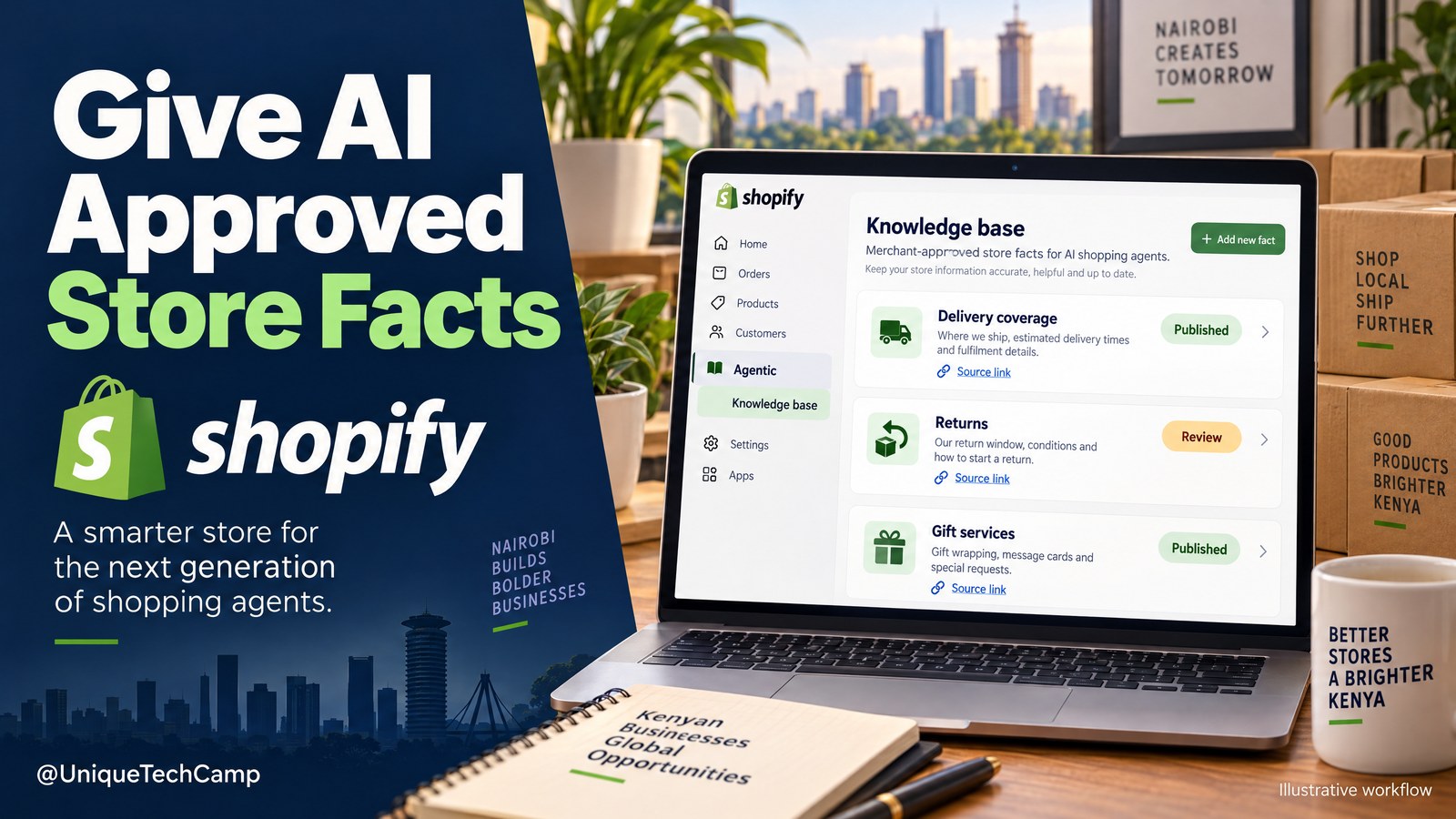
A shopper asks an AI assistant whether your shop delivers to Kisumu, how returns work or whether gift wrapping is available. The answer may be shaped by a public store fact, an old page, a cached snippet or something the assistant has found elsewhere. For a Kenyan retailer, that makes accuracy an operating task rather than a fashionable “AI visibility” promise.
Shopify’s 26 October 2026 changelog update moved Knowledge base into Sales channels > Agentic in the admin. This is an integrated admin experience replacing the standalone Knowledge Base app, not the first launch of Shopify’s broader agentic storefront work. Shopify’s 28 October 2026 Fall ’26 merchant roundup describes the practical hook: the platform can draft non-product facts from a storefront, while a merchant reviews and publishes them before Shopify-connected agents receive them.
The useful question is: Which approved store facts are public, who can maintain them, and can we prove that an answer used the right source? This guide gives a Kenyan shop owner a safe workflow, including the legacy-app deadline of 15 January 2027.
What the Shopify Knowledge base actually contains
Think of the Knowledge base as a controlled set of business facts around the catalogue, not another product-feed editor. Suitable facts can cover a returns process and window, shipping destinations and timelines, brand values, contact options, gift services, payment or fulfilment information and other practical questions a customer asks before buying. Product title, price, variant, availability and stock remain separate Catalog data.
The distinction matters. Your product feed can be perfectly tidy while an assistant still gives a poor answer about delivery coverage or exchanges. Conversely, a well-written store fact cannot make an unavailable product available. Treat the two as connected customer information, but maintain them as different sources of truth.
There are also two different publication paths:
- Facts generated by a storefront scan begin as unpublished suggestions. You can review each one, approve and publish it, or reject it and save the decision.
- Facts linked to Shopify admin data, such as policies and contacts, are published when created. Eligible legacy overrides and additional facts are transferred already published; do not assume they await fresh approval.
So “every fact starts as a draft” is wrong. “Shopify publishes every scanned claim silently” is also wrong. Check the actual state of each field in your admin.
Once published, these facts are public through Storefront MCP for Shopify and third-party agents, as described in Shopify’s Knowledge base help . They are not a private internal knowledge base. Do not place supplier contracts, customer records, private contact details, credentials or anything you would not put on a public-facing store into the fields.
Access, scope and the migration deadline
An owner or staff member needs the documented Agentic permission to manage the feature; staff access should be scoped to the job. Shopify’s Agentic storefront admin guidance shows where controls live. Check availability and controls in the store admin, because rollout and account conditions can change.
Shopify’s detailed help states a limit of 1,000 total facts, including generated and additional facts. For legacy stores with 1,000 or fewer facts, overrides and additional facts are automatically transferred and published. If the old base contains more than 1,000, the merchant must manually re-add chosen additional facts and store-fact overrides before 15 January 2027. The changelog uses slightly looser wording, so use the detailed help and your own admin count as the working reference.
Do not promise bulk export, rollback or a perfect migration snapshot. Record the count, source URLs, publication states and a sample of customer-critical facts before changing anything.
Custom storefronts and stores on the Agentic plan can add only additional facts. Password-protected stores provide admin-derived data only; the knowledge base cannot scan their private storefront.
A practical workflow for a Kenyan SME
The following eight steps keep the work small enough for a busy owner but explicit enough for a staff handover. Use one named reviewer and one backup reviewer.
1. Choose customer questions and an owner
Start with five to ten questions that cause pre-purchase friction: “Do you deliver to Nakuru?”, “How long does dispatch take?”, “What is the return window?” and “How do I reach the shop?” Assign each question to the person who can verify it. A fulfilment lead may own delivery coverage; the owner may approve brand values.
2. Audit the approved source, not your preferred wording
Open the customer-facing delivery, returns, contact and policy pages. Compare them with the operating facts staff actually use. If your courier coverage changes by county or your return handling depends on item condition, preserve the already-approved operating facts and escalate uncertainty to the appropriate reviewer. Do not invent a generous promise simply because it sounds easier for an AI assistant to repeat.
This is operational content, not legal drafting. Keep approved policy terms intact and obtain qualified review for statutory or contract wording. The Knowledge base should reflect the business, not quietly create a new policy.
3. Count the legacy base and capture a baseline
If the store used the standalone app, record whether the base is at or below the 1,000-fact total threshold. Export or copy only what your ordinary governance allows, but do not describe that as a guaranteed Shopify migration facility. Capture representative fact text, source references, publication state and the admin date.
4. Give the right staff member limited access
Ask an owner or staff member with the documented Agentic permission to open Sales channels > Agentic > Knowledge base. Grant the smallest role that supports review. Avoid the lazy instruction to grant all permissions: it expands the blast radius of an accidental edit and makes accountability harder.
5. Review each fact against one source
Each field has one source and can have multiple public reference URLs. Match it to approved storefront or admin data and provide a public supporting page. A reference URL does not automatically become the source used in a later scan. Changing a field’s source removes references supplied by the previous source; manually added references remain. Record important changes.
Check names, county coverage, timelines, contact routes and exceptions character by character where an error would create a service failure. Keep product price and stock questions in Catalog processes rather than forcing them into non-product facts.
6. Approve, reject or correct deliberately
For new scan suggestions, choose Approve & publish only when the claim matches the source. Reject a suggestion that is wrong, unsupported or redundant, then save the decision. Shopify regularly scans, but timing varies and a scan can miss a change; it is not a silent replacement engine.
If a delivery destination has changed today, edit the source and fact directly rather than waiting for a possible 48-hour rescan. Verify the public page and Knowledge base state after saving; a manual source change can affect older references.
7. Test the public answer path
Publish only customer-facing information, then test the Storefront MCP-connected experience where available. Ask a small set of exact questions using the same wording customers use and record the date, query, answer, cited source if shown, expected answer and pass/fail result. Test a wrong assumption as well: ask about a county you do not serve or a service you do not offer.
One successful test does not control every AI answer. An agent may use other sources or a cache; not every query calls Shopify; published facts do not guarantee placement, recommendations, checkout or sales.
8. Review monthly and after operational changes
Set a monthly review and an event-triggered review after a courier change, returns change, new contact route, store redesign or policy approval. Keep an issue log with owner, source, fact, correction date and retest result.
Completed example: Mavuno Home Goods
Consider Mavuno Home Goods, a fictitious Nairobi-based retailer selling storage baskets and home accessories. Its owner receives questions about delivery to Eldoret, return timing and gift notes. This is not a real client or a promised delivery service.
Its owner, Akinyi, appoints the fulfilment supervisor as reviewer and starts with three approved sources: the delivery page, the returns page and the contact page. The team finds that the delivery page names Nairobi and selected towns but does not promise every county. The Knowledge base entry therefore says only what the approved page supports; it does not add a nationwide delivery promise.
The store has 640 total legacy facts, so the help guidance indicates automatic transfer and publication for the eligible legacy set. Akinyi samples ten facts, checks their references and records the date. She discovers that a gift-note fact is outdated, edits the source page first, then updates the fact and tests the result.
For four weeks, they log 50 customer questions that mention delivery, returns or gift services. They record whether the answer was found in the published fact, the public page, a staff message or an AI answer, and whether the answer matched the approved source. This measures operational consistency; it does not claim that the Knowledge base created the enquiries or the sales.
For help turning this evidence review into an owner-friendly AI checklist, UniqueTechCamp’s AI Solutions Desk is a relevant starting route.
Measurement: count evidence, not AI excitement
Create a simple fact register with these columns: fact ID, question type, source URL, publication state, owner, last checked date, test date, answer result and correction status. For every summary, show the denominator.
Useful measures include:
- Published coverage: published customer-critical facts divided by the number of customer-critical facts in the agreed scope. State the scope, such as delivery, returns, contact and gift services.
- Source-match rate: tested answers matching the approved source divided by all tested answers. Show the number tested, date range and agent or channel.
- Correction turnaround: median hours from a verified source change to a corrected public fact, using only logged incidents.
- Migration verification rate: sampled migrated facts with a checked source and publication state divided by sampled migrated facts. A sample is not proof that every fact migrated correctly.
- Human fallback rate: questions routed to staff divided by all test questions or logged customer questions, with the rule for classifying a fallback written down.
Keep AI answer tests separate from sales reporting. If a shopper arrived from an AI referral, record the source where analytics can identify it, then follow the enquiry through qualified lead, order and fulfilment stages. Do not turn AI mentions into earnings or claim the Knowledge base caused revenue without a defined comparison, attribution method and denominator.
Costs, availability and Kenyan qualifications
Shopify’s public pricing page currently displays US Basic at US$39 per month billed monthly or US$29 per month equivalent billed yearly. Those are official US display figures, not a Kenyan quote or a currency conversion. The announcement and help page do not publish a standalone Knowledge base fee, so confirm the store’s actual plan, feature availability and any provider charges in admin before budgeting.
A Kenyan merchant’s store-admin access is a separate question from a buyer’s country, payment-provider eligibility or direct AI checkout. This article does not establish a Kenyan AI-checkout launch. Shopify Payments country support, third-party gateway availability, customer-market rules and channel rollout need their own current checks. A store may be able to review facts while a particular buyer-facing channel or payment path remains unavailable.
For a practical budget, include staff review time, source-page maintenance, testing work and existing Shopify or payment-provider charges. Ask for a current account-specific quote rather than converting a US display price and presenting it as local pricing.
Limitations you should put on the project brief
First, publication is not universal AI control. Shopify’s general agentic-storefront overview describes supported channels, not a guarantee that every AI answer will retrieve fresh knowledge-base content. An agent may consult other sources. Publishing facts does not guarantee ranking, recommendation, checkout completion or sales.
Second, scan timing is not a service-level guarantee. A new suggestion may arrive later, miss a change or require direct correction. A source and its references need human review, particularly after a delivery or returns change.
Third, the 1,000 total-fact limit demands selection. Prioritise customer questions and reviewable evidence rather than filling capacity with duplicate entries. Keep the selected legacy facts checked before the standalone app becomes unavailable after 15 January 2027.
Fourth, a public fact is not a secret. Keep confidential business and personal information out. Password protection limits scan-based storefront data, and custom storefront arrangements may support additional facts only. Access, rollout and permissions can differ by store, so the admin panel and current official help are the authority for implementation.
Frequently asked questions
Does every Shopify Knowledge base fact need manual publishing?
No. Storefront-scan-generated facts begin unpublished and require review before publication. Admin-linked policy and contact facts are published when created, while migrated edited or additional legacy facts are transferred and published automatically. Check each field’s actual state rather than applying one rule to the whole base.
What happens if my old base has more than 1,000 facts?
Shopify’s detailed help treats 1,000 as the total limit, including generated and additional facts. Above that, manually add the selected additional facts and store-fact overrides before 15 January 2027. Prioritise customer-critical facts, record what you chose and verify publication. Do not assume there is a bulk export or one-click rollback.
Can I put supplier or customer information in it so an agent knows our business better?
No. Published facts are public through Storefront MCP and may be available to Shopify and third-party agents. Use approved, customer-facing operating facts only. Supplier contracts, customer records, credentials and private contacts do not belong in a public knowledge base.
Will publishing accurate facts make my Kenyan shop appear in every AI answer or unlock checkout?
No. Agents may use other sources or caches, not every question calls Shopify, and publication does not guarantee visibility, placement, sales or checkout. Kenyan merchant access to an admin feature is also separate from buyer-country channel rules and payment-provider eligibility. Test what you can observe and verify current account-specific availability.
Conclusion
The strongest case for Shopify’s Knowledge base is not an AI sales slogan. It is a small governance routine: identify customer-critical non-product facts, maintain one approved source, understand which items are drafts or automatically published, migrate legacy priorities before 15 January 2027, and test answers with denominators. That routine can reduce avoidable confusion without pretending to control the whole web of AI answers.
Need this built for your business?
Business owners who need a practical fact register, public-answer test plan or Shopify handover can start with UniqueTechCamp’s AI Solutions Desk . To discuss your shop’s scope, book an appointment . For storefront structure, catalogue handover or implementation, review the e-commerce setup service . Bring your current source pages, legacy fact count and one urgent customer question; start with a verified scope rather than promised earnings.
Deploy An Autonomous AI Lead Gen System Today
We engineer high-converting web applications with integrated 24/7 WhatsApp qualification bots and multi-channel follow-up drips.
Related Strategy Articles

Gemini Small-Business Tools: A Safe Growth Pilot for Kenyan SMEs
Google's Gemini business page brings brand, finance and app tools together. A cautious pilot for Kenyan SMEs, with privacy and review checks.

Google Docs Captions and Cross-References for Kenyan SMEs
Use Google Docs captions, cross-references and caption tables to keep Kenyan SME reports and tender documents easier to navigate after edits.

ChatGPT for Sales: A Human-Reviewed CRM Pilot for Kenyan SMEs
OpenAI's new ChatGPT for Sales adds sales workflows. Learn how Kenyan SMEs can pilot CRM connections with human review, privacy checks and clear measures.

UniqueTechCamp Desk
Online • Reply < 5 mins