
ServiceNow in ChatGPT: A Controlled IT Handover for Kenyan Service Teams
A controlled ServiceNow and ChatGPT handover for Kenyan IT teams: read-only first, human approval, evidence checks, limits and costs.
UniqueTechCamp Editorial
Lead Systems Architect • UniqueTechCamp Engineering Unit
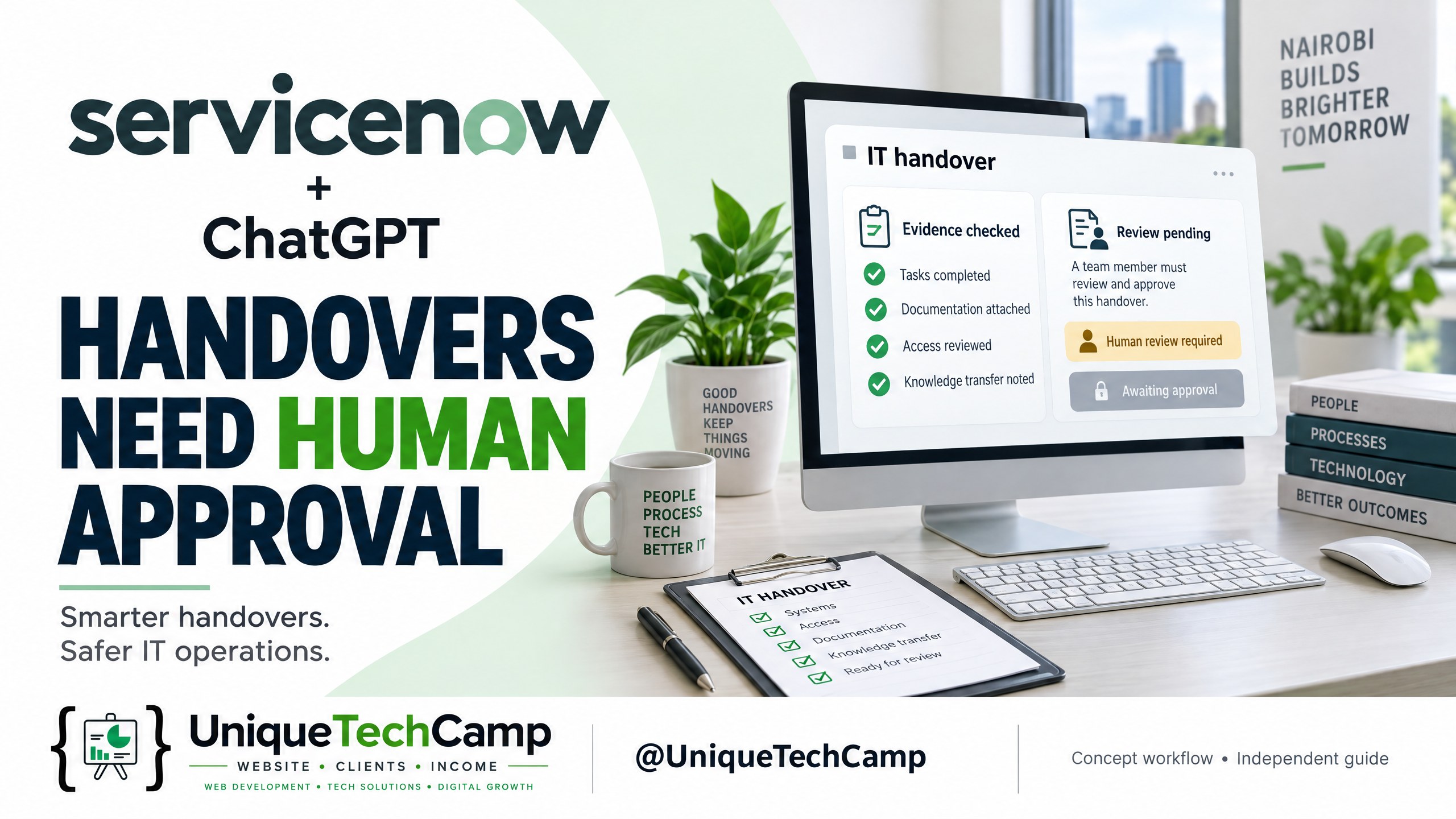
A shift handover tells the next engineer which incident remains open, who is waiting, which workaround is temporary and what to verify before touching a system. When those details are scattered across ServiceNow, chat, notes and memory, the incoming team can inherit an assumption that was never tested.
For Kenyan IT service providers already authorised to support a client’s ServiceNow instance, ChatGPT may become a useful controlled aide for that handover. The sensible starting point is not an autonomous service desk. It is a bounded process that reads approved context, prepares a concise next-shift brief, flags missing evidence and asks a named human to approve any low-risk record update. Production changes remain human work.
This article proposes an incident-to-next-shift workflow, not a hands-on product review, implementation promise or substitute for the client’s security, change-control or privacy review. The objective is traceable ownership, not a fluent AI sentence treated as fact.
What changed: dated availability, capabilities and pricing
On 28 October 2026, OpenAI described an expanded ServiceNow partnership following the January partnership. Its announcement says a ServiceNow MCP plugin is available in the OpenAI Marketplace from that date, with an enhanced experience expected by the end of 2026. Voice is expected in the first quarter of 2027; security early access in January 2027 and general availability in the second quarter; Codex integration in AI Workflow Factory is expected in 2027. These are dated announcements and targets, not a guarantee that every customer, country, plan or tenant has access at the same time. See OpenAI’s ServiceNow partnership expansion for the announcement.
The announcement describes finding similar incidents, assessing risk and updating applicable records. Organisations connect their own instance and choose capabilities. The official ServiceNow release says Action Fabric applies existing business rules and permissions, with ServiceNow remaining where actions execute and are governed. These platform-level statements do not guarantee that a particular plugin action, button or approval control is available in a client environment.
Neither company announcement states a combined ServiceNow–ChatGPT price for this use case. Treat the commercial scope as unconfirmed until the vendors provide a written quote. A Kenyan service provider should obtain written confirmation of client eligibility, ServiceNow licence scope, ChatGPT plan or workspace requirements, integration and usage costs, support terms, data handling and Kenya availability. Do not assume the plugin is free, included in an existing subscription or universally available in Kenya. Confirm whether an advertised date means preview, early access or general availability for the specific tenant.
A seven-step controlled IT handover workflow
1. Start with a dated handover brief and a narrow purpose
Agree the handover’s purpose before connecting any workflow: prepare the next shift to continue open incidents safely. Define the time window, client, support queue, severity boundary and named shift owner. The output should be a reviewable brief, not an instruction to make changes.
A useful brief contains the incident number, current state, impact as recorded, last verified timestamp, owner, next checkpoint, blockers and escalation route. Link back to source records rather than copying every comment. Keep the request narrow: “Prepare the next-shift handover from these authorised records and identify what the incoming engineer must verify.”
Do not ask the model to “fix anything urgent” or to infer a new priority from tone. If the client has a documented severity policy, the human operator applies it. If the policy or time window is missing, label that gap as unknown.
2. Read only the allowlisted records first
Use a read-only-first boundary. The service team should decide in advance which record types, fields, attachments or knowledge references may be read for this handover. A minimal allowlist might include incident records, related problem or change references, approved work notes and a named knowledge article set. That is an example design, not a claim about default permissions or available controls.
Avoid broad instance search when a source list can be supplied. Check the client’s authorisation, tenant, role, data minimisation rules and retention instructions before retrieval. Plugin installation and underlying app access are separate controls: role access determines who can use an app, action controls govern supported capabilities, and permissions govern when ChatGPT asks before using an app. Provider OAuth scopes are separate again, and some apps may not offer individually configurable actions or new action controls. Review OpenAI’s admin-controls and plugin security guidance with the client platform administrator. If the actual setup cannot block writes for a read-only pilot, do not connect it for that pilot; use manually sanitised evidence instead. Exclude secrets, credentials, unnecessary personal information and unrelated customer records. If a record cannot be retrieved, do not fill the gap from a likely pattern. Write “source not available” or “not verified”.
Every factual statement in the draft handover should carry a source ID or a clear source trail. For example, INC0012345 and CHG0007821 can be used as fictional example IDs in a training document; they are not real records and must be replaced with checked references in operation. The operator should verify that each ID exists in the client’s instance and refers to the intended record before relying on it.
3. Ask for an evidence-led incident synthesis
The synthesis should separate four things: recorded facts, reasonable interpretation, unresolved questions and proposed next checks. That separation is more valuable than a polished paragraph. Ask for a timeline with timestamps and source IDs, the last known customer impact, actions already attempted, observed results, current hypotheses and evidence that would confirm or reject each hypothesis.
A controlled prompt can require the model to quote or paraphrase only supplied records, preserve the record’s time zone, distinguish “reported” from “verified”, and mark conflicting notes. It can ask for similar incidents as possible context, but similarity is not proof that the same cause applies. A previous workaround may be unsuitable for a different client, release, dependency or risk level.
If an overnight batch appears to fail after a network alert, the handover should not state that the network caused the failure unless a checked record establishes that link. Say instead that the alert preceded the reported failure, the causal link is unverified, and the incoming engineer should check dependency status and the change timeline. Missing data stays missing.
UniqueTechCamp’s AI workflow team can help map these evidence and approval requirements into a discovery brief with the client’s platform administrator. This does not establish that any proposed capability has been tested in the client’s instance.
4. Produce a next-shift action queue without authorising action
Build a queue with an owner, evidence needed, safe next check and escalation condition. For example: verify whether an alert cleared; compare the incident with its linked change; contact the client’s duty lead if impact remains active; update the handover note only after verification.
The wording must remain advisory. “Verify”, “review”, “confirm” and “request approval” are different from “restart”, “close”, “change assignment” or “implement”. The model should not create a new priority, close an incident, alter a work note or send a customer message merely because the output sounds confident.
If the team wants to suggest an assignment or note update, keep that as a separate proposed action with its exact text, target record and reason. An allowlist for note or assignment changes should be used only if the client has separately verified that the capability is supported, authorised and tested in its environment. Do not infer support from a marketing example or from a generic MCP description.
5. Put human approval before any low-risk record update
A named shift lead checks the draft, source IDs, client and tenant before deciding whether a low-risk record update is appropriate. Even a note or assignment can misroute work or expose information; low-risk is not risk-free.
Record the approver, timestamp, target record, exact proposed text or field change, evidence checked, decision and any reason for rejection. If the approver cannot verify the underlying source, the update waits. If there is disagreement between notes, preserve the disagreement and escalate rather than choosing the most fluent explanation.
This workflow never authorises an automatic production change. No restart, deployment, configuration edit, access change, database action, security-control change or customer-impacting remediation should be executed by this handover flow. Those actions remain within the client’s established incident and change processes, with the required human approvals and technical checks.
6. Verify the handover with the incoming engineer
The next shift should treat the brief as a starting point, not as truth. Ask the incoming engineer to confirm the client, incident, current status, open risk, last verified time and first safe check. They should be able to trace important claims back to source records and identify what is unknown without opening an unbounded search.
Use a short read-back: what is still happening, what has actually been tested, what must not be changed yet, who owns the next decision and what evidence triggers escalation. If the answers do not match the brief, mark it for correction and preserve the old version or audit trail according to the client’s process.
This is also the point to catch a stale handover. An incident can change while the summary is being prepared. Show the “as at” time prominently, and require a fresh read-only check if the interval or severity makes the previous snapshot unreliable.
7. Close the loop and retain an auditable learning record
After the shift accepts the handover, record whether the brief was useful, which source was wrong or stale, which question required escalation and whether any approved low-risk update was made. Do not turn a successful handover into a claim that AI resolved the incident. The measurable outcome is the quality and timeliness of the controlled transfer.
Review a small sample with the service manager and client contact for unsupported assertions, missing source IDs, duplicated work, unclear ownership, privacy over-collection and informal approvals. Update prompts, allowlists and training examples only through the client’s change and governance process.
Measurement, limits and cost
Measure the handover as an operational control. Useful measures include median time from shift cut-off to accepted handover; percentage of factual claims with checked source IDs; percentage of briefs with an explicit unknowns section; correction rate after incoming-shift read-back; time to identify the next owner; duplicate investigation rate; approval rate for proposed low-risk updates; and incidents where an unsupported statement was caught before action. Set a defined review period and baseline. Do not claim improvement until the client’s own records show it.
Also measure failure modes: stale snapshots, inaccessible records, conflicting timestamps, over-broad retrieval, accidental personal-data inclusion, unapproved updates and escalation delays. A low correction rate can mean a good brief—or that nobody is checking. Pair quantitative measures with sampled human review.
The limits are material. Availability may differ by country, tenant, workspace, licence, preview stage and security configuration. Model output can omit context, misread chronology or make a plausible inference from incomplete evidence. A source ID can be syntactically valid but refer to the wrong client or record. A read-only workflow reduces risk but does not remove data-governance, access-control or operational risk. Human approval is a control only when the approver has the context, time and authority to check the proposed action.
Cost must be scoped rather than guessed. Because the announcements give no combined price, ask for an itemised written estimate covering the relevant ServiceNow licence and modules, ChatGPT plan or workspace, integration setup, usage, implementation, testing, support, training, data handling and any taxes or exchange-rate assumptions. Ask what is available to this Kenyan client now, what remains preview or targeted, and what happens if the client later disables the integration.
Frequently asked questions
Is this an autonomous ServiceNow agent?
No. The proposed pattern is a controlled handover aide: read authorised context, draft a sourced summary, list unknowns and propose next checks. A human reviews it, and any low-risk record update requires explicit approval. It does not autonomously change production systems, close incidents or decide that an incident is safe.
Can a Kenyan provider use the announced MCP plugin immediately?
Not necessarily. The dated OpenAI announcement says the plugin became available in the OpenAI Marketplace on 28 October 2026, but access can depend on the specific client, tenant, plan, region, security setup and release stage. Verify current eligibility and supported capabilities in writing. Do not infer universal Kenya availability or assume that a marketplace listing equals permission to connect a client instance.
Can the workflow update assignments or notes?
Only if the client separately verifies that the capability is supported, authorised, allowlisted and tested for that tenant. Even then, a named human should approve the exact target and text before the update. The workflow should default to proposing the change, not performing it. Production changes are outside this handover pattern.
What should we provide before a pilot?
Provide the client’s authorised use case, one shift window, record types and fields that may be read, data exclusions, source-ID rules, approval owner, escalation path, retention expectations and success measures. Use fictional examples for rehearsal, clearly labelled as fictional. Ask the vendors and implementation team to confirm licence, plan, usage, support, security and Kenya availability assumptions before connecting a live instance.
Conclusion
The useful bridge between shifts is a sourced brief with narrow access, checked references, visible unknowns and a named owner. Human approval remains essential before any record update, and automatic production changes stay outside this workflow.
Start with one client, one queue and one dated handover window. Expand only when measured handover quality and the client’s operations, security and commercial checks support doing so.
Need this built for your business?
If your business already supports a client’s ServiceNow environment, bring one handover example to UniqueTechCamp’s AI Solutions Desk . Book a consultation to map evidence, approvals and measurement with the client’s platform administrator. The matching Workflow Automation service covers handoffs and approval workflows. This is a scoping conversation, not a promise of native plugin setup or evidence of vendor certification or partnership.
Deploy An Autonomous AI Lead Gen System Today
We engineer high-converting web applications with integrated 24/7 WhatsApp qualification bots and multi-channel follow-up drips.
Related Strategy Articles

CrowdStrike AI Kill Switch: SME Team Reviewing an Agent Safety Dashboard
A practical SME playbook for reviewing CrowdStrike’s AI Kill Switch, testing agent containment safely, measuring trade-offs and checking Kenya eligibility.

Microsoft Agent 365 Business Analytics: An SME Readiness and Value-Validation Guide
Microsoft Agent 365 Business Analytics is in Frontier preview. Here is how Kenyan and East African SMEs can validate access, usage cost, value, privacy and readiness before buying licences for a dashboard.

Canva AI Controls: SME Design Review and Human Approval on a Laptop
A practical Canva AI Controls workflow for Kenyan and global SMEs: control settings, human review, asset provenance, measurements, costs and limitations.

UniqueTechCamp Desk
Online • Reply < 5 mins