
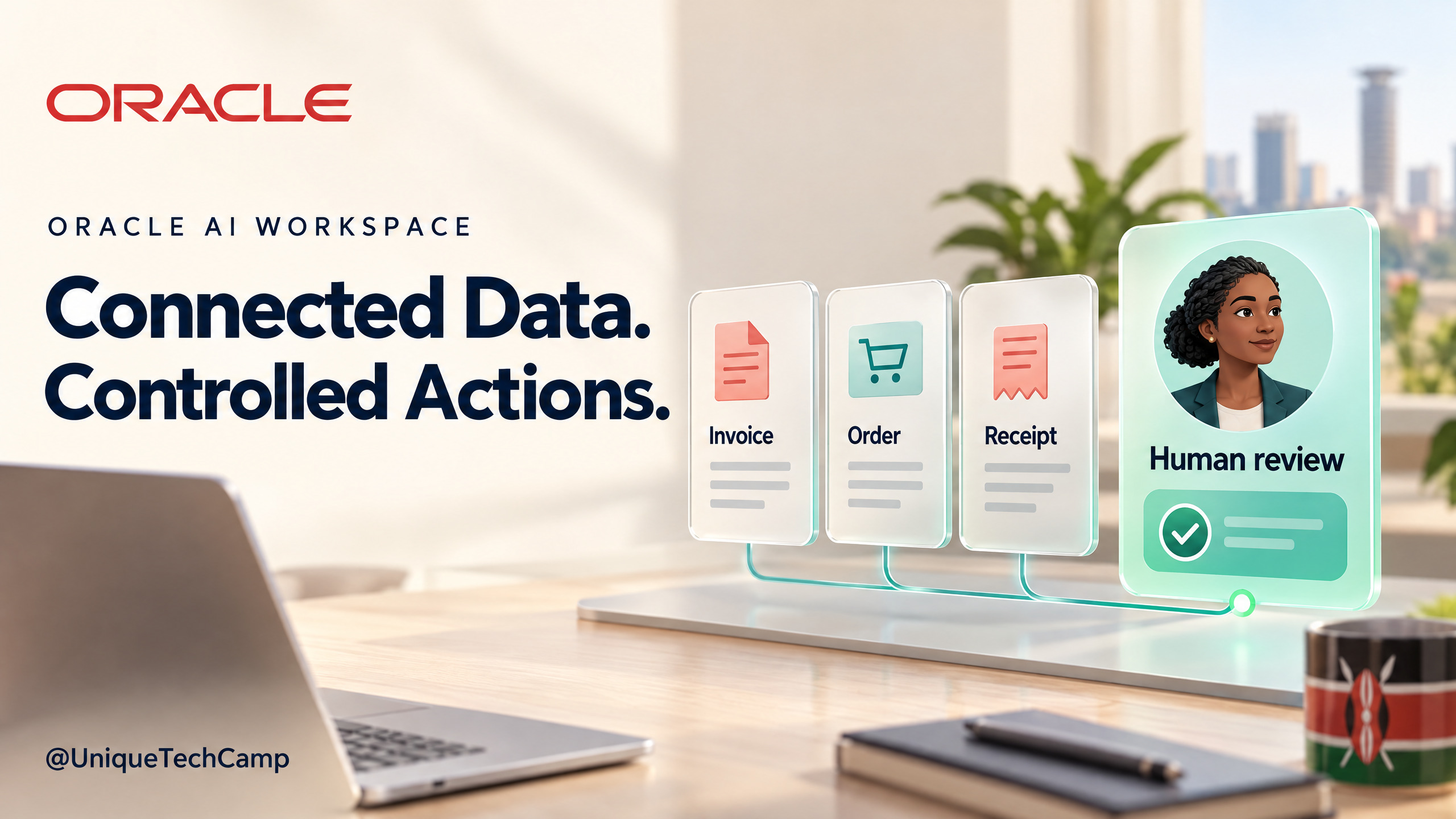
The 27 October 2026 announcement about Oracle AI Workspace ↗ is interesting for Kenyan businesses already running Oracle applications or NetSuite. It is not, however, a reason to rush into a new platform decision. The complete Workspace is explicitly described as “coming soon”. There is no established general-availability date, final price, confirmed Kenya eligibility or complete list of supported application versions in the sources reviewed for this article.
That makes the useful question a practical one: is your finance workflow ready for a connected assistant when the product becomes available? A readiness checklist lets an owner or finance operations lead improve the process now without pretending that a future product has been tested. It also keeps the decision separate from an ERP migration case. This guide is for an existing Oracle ↗ user that wants to examine evidence, approvals, access and recovery around one narrow finance task.
What has actually been announced?
The OpenAI announcement ↗ says the companies are developing Oracle AI Workspace to connect Oracle applications and data in ChatGPT. Its examples include investigating costs, purchasing and month-end close, subject to an organisation’s permissions and approvals. The Oracle product blog ↗ also describes possible investigations involving financial variance, supply-chain issues, customer commitments and employee onboarding.
The important distinction is between a proposed product direction and an available finance control. Oracle says authoritative changes belong in Oracle applications, with business rules, permissions and human approval governing approved actions. That suggests a useful design principle: an assistant may help a person find and explain evidence, but the system of record and the accountable approver remain central. It does not mean that a Kenyan SME can switch on Workspace today, or that every described use case will be supported at launch.
The announcement also mentions ↗ an AI SMB Bundle combining ChatGPT Business, Workspace, Codex, App Composer, OCI and NetSuite QuickStart. Oracle describes it as free-to-start and refers to US$12,000 per year in cloud credits, subject to terms, conditions and restrictions. That conditional credit figure is not a cash discount, a complete licence price or proof of entitlement in Kenya. Oracle’s future-product wording also warns that development, release, timing and pricing can change. It would be unsafe to approve a purchase on that announcement alone.
The readiness boundary: investigate, draft, approve
Before any pilot, write three columns for the proposed workflow:
- Read: retrieve the specific invoice, purchase order, goods-received record, supplier master details and relevant approval history that the user is permitted to see.
- Draft: produce an internal explanation of a discrepancy, cite the records used, identify missing evidence and suggest questions for the owner.
- Write or act: change a ledger, release a payment, alter a supplier record, approve a commitment, send an external message or create a tax position.
For a first exercise, allow only the first two columns. A finance person should review the evidence and draft, then decide what—if anything—goes through the existing Oracle approval process. The assistant must not pay a supplier, post an adjustment, change a purchase order, send an email or WhatsApp message, or offer tax advice. A fluent explanation is not an approval and is not evidence that a transaction is correct.
This separation also avoids a common control mistake: treating provider access as permission to perform an action. The connected-app guidance from OpenAI ↗ says availability can depend on app, plan, region, workspace, role, model and interface. The separate admin-controls guidance ↗ distinguishes provider access from action and approval controls, and notes that not every app exposes the same granular controls. Do not assume that a Business workspace has every Enterprise or Education control.
Our proposed acceptance exercise
The following is our proposed readiness test, not a tested Oracle AI Workspace capability and not a set of Workspace setup instructions. It is a bounded exercise an existing Oracle or NetSuite finance team can define using its current records and controls. Its purpose is to see whether the business can supply clean evidence and review a cautious internal draft.
Scenario: reconcile one supplier-invoice discrepancy
- Select one closed or held transaction. Choose a supplier invoice where the amount, quantity, price or receipt status does not agree with the purchase order and goods-received record. Use a low-risk example with a named finance owner, not a live payment awaiting urgent release.
- Set the evidence pack. List the invoice identifier, purchase-order lines, receipt record, currency, dates, supplier reference, approval status and any documented credit note or delivery exception. Record the source system and retrieval time for each item. Remove unrelated personal or confidential information where it is not necessary for the test.
- Write the permitted question. Ask for a comparison of the invoice, order and receipt records; a table of matching and conflicting fields; a short explanation of plausible causes; and a list of missing evidence. Require every factual statement to point back to a supplied record.
- Define refusal conditions. The exercise must stop if a required record is missing, contradictory, outside the user’s access, unreadable or too old for the business rule. “Cannot determine from the available records” is a successful controlled outcome. The draft must not fill a gap with an invented quantity, approval, delivery date or tax treatment.
- Keep the output internal. Store the draft in the agreed review location. A named finance owner checks each cited field, confirms the discrepancy, decides whether to request more evidence and records the disposition. No payment, ledger write, supplier-master update or external communication is part of this test.
For example, if an invoice shows ten units but the receipt records eight, the useful draft says that the records differ and identifies the missing delivery or credit-note evidence. It does not decide that two units were lost, invent a tax correction or recommend paying the invoice. If the purchase order was amended but the amendment is unavailable, the correct response is to request that record and escalate to the accountable owner.
Checklist for a finance-ready workflow
1. Name the accountable owner
Assign one person who owns the exercise from evidence selection through final disposition. That may be a finance manager, controller or operations lead, but it must not be an abstract “AI team”. Record who can approve a correction, who can release a payment and who can resolve a receiving dispute. The person reviewing the draft should be able to challenge it and should not be pressured to accept a result because it sounds confident.
2. Map authority to each record
Document which application is authoritative for the purchase order, receipt, invoice, supplier master and approval event. If a spreadsheet, inbox or scanned document is only a supporting source, label it as such. Define which discrepancies require the finance system’s existing workflow. Oracle’s announcement and product material point towards Oracle applications validating authoritative changes; your readiness work should test whether your own records and roles can support that principle.
3. Separate retrieval from approval
Ask a simple control question for each step: is this read-only, an internal draft, or a business-system write? A user may be allowed to view an invoice but not amend a supplier record. A draft may be shared internally but not sent to a supplier. An action may require two approvals even if a connected tool can technically present an action button. Write these boundaries into the exercise brief before anyone tests it.
4. Make missing evidence visible
Require a source list and a confidence explanation in plain language. The reviewer should see which fields matched, which did not, which records were unavailable and what decision remains open. Test deliberately with one missing receipt and one conflicting quantity. A useful workflow refuses to conclude rather than rewarding a complete-sounding answer.
5. Protect confidential information
Classify supplier, employee, customer and financial data before placing it in any connected service. Minimise the exercise pack, use a non-production example where possible and decide who may view prompts, retrieved records, drafts and logs. Check retention, access, deletion, administrator visibility, provider processing and overseas transfers with the organisation’s qualified privacy reviewer. The Office of the Data Protection Commissioner’s Kenyan resource page ↗ links the relevant Act and regulations; it is a starting point for review, not blanket compliance advice or legal advice.
6. Design recovery before convenience
Decide what happens if the connection is unavailable, a record is stale, a permission changes, the draft cites the wrong document or an action is accidentally presented as approved. Keep the current manual reconciliation route available. Preserve the original records, record the reviewer’s decision and define how an incorrect draft is corrected. Do not let a future integration become the only route to a payment or month-end close.
Measure review quality, not invented ROI
A readiness test should produce operational evidence, not a speculative return-on-investment claim. Record the transaction type, number of source records, time to assemble the evidence pack, time for human review, number of rework cycles, missing-evidence rate, citation errors, escalations and final disposition. Note whether the reviewer found the draft understandable and whether the proposed boundary prevented an unauthorised action.
Compare the exercise with the existing manual baseline only if the tasks and definitions are consistent. A shorter first draft is not a saving if a finance lead spends longer checking it. A high agreement rate is not useful if the test excludes difficult discrepancies. Include review time, rework, refusal quality and unresolved exceptions. Do not convert one demonstration into promised growth, headcount reduction or guaranteed month-end acceleration.
After one example, repeat with a different discrepancy type—such as a price variance or partial receipt—and record what changed. If the team cannot agree which record is authoritative, fix that process problem before evaluating an assistant. If reviewers cannot explain what would trigger a write or payment, fix the approval design first. Readiness is demonstrated by repeatable evidence and accountable decisions, not by a polished response.
What to verify before any future evaluation
When Oracle AI Workspace moves closer to launch, ask for dated answers rather than relying on announcement language. Verify the supported Oracle applications and NetSuite editions, required versions, connector behaviour, regional availability, data-processing terms, administrator controls, audit logs, action permissions, human-approval steps, support route and recovery options. Confirm whether the specific finance workflow is read-only or can initiate a change, and what approval remains in Oracle.
Separate component pricing from the unknown final bundle cost. The ChatGPT Business overview ↗ currently states a Standard seat price of US$20 per user per month billed annually or US$25 per user per month billed monthly in most countries, with a minimum of two Standard or Premium seats. Prices can vary by country and currency; usage beyond limits may consume credits, and API charges are separate. Those are component figures, not the final Oracle AI Workspace or SMB Bundle price. Add taxes, foreign-exchange exposure, Oracle licences, integration work, support and internal review to any future comparison, and recheck all figures before purchase.
For a Kenyan SME, the decision gate should therefore be modest: do current records support a bounded reconciliation; can the right person review it; can the business refuse when evidence is missing; and can every business-system change remain subject to existing authority? If the answer is no, improving the process and controls may be more valuable than pursuing an unreleased connection.
Frequently asked questions
Is Oracle AI Workspace available to Kenyan SMEs now?
Not on the evidence used here. Oracle’s 27 October 2026 product blog explicitly says Workspace is coming soon, with availability and capabilities to be shared closer to launch. The reviewed announcements do not establish a general-availability date, Kenya access or supported-version list. Treat regional availability as an item to verify later, not an assumption.
Does this checklist prove that Workspace can reconcile an invoice?
No. The supplier-invoice exercise is our proposed readiness test, not a test result and not Workspace setup guidance. It describes the evidence, boundaries and human review a business should define before evaluating a future product. It does not claim that Workspace currently retrieves these records, identifies discrepancies accurately or performs any finance action.
Can an assistant approve a payment or update the ledger?
This article recommends that the proposed exercise do neither. Retrieval and an internal draft must be separated from payment, ledger adjustment, supplier-master change, tax treatment and external communication. Any future action should be checked against documented permissions, business rules, audit requirements and human approvals in the relevant Oracle application and organisation.
Should an SME buy the announced bundle or migrate to Oracle?
No purchase or ERP migration follows from this announcement alone. The bundle description is subject to terms, restrictions and future changes, and it does not establish a final price or Kenya entitlement. An existing Oracle or NetSuite user can first run a manual readiness exercise, measure review and rework, and seek dated commercial and technical answers when the product is genuinely available.
Conclusion: Prepare the workflow before the connection
Oracle AI Workspace is an announced direction, not a verified deployment option for this Kenyan SME scenario. Prepare by selecting one discrepancy, tracing its evidence, limiting the exercise to retrieval and an internal draft, and preserving accountable human decisions. Evaluate the actual product only when availability, controls, supported systems and commercial terms can be confirmed.
Need this built for your business?
If your finance team already uses Oracle or NetSuite, begin with one discrepancy, one accountable reviewer and one written read-versus-write boundary. UniqueTechCamp’s AI Solutions Desk ↗ can help turn that boundary into a documented workflow discussion. For a scoped conversation, use the appointments route ↗. If the next step is a controlled multi-system process with approvals, escalation and reporting, review the workflow-automation service ↗. The aim is not to automate a promise; it is to make ownership, evidence and recovery clear before any tool is trusted.



UniqueTechCamp Desk
Online • Reply < 5 mins