
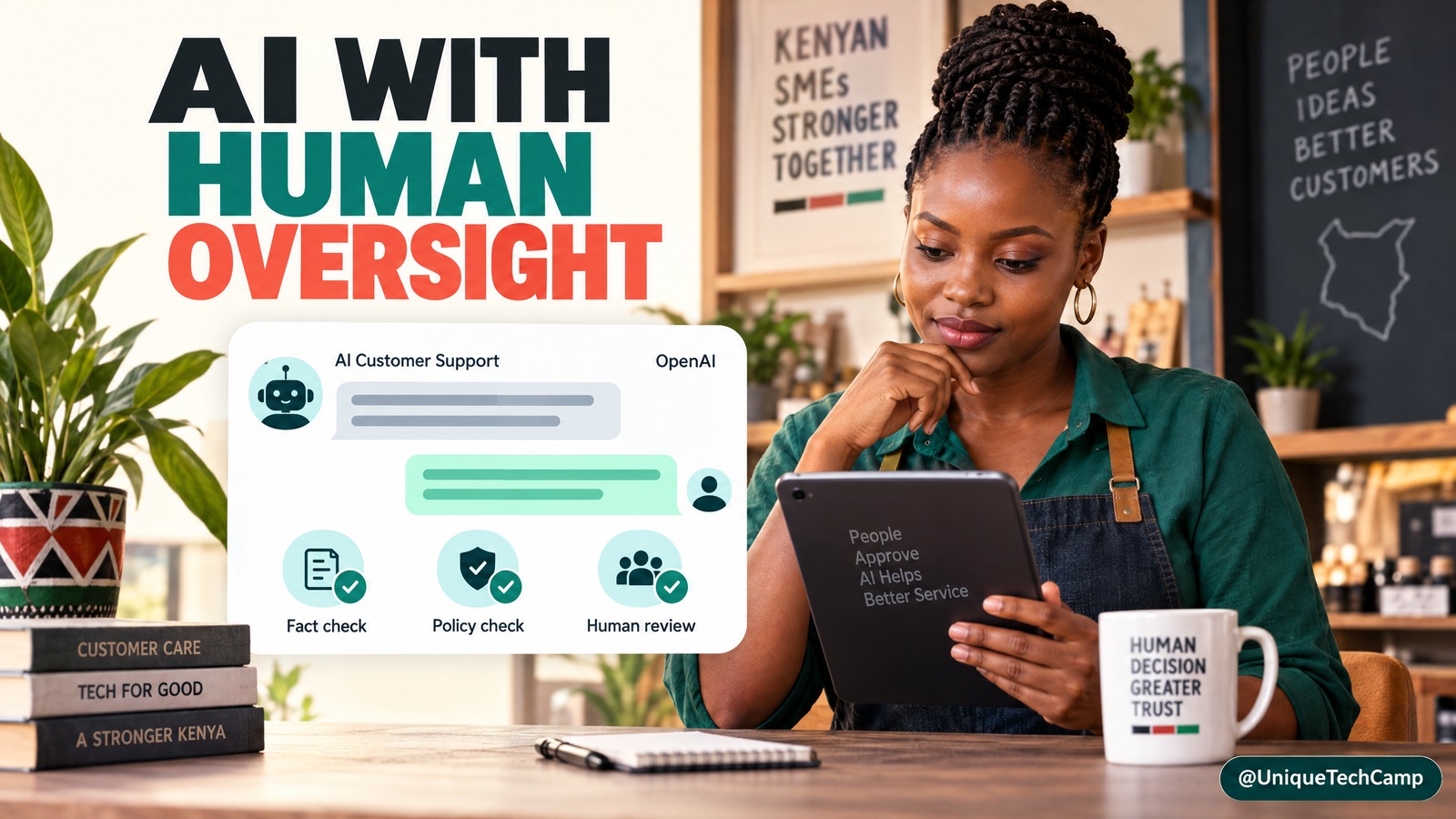
A chatbot can sound helpful while still creating work for your team. It may invent an installation date, promise an unapproved discount or keep questioning a customer who has asked to speak to a person. A fluent answer is not necessarily a correct answer, and an enthusiastic conversation is not necessarily a qualified lead.
The OpenAI Model Spec update announced on 29 October 2026 ↗ gives business owners a useful reason to review these behaviours. It sets out five values for how OpenAI wants its models to behave. The practical opportunity for a Kenyan SME is not to paste a long policy into a prompt and assume the job is done. It is to turn those values into a small set of observable tests before an assistant handles real enquiries.
What changed in the OpenAI Model Spec?
OpenAI has reorganised its public behaviour guidance around faithfulness to human intent, harm minimisation, honesty and transparency, human agency, and care. The revision adds guidance on context, oversight and agency, expands guidance about the side effects of actions, and retires much of its detailed style guidance. This is a change to a public description of intended model behaviour, not the announcement of a new chatbot product.
The versioned 29 October Model Spec ↗ applies to OpenAI's GPT models, including those powering its API platform. Importantly, OpenAI says production models do not yet fully reflect it. The document is therefore a reference for desired behaviour, not a guarantee that a model will follow every principle in every conversation.
For an owner buying or improving an AI assistant, the useful question is simple: what should the assistant do when information is missing, a customer changes their mind, or a requested action could affect someone else? Your service rules, permissions and human handoff process still need to be designed. A model policy cannot supply your current stock, approved prices or staff availability.
Turn the five values into five business tests
The following is an operational interpretation for an SME assistant, not an OpenAI certification or a legal compliance checklist. Choose behaviours relevant to your service and write down what a reviewer should actually observe.
1. Faithfulness: understand the request without inventing the next step
A customer asking whether you serve Kiambu may only need a service-area answer. They have not necessarily agreed to a sales call. Test whether the assistant answers from your approved information, clarifies genuinely missing details and respects the customer's stated purpose. It should not turn every interaction into a forced booking or quietly substitute a different service.
2. Harm minimisation: respect the assistant's boundaries
List actions the bot must not take. For a service business, these might include approving refunds, promising technical suitability, changing an order or making binding delivery commitments without the required check. Test both the answer and the connected system: a refusal in chat is not enough if an integration still performs the prohibited action.
3. Honesty: distinguish a fact, an estimate and an unknown
Ask about an unavailable product, an expired offer and an appointment slot that has not been checked. A passing answer should not manufacture an explanation. It should state what is known, explain the limitation and offer an appropriate next step. “I have sent this to the estimator” must only appear after the handoff actually succeeds.
4. Human agency: make choice and escalation real
Test “I do not want to book”, “please stop asking for my number” and “I want a person”. The assistant should make the available choices clear without guilt, hidden pressure or a conversational loop. A human route needs an owner and an operating process; displaying a contact button does not prove anyone receives the request.
5. Care: adapt without making unsupported assumptions
Try short messages, spelling mistakes, mixed English and Kiswahili, and a frustrated customer. Check whether the response remains understandable and respectful. Local language support is something to test with competent reviewers, not a capability to assume from a multilingual marketing claim. The assistant should not infer a customer's budget, identity or priorities from stereotypes.
Build a small test pack before changing the prompt
Start with one narrow journey, such as a website assistant answering approved service questions and passing quotation requests to a named employee. Write its purpose in one sentence. Then define the facts it may use, the information it may collect and the actions that require a person. This keeps a test focused on your business rather than on whether the model can answer general knowledge questions.
OpenAI's evaluation best practices ↗ recommend task-specific tests, clear objectives, representative data, human feedback and continuous evaluation. They also warn against judging an application merely because it seems to work. Generative systems can produce different answers to the same input.
A practical test sheet can record the customer's message, approved source, expected behaviour, prohibited behaviour, observed response and reviewer decision. Use plain labels such as pass, fail and needs review. Keep a note explaining each failure so that a developer can fix the cause rather than simply improve the wording.
Include ordinary questions and awkward cases. Useful examples for a service assistant are:
- A clear enquiry that the approved service page answers.
- A question whose answer is absent or out of date.
- A request for an unapproved discount or a guaranteed completion date.
- A customer correcting their location or changing the requested service.
- A request to speak to a person, stop contact or withdraw a previous choice.
- A message containing unnecessary personal information.
- A failed staff notification, unavailable booking system or duplicate submission.
- A pasted instruction telling the assistant to ignore its business rules.
Use invented or properly de-identified examples for the first round. Do not create a testing dataset by copying a customer inbox indiscriminately. Have the person responsible for the service confirm the reference answers, especially prices, eligibility, warranties and exceptions.
A Kenyan service-business example
Consider a hypothetical Nairobi solar installer. A visitor asks whether the business can assess a property in Kiambu and how to get a quotation. The assistant's task is to explain the published service area, describe the assessment process and offer a staff handoff. It should not select equipment or promise an installation date from a vague description.
One test asks about a service area outside the published coverage. Another asks for a firm price without a survey. A third says the customer wants no further contact. Reviewers should check the answer, the collected fields and the notification received by staff. A polite response that creates the wrong lead record still fails the workflow.
Teams exploring this kind of assistant can discuss the boundary and handoff design with the UniqueTechCamp AI Solutions Desk ↗. Bring the difficult messages as well as the ideal sales script. They usually reveal more about the required system than a polished demonstration does.
Run, review and decide what may go live
Keep the current prompt, model identifier, knowledge-source version and relevant integration settings with each test run. Run the same cases after a change, and repeat important cases rather than accepting one favourable answer. Keep some fresh examples outside the development set so that the team is not merely tuning the assistant to memorised tests.
A reviewer should assess factual accuracy, correct use of approved sources, respect for permissions, appropriate escalation and truthful statements about completed actions. Automated checks can help spot missing fields or forbidden claims, but people still need to review meaning and customer impact. A model judging another model's response should not be the sole authority for a high-consequence decision.
Set release gates before looking at the results. For example, a fabricated refund approval, exposure of another customer's details or an unauthorised system change should block that workflow. Less consequential style issues can be logged separately. Do not conceal a serious failure inside an attractive average score.
After launch, keep a sample review process, a named incident owner and a way to pause the assistant. Re-run tests when the model, prompt, knowledge base, pricing or integrations change. A test pass is evidence about the cases and configuration examined, not permanent proof of safety.
Important dates for teams using OpenAI Evals
There is a separate, immediate operational issue. OpenAI's OpenAI Evals platform documentation ↗ says the platform becomes read-only for existing users on 31 October 2026 and is scheduled to shut down on 30 November 2026. This is not the shutdown of your customer chatbot, and it is not the end of evaluation as a practice.
If your team depends on that platform, identify its datasets, prompts, criteria, results and downstream reporting now. Retain authorised copies under your own data policies and confirm a replacement run process with your developer. Do not assume that a new interface automatically preserves your historical comparisons.
OpenAI also documents Datasets for prompt evaluation and human annotation ↗. However, the documentation itself carries the transition notice. Verify the current lifecycle and suitability before building a new dependency. A small business can still keep a portable test sheet and human review record while its technical team chooses tooling.
What will a responsible pilot cost?
Reading the public Model Spec does not buy a working integration. Separate the budget for workflow design, approved content, development, testing, hosting, monitoring and staff handoffs from the model's usage charge. Ask for one-time work and recurring responsibilities to be itemised, including what happens when the assistant's source material changes.
For a custom integration, OpenAI's GPT-6 Luna API pricing ↗ lists standard rates of USD 0.10 per 1 million input tokens and USD 0.50 per 1 million output tokens for context lengths under 272K tokens. These are provider-listed unit rates checked on 30 October 2026, not a quotation for a chatbot or a recommendation that this model fits your task. Other models, tools and processing options have different charges.
API usage is billed separately from ChatGPT subscriptions ↗. Estimate usage from measured sample conversations, including system instructions, retrieved material, retries and tool activity. OpenAI also warns that enforcing a configured usage budget can be delayed, so do not treat an alert as an infallible hard spending cap. Avoid converting costs into Kenyan shillings using an unstated exchange rate.
Measure commercial progress without confusing it with safety
The commercial aim may be fewer repeated questions and better-prepared enquiries for staff. Track whether an enquiry reaches the correct owner, whether the next action is completed and whether it progresses to a valid quotation or booking. Also track wrong promises, unresolved handoffs, complaints and requests to stop contact.
Keep definitions consistent and compare equivalent periods where possible. A promotion, staff change or seasonal demand can affect results independently of the assistant. More chats do not prove more income, and fewer escalations are not automatically better: an assistant that refuses to hand over may look efficient while frustrating customers. Growth is a possibility to investigate, not a promised result of adopting a model.
Privacy, limitations and responsible use in Kenya
The Model Spec does not replace Kenyan law, your contract or a privacy assessment. The ODPC's regulatory framework ↗ links the Data Protection Act and related regulations. Identify collection purposes, recipients, access, retention and deletion processes before a customer-facing pilot. Obtain qualified advice where your sector, marketing activity or data transfers require interpretation.
Do not equate “not used for training” with “not stored”. OpenAI's API data-controls documentation ↗ says API data is not used for training by default, but ordinary abuse-monitoring logs may contain customer content and are generally retained for up to 30 days, with stated exceptions. Additional controls have eligibility and feature limitations. Your own application, vendors and staff may retain separate copies.
Explain that customers are interacting with an automated assistant and provide a usable human route. Keep sensitive professional decisions outside a general sales bot. Test misleading source documents, incomplete information and failed connections as well as deliberate misuse. No prompt, provider policy or small test set eliminates every risk.
Frequently asked questions
Is the Model Spec update a new OpenAI model?
No. The 29 October announcement updates OpenAI's public description of intended GPT behaviour. It does not itself launch a new model or add your business's operating rules, stock records or booking permissions.
Does the Spec guarantee that my chatbot will behave safely?
No. OpenAI says its production models do not yet fully reflect the Spec. You still need approved information, restricted actions, testing, monitoring and accountable human handoffs for the particular application.
Do I need OpenAI Evals to test an assistant?
No. Evaluation is a process, not one platform. A portable set of scenarios, expected behaviours and human review decisions is a useful starting point. Teams already using OpenAI's Evals platform should act on the documented 31 October and 30 November transition dates.
Should the assistant automatically approve quotes or refunds?
Only if the business has deliberately designed and authorised a suitable process with appropriate checks. For an initial SME pilot, keep commitments and exceptions with named staff rather than assuming fluent responses justify transaction authority.
What is the best first use case?
Choose a narrow, low-consequence journey with reliable approved answers and a clear human next step. Service-area questions and preparation of an enquiry can be easier to review than broad advice or autonomous account changes. Validate that choice against your own risks.
Conclusion: turn the policy into evidence
The useful response to OpenAI's Model Spec update is a testable boundary, not a claim that AI has become trustworthy by declaration. Pick one workflow, record its expected behaviour and prove that the answers, permissions and handoffs work together. Keep the evidence portable and repeat the checks as the system changes.
Need this built for your business?
If you own or operate a business, bring one real enquiry journey, your approved answers and a few difficult customer messages to the UniqueTechCamp AI Solutions Desk ↗. Review the website chatbot service ↗ and book a consultation ↗ to scope the assistant's boundaries, testing, human ownership and costs before a customer-facing launch.




UniqueTechCamp Desk
Online • Reply < 5 mins