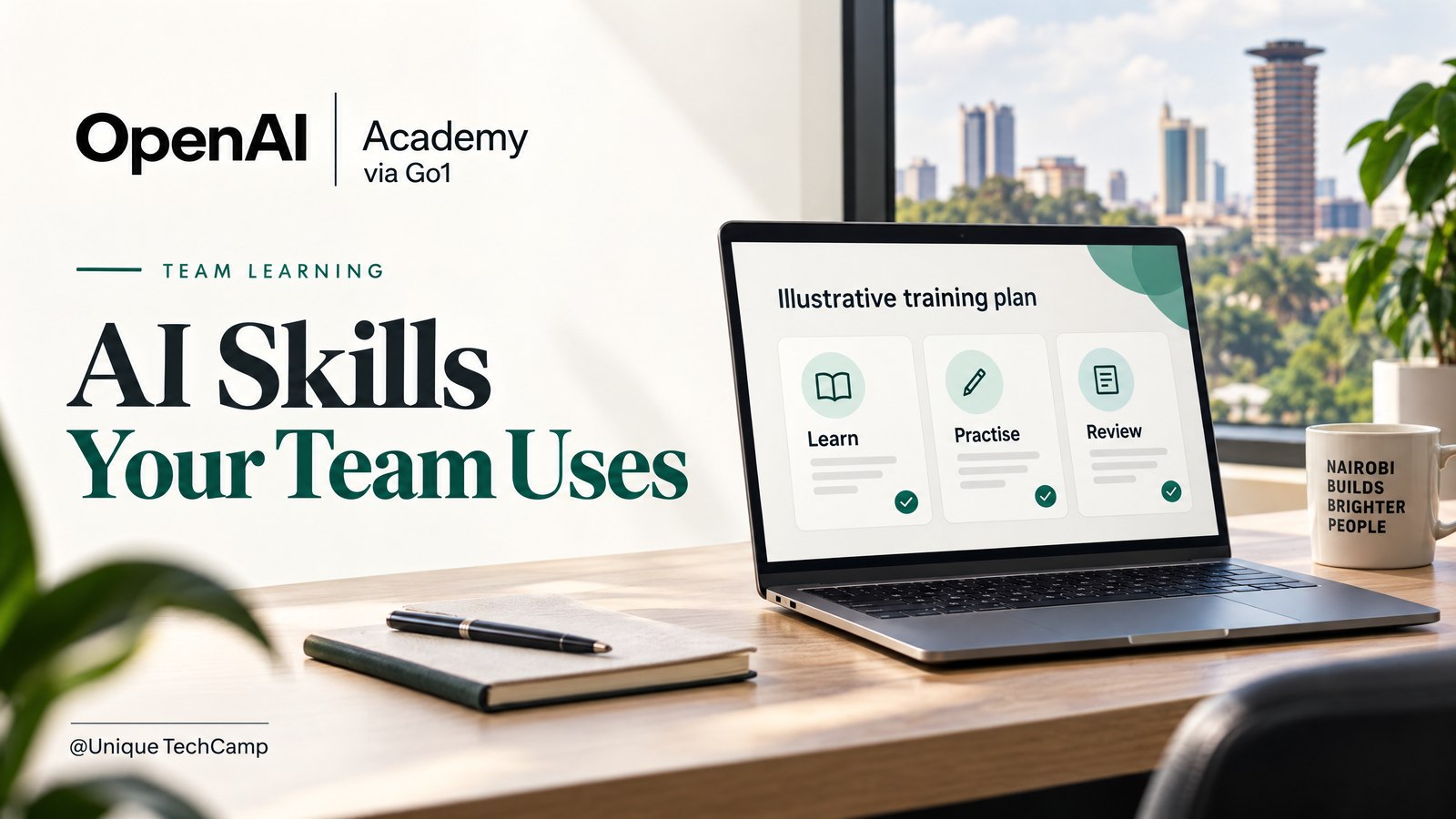
OpenAI Academy on Go1: AI Training for Kenyan SMEs
Go1 added OpenAI Academy courses on 4 November 2026. Plan practical AI training for Kenyan SME teams, confirm access and measure work quality.
UniqueTechCamp Editorial
Digital Services Team • UniqueTechCamp Engineering Unit
A small business can buy access to capable AI tools and still get very little value from them. The obstacle is often not the model. It is the gap between a general demonstration and a repeatable way for a receptionist, sales colleague, bookkeeper, manager or technician to use AI safely in the work already on their desk.
That is why the announcement from Go1 and OpenAI matters as a training-access update. On 4 November 2026, Go1 announced that existing OpenAI Academy courses would be available through its learning platform. The official Go1 announcement describes a partnership for helping organisations build AI capability; it does not announce a new OpenAI Academy or a new AI model.
For a Kenyan small or medium-sized enterprise, the useful question is therefore not “Will this make our business grow overnight?” It is: “Can we give a small group of people structured practice, connect that practice to real responsibilities, and measure whether the work becomes more consistent?” This article explains what changed, what a business should confirm before committing, and a proposed four-week rollout that keeps learning tied to accountable work.
The actual business problem: AI interest without operating habits
Many teams have already experimented with chat assistants. Someone writes a prompt, gets a plausible paragraph and moves on. Another person copies an answer into a customer message without checking it. A third starts a spreadsheet experiment that only they understand. When those people leave or become busy, the experiment disappears.
This pattern creates three practical costs. First, staff spend time rediscovering the same use cases instead of agreeing on a shared method. Second, managers cannot tell the difference between a useful draft and an answer that needs specialist review. Third, a business can end up paying for software subscriptions while its team has no agreed owner for quality, privacy or handover.
Training can help with those operating gaps, but only when it is attached to a workflow. A customer-service colleague should practise turning an enquiry into a clear draft and escalating uncertainty. An administrator should practise extracting fields from a supplied document and checking them against the source. An owner should practise deciding which tasks may be assisted, which require approval and which should remain human-led.
The goal is not to make every employee an AI specialist. It is to create a common baseline: what the tool is being used for, what information may be supplied, how an output is reviewed, who owns the final decision and how an error is recorded.
What changed on 4 November 2026?
The specific change is distribution. Go1 says organisations can access OpenAI Academy content through Go1, with named areas including AI Foundations, Applied AI Foundations, and Agents and Workflows. The Go1 OpenAI Academy page describes complete courses and focused modules. It also says an organisation activates the content, an administrator curates or assigns it, and learners find it after activation.
That is different from saying that OpenAI launched a new Academy on 4 November. The Academy already exists as a public learning initiative. Its official course catalogue groups learning for knowledge workers, builders, leaders and education, including practical material about repeatable workflows, building and evaluating solutions, and adoption planning. The date in the Go1 announcement concerns a new route for organisations to distribute existing course content—not the creation of the Academy itself.
It is also important to separate three things that are easy to blur together:
- Direct browsing or joining through the OpenAI Academy home page is not proof that the same content is included in a Go1 plan.
- Training access is not the same as access to an AI model, an API, a chatbot subscription or another software tool.
- Completing a course does not automatically deploy a workflow, connect a business system or authorise an employee to make a sensitive decision without review.
The practical implication is that a business should ask Go1 what its team will receive, how the content is activated, how administrators assign modules, what reporting is included and which parts depend on the organisation’s existing setup. Go1’s announcement is a distribution and learning proposition; the implementation work inside a company remains a management responsibility.
Access, account setup and cost questions
Go1’s partnership material points organisations towards activation and a demo rather than a simple public checkout for this particular content package. A prospective buyer should expect an account conversation, configuration questions and an administrator who can assign learning to the right people. Availability and the final experience may vary with the organisation’s Go1 arrangement.
Go1’s partnership pages do not publish a numeric price for this Academy content. Go1’s plans page presents plan options but does not state a price for this specific offer. Its small-business information describes a personalised trial and says the team considers matters such as team size and needs before configuring it. That is useful context, but it is not a promise that a Kenyan company qualifies for a particular plan, price or trial.
Ask these questions before approving anything:
- Is the Academy content available for the organisation’s intended location, account type and team size?
- Which courses and focused modules are included, and can an administrator assign only the relevant ones?
- What is required for activation, user invitations, reporting and account administration?
- Is the proposed cost for learning content, the wider Go1 platform, implementation support, or a combination?
- What happens after any trial or initial term, and who can export completion or participation records?
Do not compare a Go1 learning package directly with a standalone AI subscription. One is primarily an organisational learning and administration decision; the other may provide software access. A team may need both, but neither replaces the other. Equally, a course catalogue does not by itself create an internal policy, review queue or safe data-handling practice.
A proposed 30-day rollout for a small team
The following is an editorial implementation plan, not a Go1 timetable or vendor guarantee. It is designed for a small team that wants evidence of practical adoption before expanding access. Choose three to six people first, include at least one operational owner and select one workflow that can be measured without exposing confidential customer information.
Week one: choose the work and set the baseline
Start with a short meeting rather than assigning every course to everyone. List recurring tasks that are frequent, bounded and reviewable: drafting a service reply, turning meeting notes into actions, preparing a first-pass product description, sorting an internal request or creating a checklist from a supplied procedure.
Choose one task for the pilot and write down how it is currently completed. Record a small baseline sample: how long it takes, how often it needs rework, what errors commonly appear and who approves the result. If a task is too sensitive to use with real information, create a synthetic example that preserves the structure without copying personal, financial or confidential data.
Then assign learning by role. Everyone might begin with foundations. The customer-facing colleague can take a practical application module; the manager can study adoption and review responsibilities; a technical colleague can explore agents and workflows only if that subject is relevant to the chosen task. The point is not to maximise completions. It is to give each person enough shared language to perform and review one defined piece of work.
Week two: practise one workflow with synthetic examples
Have each participant complete the chosen task two or three times using an agreed template. The template should identify the input, the desired output, constraints, checks and escalation point. For example, a customer-response exercise might require a concise draft, a list of unknowns, a source reference and a human approval before sending.
Use synthetic examples deliberately. They make it easier to compare attempts and discuss mistakes without turning a training session into an uncontrolled data-sharing exercise. Ask staff to mark where the output was useful, where it invented detail, where the instruction was ambiguous and where a human had to intervene.
Appoint a named review owner. This person is not expected to approve every low-risk sentence forever; their first job is to make the quality standard visible. They should collect a few examples, explain the reason for corrections and update the workflow note when the same problem appears repeatedly.
Week three: run a supervised live pilot
Move to a limited live queue only after the team can explain the checks. Keep the human handoff explicit. A staff member may use AI to prepare a draft or organise information, but the responsible employee remains accountable for the final communication, record or decision.
For a Kenyan SME, the live pilot might be a handful of internal requests, a set of generic website enquiries or a de-identified service-admin task. Set a stop condition: pause the experiment if the tool produces repeated unsupported claims, exposes information, creates duplicate work or makes the reviewer slower than the original process.
The UniqueTechCamp AI Solutions Desk can be a useful place to discuss how a business-specific assistant or workflow might fit around these controls. The appropriate question is not “Can we automate everything?” It is “Where would a defined handoff, source check and named owner make this particular task more dependable?”
Week four: review evidence and decide what to do next
Compare the pilot with the baseline, using the same task definition. Look at participation, but do not treat course completion as the main success measure. Review the time taken, first-pass quality, rework, escalation frequency and the reviewer’s confidence. Record examples of improvement and examples where the old method was safer or faster.
Hold a short decision meeting. Continue if the workflow is clearer and the quality checks are workable. Change the prompt, template or approval step if the output is inconsistent. Stop if the task is not suitable for assistance. Expand to another role only when the first workflow has an owner, a written check and a way to spot failure.
This sequence helps an owner check whether staff are applying the learning rather than leaving a catalogue untouched. It also gives an owner a defensible basis for asking Go1 for more configuration, more seats or a different content mix—if the evidence says the team needs it.
Measure capability, not just completion
A useful scorecard can stay small. Track how many assigned people attended or completed the relevant learning, but put that beside the number of practice tasks completed, median task time, first-pass acceptance, rework count, escalation count and the review owner’s qualitative notes. If the workflow affects customers, also monitor complaints, corrections and handoff delays.
Define each measure before the pilot starts. Measure both drafting and checking time on the same kind of task before and during the pilot. Call it time saved only when the combined effort is lower; a faster draft that creates extra review work is not enough. “Quality” should mean a checklist or reviewer decision, not a polished-looking paragraph. “Adoption” should mean repeated use in the chosen workflow with the required checks, not a single impressive demonstration.
Keep a before-and-after sample. A manager can review ten baseline examples and ten pilot examples, noting factual errors, missing context, unnecessary edits and approval outcomes. The sample does not need to support a grand claim about revenue. It needs to answer whether this team can perform this task more consistently under defined conditions.
There are limits. Training cannot fix missing source data, unclear pricing, weak service processes or an owner who never reviews the output. A module about agents does not make an agent safe to deploy. A completion record does not prove competence in a regulated or specialist role. And a promising first month may not survive staff turnover unless the workflow note, examples and review responsibility are maintained.
Frequently asked questions
Did OpenAI launch a new Academy on 4 November?
No. The 4 November 2026 announcement concerns Go1 making existing OpenAI Academy courses available through its organisational learning platform. It should not be described as the launch of a new Academy. The Go1 press release describes the partnership as expanding access to Academy courses for organisations.
Can a Kenyan SME buy the package at a published price?
The reviewed official pages do not publish a numeric price for the OpenAI Academy content on Go1, and they do not establish Kenya-specific purchase eligibility. A business should request a current proposal or demo, confirm account and location requirements, and ask what is included. Do not assume that a public Academy page, a Go1 plan page or a personalised trial means the same offer is automatically available to every Kenyan organisation.
Does course access include an AI tool or automatic deployment?
Not by itself. The Go1 offer concerns learning content and its administration. It does not automatically provide every AI software subscription, connect to a CRM, create an agent or deploy a production workflow. Treat training, tool access, integrations, security review and human approval as separate decisions that may need to be coordinated.
What should an owner do before booking a demo?
Bring a short list of roles, one candidate workflow, a synthetic example, a baseline task time and the name of the person who would review results. Ask about course/module scope, activation, user administration, reporting, trial terms, ongoing cost and data-handling expectations. A focused brief will produce a more useful conversation than asking for “AI training” without a work context.
Conclusion
Go1’s 4 November update gives organisations another route to distribute established OpenAI Academy learning. For a Kenyan SME, its value will depend less on announcing that staff have completed a course and more on whether a small team can practise one defined workflow, review the output and learn from measured rework.
Treat the announcement as an access and capability decision. Confirm the package, account setup and commercial terms directly. Keep direct Academy access separate from Go1 access, and keep training separate from software subscriptions and deployment. Start with synthetic examples, a named reviewer and a modest baseline. If the evidence is useful, expand deliberately.
Need this built for your business?
Business owners can bring one candidate workflow, a synthetic practice example and a named review owner to the UniqueTechCamp AI Solutions Desk . Ask how the task could be supported by a business-specific assistant, a clear approval step or a measured handoff. You can book an appointment and review the AI business automation services before choosing the next implementation step.
Deploy An Autonomous AI Lead Gen System Today
We engineer high-converting web applications with integrated 24/7 WhatsApp qualification bots and multi-channel follow-up drips.
Related Strategy Articles

CrowdStrike AI Kill Switch: SME Team Reviewing an Agent Safety Dashboard
A practical SME playbook for reviewing CrowdStrike’s AI Kill Switch, testing agent containment safely, measuring trade-offs and checking Kenya eligibility.

Microsoft Agent 365 Business Analytics: An SME Readiness and Value-Validation Guide
Microsoft Agent 365 Business Analytics is in Frontier preview. Here is how Kenyan and East African SMEs can validate access, usage cost, value, privacy and readiness before buying licences for a dashboard.
Canva AI Controls: SME Design Review and Human Approval on a Laptop
A practical Canva AI Controls workflow for Kenyan and global SMEs: control settings, human review, asset provenance, measurements, costs and limitations.

UniqueTechCamp Desk
Online • Reply < 5 mins