
Microsoft Maia 300: What Kenyan SMEs Should Know Before Changing AI Providers
Microsoft plans Maia 300 production deployments in 2027. What Kenyan SMEs should check on AI access, costs, data protection and a practical pilot.
UniqueTechCamp Editorial
Lead Systems Architect • UniqueTechCamp Engineering Unit
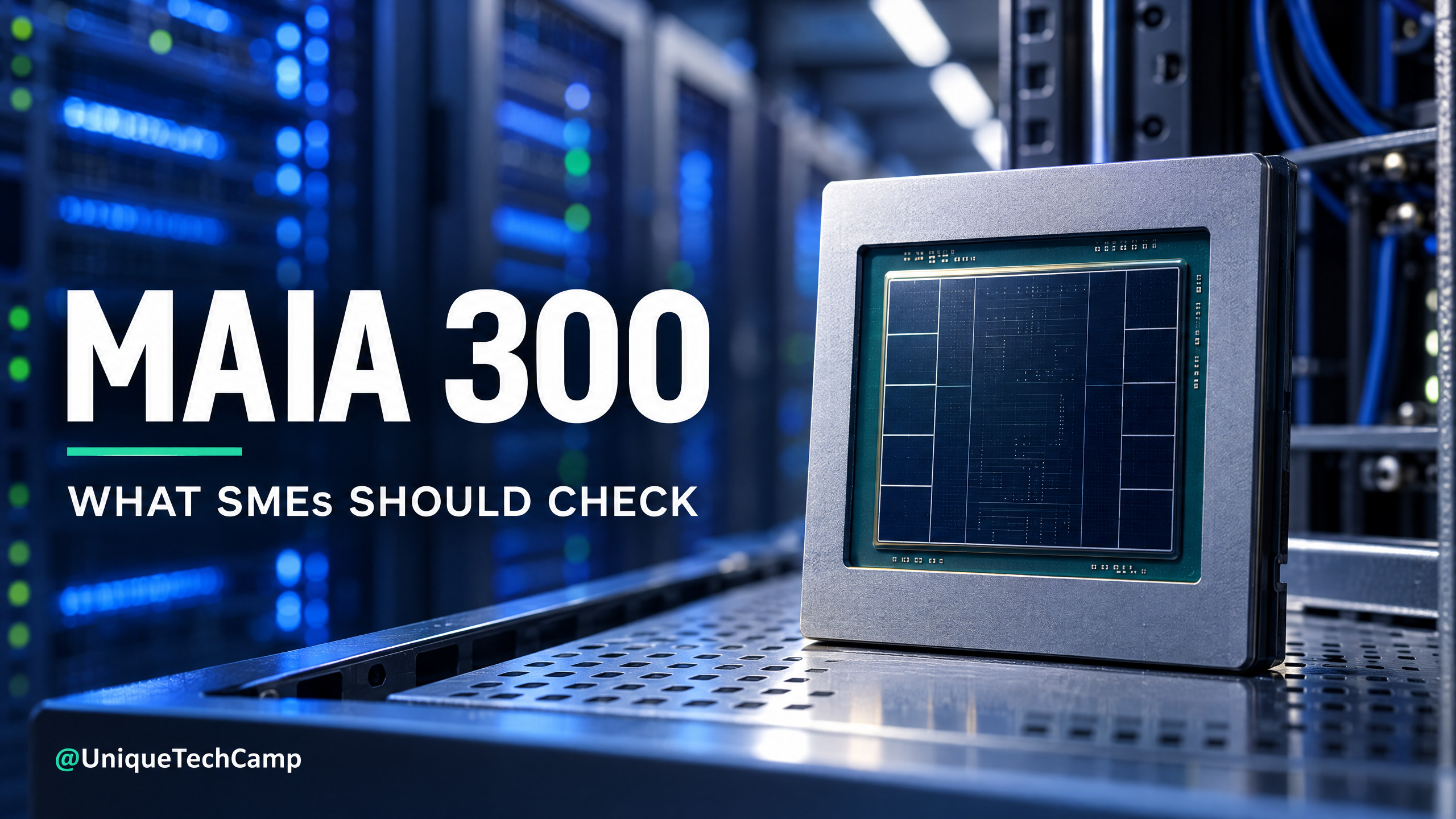
Microsoft's latest custom-chip announcement may sound like a promise that AI will soon become cheaper. For a Nairobi business, that is an understandable - but premature - conclusion. On 12 October 2026, Microsoft said it plans to expand its Azure Maia system into multi-gigawatt deployments, with Maia 300 production deployments expected in 2027. That is an infrastructure plan, not a customer quote or a date when every Azure AI service will change.
This guide separates the news from the decisions a Kenyan SME can make today: check which service and region are actually available to your account, price the workload you intend to run, test it on real business tasks, and protect the data involved. The aim is not to predict a price cut. It is to help an owner decide whether an AI workflow is useful on its own evidence, rather than on a chip headline.
What Microsoft actually announced
Microsoft's official Azure Maia announcement describes a broader infrastructure programme. Microsoft says Maia 200 is already in production and that Maia 300 production deployments are planned for 2027. The company intends to use its accelerator systems for inference - the stage where a trained model responds to a prompt or request - across its own products and Azure services. The announcement is about data-centre systems at cloud scale; it is not an offer to buy an individual chip.
 describes a broader infrastructure programme. Microsoft says Maia 200 is already in production and that Maia 300 production deployments are planned for 2027. The company intends to use its accelerator systems for inference - the stage where a trained model responds to a prompt or request - across its own products and Azure services. The announcement is about data-centre systems at cloud scale; it is not an offer to buy an individual chip.
The same post makes several performance claims. Microsoft says Maia 300 can produce up to 40% more tokens per megawatt than what it calls leading GPU systems. Its separate Maia 300 architecture deep dive describes up to 7x rack-level token throughput compared with Maia 200 for a full rack configured with 96 accelerators, and reports more than 2.5x performance per watt versus Maia 200. These are vendor-attributed results, not an independent benchmark of a Kenyan company's workload. The comparison, system configuration, model and quality target all matter.
That distinction is important. "Tokens per megawatt" describes output relative to power consumed at infrastructure scale. "Rack-level throughput" describes a particular system configuration. Neither measure is the same as the price an SME will pay for a completed customer task. A faster data-centre system can be useful to a cloud provider without automatically changing a customer's service plan, model access, bill or response time.
Same-day CNBC reporting on Microsoft's inference strategy also framed Maia as part of Microsoft's effort to serve AI requests on its own infrastructure. That context supports the practical reading: the release is a cloud-capacity and supply-chain story. It is not evidence that a local business needs to replace its chatbot, CRM or model provider this week.
What the announcement does not change for your business
The announcement does not give your organisation a Maia 300 customer price, a guaranteed reduction in Azure AI charges, or a date when a named model will be available in a particular region. Microsoft's public Azure OpenAI pricing page describes customer-facing service and model pricing, which can depend on the model and deployment option. It is the relevant place to start a cost check - not a hardware-efficiency percentage in an announcement. Use the rate that applies to your account and region, then confirm whether your commercial agreement changes it.
Availability is a separate question from the date a chip enters production. The current Azure model quotas and limits documentation directs customers to check model, region and quota availability for their own subscription. A data-centre deployment plan does not guarantee that the model, capacity tier or service you want can be provisioned for your tenant. Nor does it show that a request will be processed in Kenya. Check the service's regional options and data terms instead of inferring location from a chip launch.
When you compare an AI service, include more than the model call. Your actual operating cost can include application hosting, integration work, retries, monitoring, secure storage, staff review, support and ongoing evaluation. A token rate may be only one line in that picture. Ask for a test or estimate based on your own expected inputs, outputs, traffic pattern and response-time needs. Do not convert Microsoft's tokens-per-megawatt figure into a claimed percentage saving on your invoice.
Start with the work, not the hardware
For an SME, the best first question is not "Which accelerator is fastest?" It is "Which repeated task is slow, costly to review or easy to misroute - and how will we know if a change helps?" Useful low-risk candidates can include classifying incoming enquiries, extracting fields from a supplier document, drafting an internal summary or routing a support message to the right team. Pick one job with a clear owner and a human fallback. Do not begin by giving a bot authority to approve a refund, promise a delivery date or make a decision that affects someone's rights.
Write the workflow down before selecting a model. Record what arrives, what information is needed, what the system may produce, who checks the result, and what happens when the input is incomplete or unusual. If the task touches customer communication, decide which messages may be drafted automatically and which must wait for a person. If a request fails, the fallback should be a real queue or named staff member - not a vague promise that "the AI will try again".
For example, a Nairobi property-maintenance team might test whether a system can sort new repair enquiries into a small set of service categories and capture the property, issue and preferred callback time. Staff should confirm urgency, scope and any appointment before the customer receives a commitment. That pilot would test an operational step; it would not assume the model can diagnose a fault, quote a repair or schedule work without review.
A practical pilot checklist for an AI service
- Set a baseline. For a representative period, record the current task volume, time from arrival to completion, hand-offs, corrections, missed enquiries and any verified business result such as a booked appointment. Use definitions everyone on the team understands. "Chat volume" is not the same as a completed job, and a faster draft is not a saving if a member of staff must rewrite it.
- Build a small evaluation set. Collect examples that reflect ordinary requests, incomplete details, ambiguous wording and common exceptions. Remove or mask personal information unless there is an approved reason to use it. Have a knowledgeable person label the acceptable answer or route before testing. Keep some examples aside so the team can check whether the system works on inputs it did not help tune.
- Compare the service on the same task. For each option, use the same input, expected outcome and review standard. Check accuracy, unsupported statements, completion time, escalation behaviour and the amount of human correction. If you compare model or vendor claims, ask what model, prompt, data, configuration and quality target were used. A benchmark with a different task is not a decision-ready comparison.
- Run a supervised pilot. Start in a test environment or shadow mode where staff can compare the suggested result with the existing process. If the result will reach a customer, require a named reviewer until the owner has evidence to justify any narrower automation. Keep a simple manual route for outages, rate limits, low-confidence cases and staff who cannot use the normal interface.
- Calculate the whole cost per completed task. Use your real service price and observed usage; include prompts and responses, retries, hosting, connectors, monitoring, staff review, maintenance and the cost of correcting mistakes. Divide by tasks that actually meet the agreed quality standard - not by every request sent to a model. Set a usage alert or budget limit if the service supports it, and identify who receives the alert.
- Agree the stop-or-scale rule in advance. Decide what quality, response time, human-review effort and operational result would justify continued use. Include a stop condition for data exposure, repeated unsupported answers, an unmanageable exception queue or costs that exceed the approved limit. If the pilot misses its gate, pause it, inspect the failure and either change the workflow or stop. A trial is useful even when it shows that automation is not the right answer.
Track business outcomes with a clear numerator and denominator. For a booking flow, for example, measure verified appointments against eligible enquiries handled during the same period; do not count greetings, repeated messages or abandoned chats as conversions. Compare like with like, note seasonality and staff changes, and keep the original process available so that a result can be reviewed rather than attributed to AI by assumption.
If the technical choices feel abstract, the UniqueTechCamp AI Solutions Desk is a relevant route for mapping a business workflow before choosing an architecture. Treat any proposal as a separate decision: ask what is included, what data is handled, who owns the human review and how success will be measured.
Questions to ask before choosing an AI platform
- What can my account use now? Ask for the exact model, region, deployment type, quota and capacity available to your subscription - not a general roadmap. Check whether a fallback model is available if capacity changes.
- How will the bill be calculated? Request the current rate and billing unit for the specific model and deployment. Ask how input and output, retries, provisioned capacity, storage and related services are charged, and how usage can be monitored. Keep the estimate separate from any infrastructure-efficiency claim.
- Where does data go and how long is it kept? Ask about processing location, retention, deletion, subprocessors, access controls and whether prompts or outputs may be used for model improvement. Get the current terms for the exact service you plan to use.
- What does failure look like? Ask about latency, rate limits, service levels, support and outage handling. Confirm who owns the manual route and whether a human can see what the model attempted.
- Can we verify and change course? Ask whether the team can export its prompts, evaluation examples, logs and outcome measures. A pilot should leave the business with evidence and a documented workflow, not only a dependency on a vendor demonstration.
A useful answer points to current product documentation and terms. "The next chip should make it cheaper" is a forecast, not a quote. "We tested this specific workflow in this region, at this model tier, against these examples, and here are the observed errors and costs" is a basis for a business decision.
Kenyan data protection and human oversight
If a workflow uses identifiable customer, employee or supplier information, include privacy and security in the pilot design. Kenya's Data Protection Act and the Office of the Data Protection Commissioner's personal data protection handbook are relevant official references. This article is operational guidance, not legal advice; the organisation should get advice suited to its data, service and role.
At minimum, identify the purpose for collecting each field, limit the prompt to the information needed for that purpose, restrict access, and decide how long records are retained. Ask the provider about storage, deletion, security, subprocessors and use of submitted information. Do not assume that choosing an AI provider or an Azure chip determines where a particular request is processed. For transfers outside Kenya, review the Act's applicable requirements and safeguards with a qualified privacy adviser before sending personal data across borders.
Make the human role explicit. A reviewer needs enough context to spot an incorrect summary or a misrouted enquiry, a way to correct the record, and authority to stop the workflow. Document how a person can take over, what happens if the system gives no useful answer, and who handles a data-access or deletion request. For a higher-risk use, complete an appropriate impact assessment and involve the people responsible for privacy, security and the affected business process before launch.
The NIST AI Risk Management Framework can help organise this work around Govern, Map, Measure and Manage. It is a voluntary US framework, not Kenyan legislation. Used as a checklist, it can prompt a team to name an owner, map the workflow, test the risks and keep monitoring after launch.
A measured first-month plan
Week one: choose one workflow, assign an owner, map the current process and record a baseline. Agree which data may be used, what a correct result looks like and what must remain with a person. Confirm the service, region and price for the account that will run the test.
Week two: build a limited test using representative, minimised examples. Check the outputs against a reviewer's labels, including exceptions and ambiguous cases. Update the instructions or choose a different model only when the test shows a specific failure that the change is intended to address.
Week three: run a supervised pilot or a shadow comparison. Keep a record of completed tasks, corrections, escalation reasons, response times and actual usage. Do not quietly widen the scope or reuse customer data for another purpose because the first test looked promising.
Week four: review the same measures against the baseline, include staff review and operating effort in the cost calculation, and write down what did not work. Decide to stop, revise or expand only if the pre-agreed quality, privacy, service and business gates have been met. If the outcome is mixed, make the next test narrower; do not claim that the infrastructure release caused a result your own data cannot attribute.
Sources and further reading
- Microsoft: Azure Maia multi-gigawatt deployment announcement - the company's announcement and deployment timeline.
- Microsoft Azure: Maia 300 architecture deep dive - architecture and vendor-reported system comparisons.
- CNBC: Microsoft's Maia inference strategy - independent same-day reporting.
- Microsoft Azure OpenAI pricing - customer-facing pricing information to check for the model and deployment in use.
- Microsoft Learn: Azure model quotas and limits - quota and regional availability checks.
- Kenya Law: Data Protection Act - official Kenyan legislation.
- ODPC: Personal Data Protection Handbook - practical guidance from Kenya's data-protection regulator.
- NIST AI Risk Management Framework - a voluntary framework for organising AI risk work.
Frequently asked questions
Do Kenyan SMEs need to buy or install Maia 300?
No. The announcement describes Microsoft's data-centre accelerator programme, with production deployments planned for 2027. It is not a retail chip offer for a small business. Most SMEs should assess the customer-facing AI service they can actually access, its region, terms and price.
Will Maia 300 make Azure AI cheaper?
Microsoft's efficiency and throughput figures do not promise a matching reduction in a customer's bill. Pricing depends on the model, service, deployment option, region and account terms. Check the published rate for the service you will use and test it with your own workload before budgeting around any expected saving.
Can I choose Maia 300 for my Azure AI request?
The announcement does not describe a customer control for selecting this chip for an individual request. Check the model and deployment options available to your subscription, and ask the provider for the service-level details that matter to your application. Do not plan a production workflow around an unconfirmed hardware choice.
What should a business measure first in an AI pilot?
Choose one completed task and define quality, review effort, response time, exceptions and the business outcome before the pilot. For a booking workflow, count verified appointments against eligible enquiries, not message volume. Keep a human fallback and compare the results with the current process.
Conclusion
Maia 300 is a meaningful infrastructure announcement for Microsoft, but it is not a ready-made business case for a Kenyan SME. The practical opportunity is to make a better decision about the work your team wants to improve: verify the service and region, test quality on representative tasks, count human effort, include the full operating cost, and review data handling before production. If the pilot meets its agreed gates, you will have evidence for the next step. If it does not, you will have avoided scaling a workflow that was never suited to your business.
Need this built for your business?
If you have a repeated enquiry, booking or back-office task to improve, start with the UniqueTechCamp AI Solutions Desk to discuss the workflow and its human safeguards. You can book an appointment to scope a focused pilot, or review the AI Business Automation service as one implementation option. Bring one real workflow, its baseline and the questions your staff must still answer. A useful build starts with that evidence - not with an assumption about the next chip.
Deploy An Autonomous AI Lead Gen System Today
We engineer high-converting web applications with integrated 24/7 WhatsApp qualification bots and multi-channel follow-up drips.
Related Strategy Articles

CrowdStrike AI Kill Switch: SME Team Reviewing an Agent Safety Dashboard
A practical SME playbook for reviewing CrowdStrike’s AI Kill Switch, testing agent containment safely, measuring trade-offs and checking Kenya eligibility.

Microsoft Agent 365 Business Analytics: An SME Readiness and Value-Validation Guide
Microsoft Agent 365 Business Analytics is in Frontier preview. Here is how Kenyan and East African SMEs can validate access, usage cost, value, privacy and readiness before buying licences for a dashboard.
Canva AI Controls: SME Design Review and Human Approval on a Laptop
A practical Canva AI Controls workflow for Kenyan and global SMEs: control settings, human review, asset provenance, measurements, costs and limitations.
UniqueTechCamp Desk
Online • Reply < 5 mins