Kong AI Management: Control Lead Workflows in Kenya
Use Kong AI Management to scope allowed tools, identities, usage alerts and staff review for a controlled AI lead-workflow pilot in Kenya.
UniqueTechCamp Editorial
Lead Systems Architect • UniqueTechCamp Engineering Unit
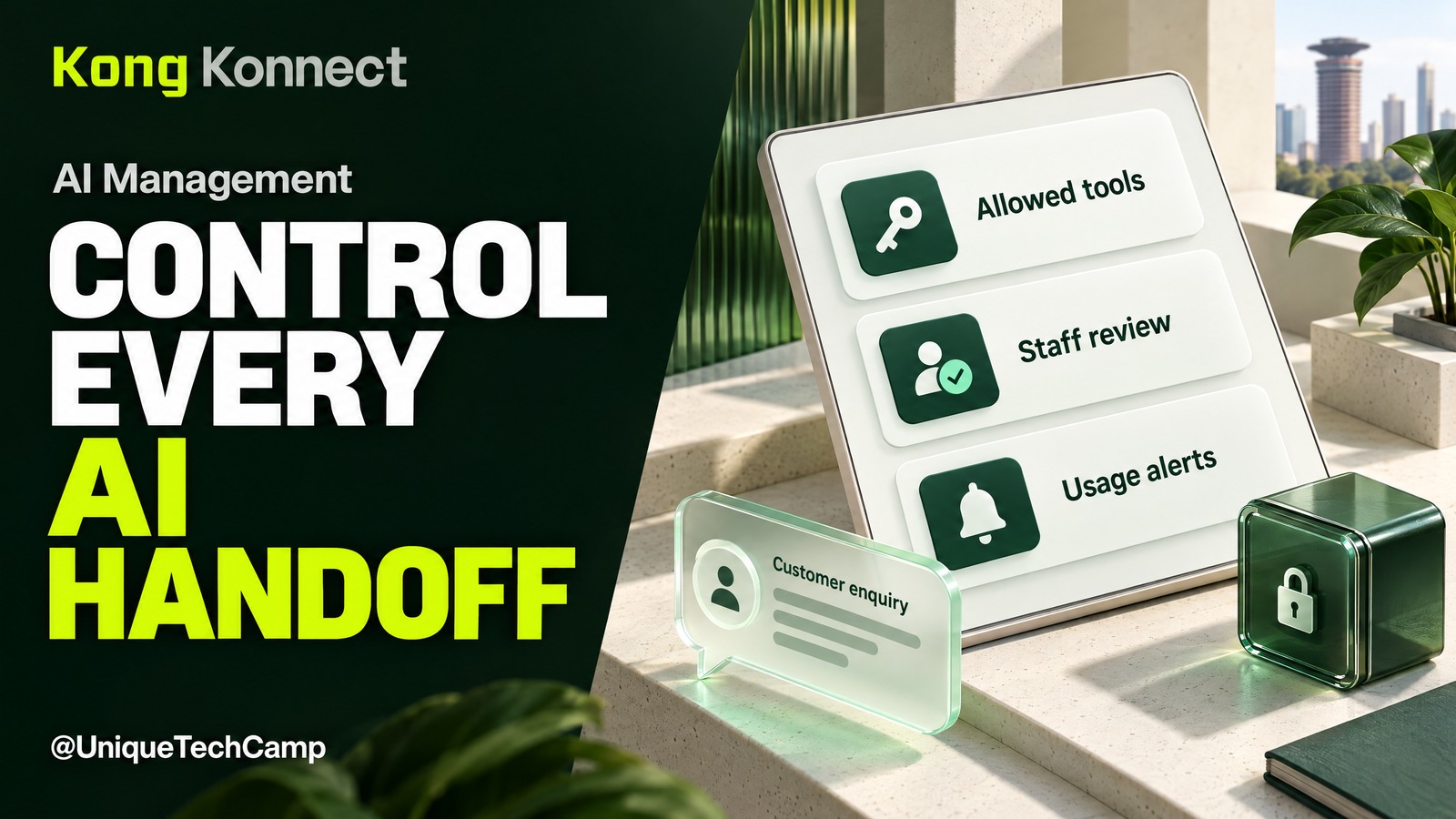
A helpful bot can still become an expensive business risk. It may call the wrong tool, expose a customer record, retry until a provider bill grows, or leave a promising enquiry without an owner. For a Kenyan property manager, equipment installer or field-service company, the important question is not simply whether an AI assistant sounds clever. It is whether one carefully chosen lead workflow can be commissioned with clear boundaries, visible costs and a reliable hand-off to staff.
Kong AI Management ↗ was featured in an official expansion announcement dated 4 November 2026. Its promise is a control layer for AI models, agents, tools and data paths, rather than a ready-made sales chatbot. The official expansion announcement ↗ makes this distinction important for an East African small or growing business. Kong may help govern an existing, configured flow through Kong AI Gateway and Konnect; it does not automatically take control of every application in your organisation.
The practical commissioning target
Start with one governed workflow: a property or field-service enquiry arrives, the system retrieves approved information, and a staff-reviewed hand-off is created in the CRM. The AI may identify the service area, ask permitted qualifying questions, check an approved availability or service catalogue, and prepare a concise summary. A named employee then reviews the summary, corrects it where necessary and decides whether to contact the prospect, create or update the CRM record, or send a final quote.
This narrow target makes acceptance testable. You can ask: did the workflow use only the approved tools? Did it collect only the necessary details? Did a human review happen before a consequential CRM change or quote? Did a failure create an owned follow-up rather than silently disappearing? A good implementation should answer those questions with logs and evidence, not assurances in a sales presentation.
What the words mean in ordinary business language
An LLM is the language model that interprets a message and produces text. It can draft a response or extract fields from an enquiry, but it should not be treated as a database of your current prices or as an authorised employee. An API is a defined doorway between software systems. A CRM API, for example, may let an approved service create a lead or read a limited set of fields.
MCP is a standard way for an AI application to discover and use tools or sources supplied by another service. Think of it as a structured menu of capabilities, not a blanket permission slip. An A2A connection lets one AI agent communicate with another agent. Each additional agent is another identity, instruction path and failure surface to govern.
Kong’s AI Gateway documentation covers LLM, MCP and A2A traffic. In practice, the gateway is a controlled checkpoint through which configured requests can pass. It can apply authentication, policies, transformations, logging and rate limits. The AI Gateway product information ↗ also discusses governed context from APIs and event data. That describes platform scope, not a plug-and-play integration for every Kenyan system.
For an owner, “governed” should mean something concrete: the workflow has a named owner; its permitted model, agent, MCP server and API tools are listed; its identity is traceable; its credentials are not pasted into prompts or agent code; and its staff hand-off is implemented outside a mere catalogue entry.
Use the registry as a catalogue, not as approval theatre
AI Registry ↗ is intended to provide an inventory of models, agents, MCP servers, tools, resources and skills. An entry can carry ownership, version, risk, authentication, policy and approval-status metadata. Teams or partners can be shown the capabilities intended for them. That is valuable when an engineer needs to prove which tool a lead workflow was allowed to call.
However, an approval-status field is metadata. It is not automatically a human business-approval engine. If your rule is “a staff member must review every proposed CRM update” or “no final quote may be sent without an authorised person”, the engineer must build that step into the workflow and test it. The registry cannot, by itself, establish that the right employee saw the right enquiry.
Ask for evidence showing the workflow owner, version, risk notes, approved model, allowed tools and intended audience. Require an explicit transition from AI draft to staff queue, where the reviewer sees the source enquiry, approved information, uncertainty and proposed action before accepting, editing or rejecting it.
Identity, tools and credential boundaries
Give the workflow a named technical identity and business owner. Kong’s identity and credential controls ↗ map credentials to a persistent Principal with associated activity, teams and metadata. That helps identify who or what initiated a request; it does not define who may approve a hand-off.
Use least privilege. The enquiry workflow might be allowed to read a public service catalogue, check a restricted availability endpoint and create a draft task. It should not be allowed to delete CRM records, export the whole customer database, change price lists or send an irreversible message unless those actions are separately justified and protected. AI Consumer Groups and policy controls can help scope access to models, agents and MCP servers, subject to the exact configuration your team implements.
Token Vault is designed to keep downstream OAuth, API-key or service-account credentials centrally brokered rather than embedded in agent code. That is a healthier boundary: the model receives a constrained operation, while the gateway or connected service handles the secret. Still, ask an engineer to document the complete data flow. A credential hidden from the model is not the same as customer data hidden from every provider, log, support process or downstream system.
For each tool, record its purpose, inputs, outputs, permitted fields, failure response and owner. Block broad “search everything” functions where a narrow availability lookup will do. Require redacted logs for tokens and sensitive fields, plus an expiry, rotation and revocation procedure.
Approved information and the staff hand-off
Define the source of truth before writing prompts. Approved information could include a dated service list, coverage areas, opening times and reviewed questions. It should not include an unverified availability guess, made-up discount or confident promise about a legal, financial or medical matter. This workflow is for operational enquiry handling, not medical advice.
When a prospect writes in, the AI should classify the enquiry, extract only necessary details and retrieve approved content. It can prepare a response draft and a CRM hand-off containing the customer’s request, contact preference, location at the level needed for service, source, confidence or missing information, and recommended next action. A staff reviewer should then accept or amend the record.
Make the hand-off owned. Assign a queue, person or team, deadline and status. If CRM creation fails, the system should preserve a safe task for follow-up without duplicating the lead on every retry. If the approved information is missing, it should ask for staff help or tell the prospect that a person will confirm, rather than inventing an answer.
A practical implementation partner such as UniqueTechCamp ↗ can help translate these rules into an owned workflow, but the business must still decide what it is willing to authorise. Good automation makes a decision boundary visible; it does not outsource accountability.
Cost alerts are not the same as hard stops
Kong describes AI Cost Management in terms of attribution, budgets, alerts, forecasting, runtime controls and showback or chargeback. Use those capabilities to see spend by workflow, team, application or agent, while separately confirming what is included in your chosen plan and what your model provider charges. Provider fees remain an external cost input.
The public pricing page ↗ lists AI Management Plus from USD 25 per month plus usage; Enterprise pricing is custom. Confirm the entitlements, usage dimensions, topology, payment route and support terms for your business before treating either description as a quotation. The pilot budget must also allow for engineering, hosting, monitoring and staff review. Do not assume Kenya-specific access, Kenyan shilling billing, a Kenyan data-residency region or local support simply because the service is documented online.
Model cost can depend on input and output tokens, cache activity, context thresholds and service tiers. Ask for a plan covering requests, prompt tokens, completion tokens, calculated cost and cost per reviewed enquiry. Do not confuse provider model charges with gateway metering.
Most importantly, distinguish an alert from a block. An alert tells an owner that usage has crossed a chosen level. A budget configured for observing and email notification can allow requests to continue. A rate-limit policy may block later traffic, but Kong’s documented cost limitation says cost is reflected during the next request, so the request that crosses a threshold may complete before a subsequent request is refused. Checking a budget is therefore not a universal, immediate, guaranteed hard cap.
Write the expected behaviour in plain language: who receives an alert, which request types may be stopped, what happens to a valid enquiry during a stop, and who can authorise a temporary change. Test an expensive retry and a provider error, not just the happy path. A safe failure may queue the enquiry for a person, use a deliberately limited fallback, or tell the prospect that confirmation will follow.
For the specific caveat, read the AI Rate Limiting Advanced documentation ↗. It describes token and cost strategies, but your implementation still needs an operational test that demonstrates what happens before, at and after a threshold.
Observability, availability and data protection
Basic dashboards, logs and explorers can support acceptance if they trace a request, tool call, identity, outcome and cost without exposing unnecessary personal data. Do not promise advanced session-and-turn tracing for a 4 November 2026 launch. Kong’s dated release says Advanced AI Observability is coming in late November or early December, so treat it as unavailable until confirmed in writing.
Agree what is logged, who may view it, how long it is retained, how personal data is redacted and how a reviewer investigates an incident. Minimise names, phone numbers, exact addresses and free-text content. Keep the smallest useful record for the business purpose. A log that contains a full conversation and a copied credential is not automatically a sign of better governance.
Kong’s public privacy policy ↗ explicitly excludes data submitted to Kong-hosted cloud services, telemetry and support services. Use the Konnect Customer Agreement or other written terms, a data-processing agreement where relevant, the Trust Center materials and the current subprocessor list ↗. Ask for a written map of control plane, data plane, identity, telemetry, provider pass-through and retention. The subprocessor information notes US-hosted Konnect identity and authentication; do not assume an African or Kenyan region.
Review the Kenya implications with the appropriate adviser and consult the Office of the Data Protection Commissioner resource ↗. This article is not legal advice. Your assessment should cover lawful handling, notices, access controls, cross-border transfers, processor terms, retention and incident response. It should also cover the app and model provider, because a centrally brokered credential does not make the overall data flow private by magic.
Acceptance tests for an owner
Before launch, require a test report with evidence, an owner and a pass or fail result for each case:
- Allowed-tool test: the workflow can call the approved catalogue and availability service, but a deliberately unapproved tool is refused and recorded.
- Identity test: every request maps to the named workflow Principal, while staff approval maps to the actual reviewer.
- Credential test: prompts, model output and ordinary logs do not reveal downstream secrets; revocation prevents further use.
- Information test: the assistant answers from approved material, flags missing information and does not invent a price, coverage promise or availability.
- Human-review test: no CRM update, final quote or consequential outbound message occurs until an authorised reviewer accepts it.
- Privacy test: unnecessary personal fields are rejected or redacted, and the retention and deletion process is demonstrated.
- Cost-alert test: the owner receives an alert at the configured level, with the measured unit and next action clearly shown.
- Stop test: the team demonstrates what is blocked, what may still be queued and how a valid enquiry is recovered after a limit.
- Retry test: timeouts and duplicate callbacks do not create duplicate leads or uncontrolled loops.
- Failure and escalation test: a provider outage, bad tool response and ambiguous enquiry each create a visible human task with an owner.
Run these tests with realistic, sanitised examples from your business. Capture the baseline before automation: accepted staff hand-offs, retry count, cost per reviewed enquiry, valid work blocked, and completed follow-ups. After launch, compare the same measures. Add response time and correction rate if they matter to your service promise. These are operating measures, not a promise of more customers or guaranteed income.
Frequently asked questions
Is Kong AI Management a ready-made chatbot for Kenyan SMEs?
No. It is a governance and traffic-management proposition for configured AI interactions. You still need to build or connect the enquiry workflow, approved information source, CRM hand-off, human review, identities, policies and failure handling. Kong does not establish a Kenya-specific WhatsApp, M-Pesa or CRM integration simply because it supports relevant protocols.
Does an approved registry entry mean a human has approved a CRM change?
No. Registry approval status is metadata about a capability. Your engineer must implement the staff review and authorisation step before changing a CRM record or sending a final quote. Test that the system cannot bypass that step during retries, tool errors or a prompt that asks it to act urgently.
Will a budget guarantee that spending stops immediately?
No. An alerting budget may allow requests to continue, and a documented cost limit can be reflected on the next request. The request that crosses a threshold may complete. Confirm the policy behaviour, model-provider billing and recovery process, then test them with a controlled failure rather than relying on a dashboard label.
Can I assume my lead data stays in Kenya?
No. The available evidence does not establish a Kenyan region, local support, local legal entity or Kenyan data residency. Obtain a written control-plane, data-plane, identity, telemetry, subprocessor and provider data-flow answer, then complete your privacy and cross-border assessment with appropriate professional advice.
Conclusion
Kong AI Management is worth considering when your business needs control over one real AI lead workflow rather than another generic promise about automation. Commission it as a bounded system: approved information in, limited tools through named identities, centrally brokered credentials, visible cost behaviour, careful logs and a staff-reviewed CRM hand-off. Keep the business owner responsible for the approval rule, the engineer responsible for implementation evidence and the reviewer responsible for the final customer-facing action.
Need this built for your business?
Business owners can speak with the UniqueTechCamp AI Solutions Desk ↗, book an appointment ↗, or review workflow automation services ↗ to scope a governed enquiry flow with practical acceptance tests, clear ownership and a human review point.
Deploy An Autonomous AI Lead Gen System Today
We engineer high-converting web applications with integrated 24/7 WhatsApp qualification bots and multi-channel follow-up drips.
Related Strategy Articles

CrowdStrike AI Kill Switch: SME Team Reviewing an Agent Safety Dashboard
A practical SME playbook for reviewing CrowdStrike’s AI Kill Switch, testing agent containment safely, measuring trade-offs and checking Kenya eligibility.

Microsoft Agent 365 Business Analytics: An SME Readiness and Value-Validation Guide
Microsoft Agent 365 Business Analytics is in Frontier preview. Here is how Kenyan and East African SMEs can validate access, usage cost, value, privacy and readiness before buying licences for a dashboard.
Canva AI Controls: SME Design Review and Human Approval on a Laptop
A practical Canva AI Controls workflow for Kenyan and global SMEs: control settings, human review, asset provenance, measurements, costs and limitations.

UniqueTechCamp Desk
Online • Reply < 5 mins