
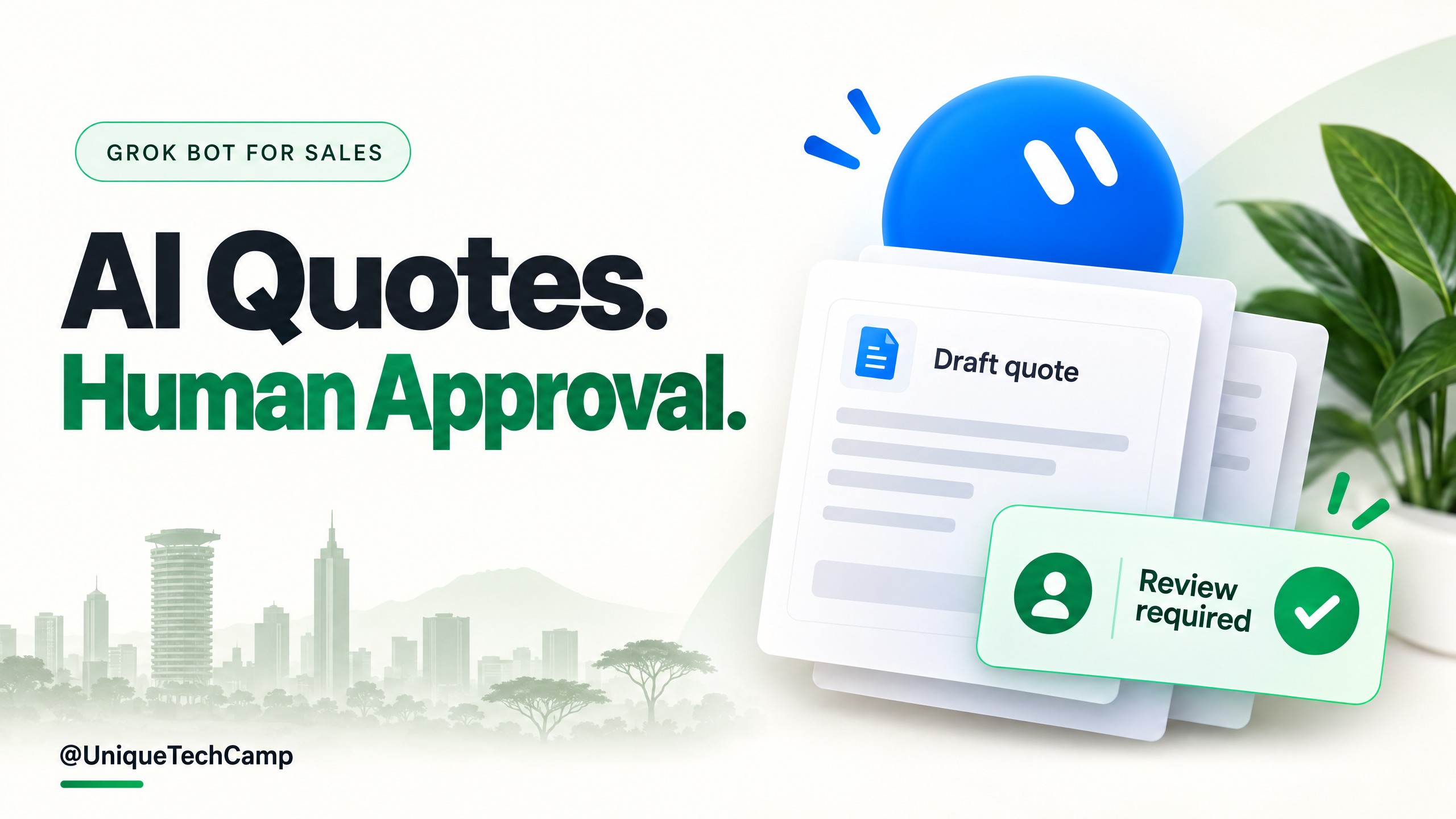
A sales call ends well. The customer wants a proposal. Then the work spreads across a notebook, an old price list, a spreadsheet, a CRM and an email draft. Someone must confirm the products, check the discount, prepare the quote and remember the follow-up. An AI assistant that writes a convincing paragraph does not automatically solve those handoffs.
On 27 October 2026, xAI’s website published a new Grok Bot sales-workflow account ↗ describing how the SpaceXSI Sales team uses Shared Bots for account intelligence, quoting and deal review. The most useful lesson for a Kenyan business owner is not “replace the sales team”. It is to give each automated role a clear source of truth, limited authority and a named human decision-maker.
This is a vendor’s description of its own operation, not an independently verified sales result. It contains no evidence that the same setup will improve your conversion rate. It does, however, provide a timely pattern worth testing on one controlled workflow.
What the 27 October update actually shows
Grok Bot itself is not new today. The original product launch was on 11 August 2026 ↗. The new sales article explains how one organisation has built specialised Shared Bots around existing jobs, shared business knowledge and permissions.
Its Account Intel Bot researches accounts, prepares meeting briefings and helps update Salesforce after customer calls. It can read a Gong transcript, identify updates and draft a follow-up for the representative to review. Quote Bot prepares pricing options through Salesforce and CPQ tools, routes approvals and can prepare an Ironclad order form. Deal Bot supports the Deal Desk with non-standard pricing or contract terms and recommendations requiring specialist judgement.
Those are the company’s own systems and custom roles. They are not proof that every customer receives those exact Bots, integrations or permissions in a subscription. A Kenyan SME should verify its required tools and team features before purchase, rather than treating the published example as a ready-made installation.
The operating boundaries matter more than the names. The article says Quote Bot previews Salesforce changes and requests confirmation. A representative cannot use it to approve their own discount. Human review remains necessary for customer-facing communications and decisions whose criteria are not clearly defined. That is a better starting point than an unrestricted “sales agent”.
Copy the structure, not an enterprise software stack
A small distributor, consultancy or equipment installer probably does not need three Bots and several enterprise platforms to begin. Start with the handoff that repeatedly delays a real customer: turning an approved enquiry into a checked proposal, for example. If the catalogue is outdated or nobody knows who may authorise a discount, automation will expose the confusion faster, not repair it.
Choose one owner for the pilot and one responsible approver. Write down what the assistant may read, what it may draft, which records it may change and what it must never send or approve. Give the role a measurable job: “prepare an internal quote draft from these approved inputs” is clearer than “increase sales”.
Use the CRM or controlled spreadsheet you already maintain as the record of truth. Do not introduce a second, unofficial price list inside a chat. Product codes, customer identity, quote versions and approval status must remain traceable outside the assistant’s conversation.
A practical quote pilot for a Nairobi supplier
1. Start with a complete enquiry
For an illustrative pilot, imagine a supplier receiving a request for equipment and installation. Capture the customer’s organisation, contact, required products, quantity, delivery location, deadline and unresolved questions in a structured record. Mark missing information explicitly. The assistant should ask for clarification or flag a gap, not invent an address, product specification or delivery commitment.
Keep initial tests separate from live sales. Use invented customer records or appropriately redacted past examples, including an ordinary enquiry, an ambiguous product request and a repeat customer with different delivery requirements. A successful demonstration on one clean example is not sufficient evidence for unattended work.
2. Ground the draft in approved commercial inputs
The quote role needs a current catalogue, an approved price source, delivery rules, warranty wording and an explicit discount policy. Calculate totals through your established quoting system or validated formulas. Do not make free-form text generation the authority for arithmetic, tax treatment, stock availability or credit terms.
Each draft should identify the source version and show assumptions separately from confirmed facts. If the requested item is absent, stock has not been checked or a price has expired, the output should stop at an exception for the owner. An attractive proposal with an unsupported commitment is still a bad quote.
3. Separate preparation from commercial approval
Begin in draft-only mode. Let the assistant assemble an internal proposal, a list of changes and a suggested follow-up. A salesperson checks customer identity, specifications and tone. The person authorised to approve pricing checks discounts, payment terms and exceptions. Only then should the approved document enter the customer-facing channel.
Make approval specific to a version. If someone changes a quantity, discount or contract term after approval, that approval should not silently carry over. Record who approved, what they approved and when. This reflects the useful separation in the published Quote Bot and Deal Bot example without assuming the two named Bots themselves create a security boundary.
4. Add narrowly scoped system updates
Once draft quality is reliable, test one reversible update, such as adding a reviewed note to a pilot opportunity. Show a before-and-after preview and confirm the exact target record. Check for duplicate activity before writing again after a timeout. An uncertain response is not permission to repeat a change.
At this stage, UniqueTechCamp’s AI Solutions Desk ↗ can help business owners map the handoffs, data access and approval rules before commissioning an integration. The useful specification is a small, testable workflow, not simply a request for “an AI salesperson”.
5. Keep the customer handoff human
The salesperson should review the final attachment, recipient, message and next step before sending. Keep contract acceptance, non-standard terms, payment instructions, refunds and changes to bank details outside the pilot’s autonomous authority. A customer’s request in an email is information to evaluate, not a new permission to bypass your approval rules.
Give the team a fallback: prepare the quote manually, record the interruption and resume only after checking the CRM and document versions. If an app layout changes or a session expires, the assistant should stop rather than improvise around a login or commercial control.
Named Bots are not separate security compartments
The current Grok Bot product page and FAQ ↗ say a user’s Bots share one persistent cloud computer, including files, browser and logins; isolation is per user rather than per Bot. A new Bot name therefore does not automatically create an independent environment for confidential accounts.
The same page describes encryption, training opt-out, Auto Review for sensitive actions and enterprise controls. Those are vendor-described capabilities, not a substitute for checking your actual plan and configuration. Ask which actions pause for approval, who can change that policy, how credentials are revoked and how a mistaken action is investigated. Do not assume a review setting is enabled everywhere by default.
Use the least access needed for the task. Separate research from privileged changes, restrict the records used in the pilot and avoid broad administrator accounts. Test an unauthorised discount request, a wrong recipient, a duplicate record and an outdated catalogue. Your pass condition should be a safe stop or escalation, not a plausible-sounding explanation.
Costs: distinguish an individual plan from a business deployment
The product page currently displays individual Premium at $30 per month, Super at $100 per month and Ultra at $200 per month, billed monthly. These are the page’s displayed individual-plan prices, not a quotation for your team. Confirm billing currency, taxes, regional access and the exact features before committing.
The page says subscriptions include weekly usage and that additional usage is billed based on token cost. It lists Teams and Enterprise availability, but does not publish a complete business-deployment price on that page. Ask for the applicable usage allowance, overage controls, team rights and support terms in writing. Do not assume an individual subscription reproduces the internal Shared Bot setup.
Your total cost also includes existing CRM or quoting-tool licences, integration work, data preparation, testing and human review. The article’s Salesforce, Gong, CPQ and Ironclad example is not a claim that those products are bundled. If a simpler CRM rule or template solves the bottleneck, it may be the better purchase.
Set an operational spending ceiling and inspect usage during the pilot. Compare the full cost with verified time saved and reduced rework, not with an assumed increase in revenue. There is no published guaranteed return for your business.
Protect customer information and resist outside instructions
Sales records can contain personal information, private negotiations and commercially sensitive terms. Kenya’s Data Protection Act ↗ sets requirements around lawful, fair and transparent processing, specified purposes, minimisation and retention. The ODPC regulatory framework ↗ provides the Act and related regulations. This is an operational checklist, not legal advice.
Before using live customer data, establish the lawful purpose, appropriate notice, access restrictions, retention and deletion process, applicable processor terms and safeguards for any cross-border processing. Obtain qualified advice where necessary. An encrypted cloud computer alone does not answer those questions. Begin with the minimum fields needed, rather than an entire customer database or inbox.
Browser-based agents also encounter untrusted material. OWASP’s prompt-injection guidance ↗ explains how instructions embedded in websites or files can influence a model, and recommends least privilege and human approval for high-risk actions. Treat customer documents, web pages and emails as evidence to read, not instructions that can rewrite your business rules.
No single prompt makes that risk disappear. Combine bounded permissions, validated outputs, human checkpoints and tests that deliberately include hostile or misleading content. Stop the pilot if it exposes confidential data, changes unauthorised records or bypasses approval.
Decide with a small sales-operations scorecard
Record the current process before introducing the assistant. Measure enquiry-to-draft time, human correction time, quote errors, approval turnaround and missed follow-ups. Track whether a quote eventually becomes won work, but do not attribute a change in sales to AI without considering demand, pricing and the quality of enquiries.
For the pilot, review every draft and write. Keep examples of mistakes and the rule or source that would have prevented each one. Include the reviewer’s effort in the comparison: a faster draft that requires extensive checking may save nothing.
Expand only when the workflow meets your agreed accuracy, access and escalation criteria. Keep a named owner for maintaining the price source and approval policy. Shared expertise is useful only while someone is responsible for keeping it current.
Frequently asked questions
Is Grok Bot a new product launched on 27 October?
No. Its original launch was in August. The 27 October article is a new first-party account of specialised Shared Bots in the company’s sales process. It should not be confused with a new Grok model or independent evidence of sales performance.
Can a Kenyan SME buy the exact Quote Bot shown?
The published story describes an internal setup, not a universal ready-made package. Check current regional access, business-plan features, supported tools and implementation requirements with the vendor. Do not assume your subscription includes the same integrations or custom commercial rules.
Should an AI Bot send quotes or approve discounts?
Not in an initial pilot. Keep customer-facing messages, pricing exceptions and contract decisions under explicit human authority. The company’s own example separates a representative’s permissions from Deal Desk approval and requires confirmation before Quote Bot changes Salesforce.
How will I know whether the pilot is worthwhile?
Compare total subscription, usage, implementation and review costs with measured preparation time, correction rates and handoff reliability. Track actual sales outcomes separately. Continue only if the controlled workflow is safer or more useful than your existing process; revenue growth is not guaranteed.
Conclusion: automate preparation before authority
The useful idea in the new Grok Bot sales account is a division of responsibility: shared knowledge, specialised preparation and explicit escalation. For a Kenyan SME, the sensible first step is one approved quote workflow with an accountable owner—not a collection of Bots with unrestricted access. Earn the right to automate more by proving the narrow task works.
Need this built for your business?
Business owners can bring one sample enquiry, an approved price source and their approval rules to the UniqueTechCamp AI Solutions Desk ↗. Explore the Workflow Automation service ↗, or book a consultation ↗ to scope a human-reviewed CRM and proposal handoff around your actual tools.



UniqueTechCamp Desk
Online • Reply < 5 mins