
GPT-6.1 Terra: A Safe Invoice-Entry Pilot for Kenyan SMEs
Explore a controlled GPT-6.1 Terra invoice-entry pilot for Kenyan SMEs, with sandbox review, field checks, privacy controls and human approval.
UniqueTechCamp Editorial
Business Workflow Editorial • UniqueTechCamp Engineering Unit
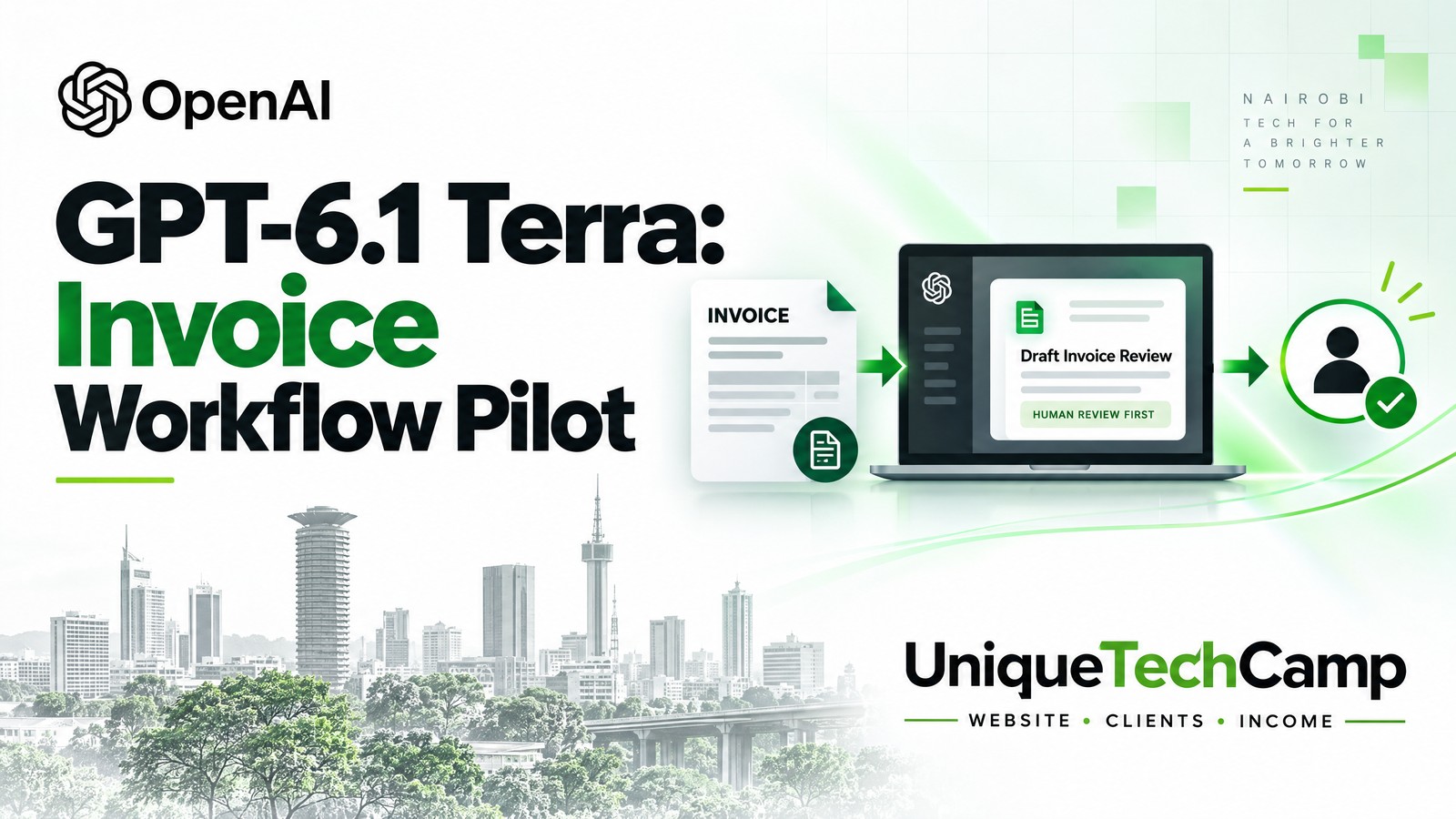
GPT-6.1 Terra arrived on 26 October 2026 with a practical promise: combine detailed visual reasoning with computer use, so a model can understand what is on screen and take a bounded action. OpenAI’s launch example includes reading incoming invoices and entering their details into accounting software. That is interesting for a Kenyan small or medium-sized enterprise, but it is not a reason to hand an AI unrestricted access to finance systems.
A safer starting point is narrower: use an invoice image as input, map visible fields into a draft record in a sandbox, and place that draft in a human review queue. The proposed workflow below deliberately stops before payment, ledger posting, supplier-master writes or tax decisions. It is a design for a controlled pilot, not a tested integration or a claim that Terra will deliver a particular accuracy, saving or processing-time outcome in Kenya.
The distinction matters. A scanned invoice may contain a supplier name, invoice number, issue date, due date, currency, line items, totals, bank details and personal data. A model can misread a blurred digit, mistake a delivery note for an invoice, follow an instruction printed inside the document, or save into the wrong screen. Computer use makes the last error operationally important. The right question is therefore not “Can it click?” but “What may it click, what must it prove, and where does a person take over?”
What GPT-6.1 Terra changes—and what it does not
OpenAI describes GPT-6.1 Terra as a fast model for visual reasoning and computer use, available through the API as gpt-6.1-terra. The official Terra announcement gives the launch context, while the ChatGPT release notes explain that its Work and Codex roll-out depends on plan, region and workspace settings; the 26 October release note does not mean every account has the same access. The model’s advertised capabilities and vendor evaluations are useful context, not evidence of performance on a Kenyan company’s invoices, accounting software or approval policy.
The official API pricing page lists US$1 per million input tokens, US$0.05 per million cached input tokens and US$5 per million output tokens for the standard GPT-6.1 Terra rates. Eligible regional-processing endpoints add a 10% uplift. Those are model-token prices, not a complete project budget: image handling, browser or computer-use tooling, storage, identity, monitoring, implementation and the destination system may add costs. For an illustration, assume 2,000 input tokens and 500 output tokens per invoice, with no caching or uplift. Under those assumptions, the model-token charge would be US$0.0045 per invoice. It says nothing about accuracy or total cost of ownership.
OpenAI’s Terra safety materials discuss safeguards and evaluations, including prompt-injection and workplace-action scenarios. They should encourage a layered design rather than replace one. An invoice is an untrusted document, the model is fallible, and a review queue is a control point. The proposal here keeps the model’s authority small and makes its uncertainty visible.
The proposed screen-to-draft pattern
Think in a loop: screen, action, reobserve. First, the agent observes the invoice image and the permitted sandbox screen. Next, it performs one small action, such as opening a draft form or entering a value. Then it observes the screen again to confirm that the intended state changed. It should not chain a long sequence of clicks based on an assumption that the interface stayed put.
A pilot should use a dedicated test tenant or sandbox with synthetic suppliers and non-production records. The agent can create a draft, attach the source image, and produce a field-level evidence view. It should not post a transaction, release funds, edit a supplier master, decide tax treatment, send an external message or change a permission. A named finance approver reviews the draft against the image and approves or rejects it outside the agent’s authority.
This is the useful boundary between image-to-field entry and autonomous finance operation. It preserves a human decision while still testing whether visual extraction and repetitive screen entry are worth developing further.
Seven-step invoice-entry workflow
1. Receive and quarantine the invoice image
Start with a defined intake route: for example, a staff member places a file in a restricted pilot folder or uploads it through a small internal form. Record a receipt identifier, timestamp, uploader and file hash where practical. Do not let an untrusted email attachment become an instruction to the agent. The source image should be read-only during processing, and the pilot should define accepted formats, maximum size and a retention period.
Before opening it, classify whether the document appears to be an invoice, credit note, quotation, delivery note or something else. If the classification is uncertain, route it to a person. This prevents a workflow designed for invoice fields from quietly treating another document as a payable obligation. Keep the original available for comparison, but restrict access to the staff who need it.
2. Inspect the screen and set the allowed task
The agent should enter a known sandbox page, confirm the expected tenant and see a clear task instruction: create a draft invoice record from the attached image, populate only approved fields, save as draft, and stop. The instruction should state what is forbidden: no posting, payment, supplier creation or update, tax selection, external communication, deletion or navigation outside the approved screens.
A run should have a unique job ID and a maximum action budget. If the expected page, tenant name, user identity or draft form is missing, the agent must stop rather than search broadly. Screen coordinates are not enough; the agent should use visible labels and re-check the page after navigation. The operator should be able to terminate the session and see its action log.
3. Extract fields with evidence and confidence
Use a field map agreed before the pilot. It might include supplier name as displayed, invoice number, invoice date, due date, currency, subtotal, visible tax amount, total, purchase reference if present and line descriptions. It should also define fields that are deliberately not extracted or acted upon, such as bank-account changes, tax classification and payment instructions.
For each proposed value, preserve the source location or a cropped evidence image, the exact displayed text and a confidence or review flag. “KSh”, “KES” and a handwritten currency mark should not be silently normalised without a rule. Dates such as 03/04/2026 need a locale policy or human confirmation. If a field is absent, the draft should say “not found”, not invent a value. If two totals conflict, retain both observations and stop for review.
4. Map values into a sandbox draft
Mapping is a business decision, not merely a model prompt. Define how the invoice number maps to the draft’s reference field, how line descriptions are represented, and what happens when a field exceeds the destination’s length. Keep the original value alongside any normalised value. Do not use an AI guess to populate a supplier ID, account code, tax rate or payment term that was not explicitly confirmed by an authorised rule.
The safest first version may use a simple approved field list and a staging table, then display the proposed values for a reviewer. If a destination form has autocomplete, the agent should select only an exact, pre-approved match and flag near matches. A similarly named supplier is not good enough. The workflow should never create or edit supplier-master data as a side effect of invoice entry.
For teams designing these handoffs, UniqueTechCamp offers a route to discuss the field map, staging form and reviewer responsibilities before connecting live finance tools. This proposed Terra workflow has not been connected or tested here.
5. Protect against duplicates and prompt injection
Before saving, compare a stable invoice identifier made from defined attributes, such as supplier reference plus invoice number, with existing sandbox drafts. If the same identifier is already present, do not create another record; route it to a duplicate-review queue. The stable invoice ID should be transparent and reproducible, not a hidden model judgement. Where the same supplier legitimately reuses numbers across periods, the business rule must include the necessary context and a human exception path.
Treat all text inside the invoice as data, not authority. A PDF or image might contain “ignore previous instructions”, a request to change bank details or a fake approval note. The agent should not follow those instructions. Separate system policy, operator instructions and document content; visually mark document-derived text in the review screen. Prompt-injection resistance reported in vendor safety material is not a guarantee, so the destination permissions and stop rules must assume that malicious content can be encountered.
6. Save once, reobserve, then stop on ambiguity
When the fields are ready, the agent may press the sandbox’s save-as-draft control once. It must reobserve the resulting page and verify that the status is Draft, the expected record identifier appears and the source image is attached. If the button is disabled, the page changes unexpectedly, a warning appears, a login prompt is shown or the confirmation is unclear, stop and hand the job to the named approver. Do not retry blindly or click a neighbouring button.
This is the most important operational rule: ambiguity after a save is a stop condition. The system should capture the last screenshot, action, timestamp and visible message. A human can determine whether a draft exists. The agent must not attempt a second save, post, submit, approve or pay merely to make the screen look complete.
7. Run readback checks and human approval
The review queue should show the source image next to the draft and make discrepancies easy to inspect. Check supplier display name, stable invoice ID, invoice date, due date, currency, subtotal, visible tax amount, total and line-item arithmetic where applicable. A date or currency check is a validation prompt, not permission to decide a tax treatment. If the image is unclear or the totals do not reconcile, the reviewer chooses the next step.
Assign a named approver, not an anonymous “finance team”. The approver confirms whether the draft is acceptable under the organisation’s policy and records approve, reject or return-for-correction with a reason. Approval should occur through the normal control, outside the model’s action scope. The pilot should measure exceptions and review effort, but it should not be declared successful merely because records were created.
Kenyan privacy and operating controls
Invoice files can include names, addresses, telephone numbers, bank details and signatures. Kenya’s Office of the Data Protection Commissioner publishes the Data Protection Act, 2019 and related regulations , including obligations for data controllers and processors. A business considering this pilot should document its purpose, lawful basis, access roles, processor arrangements, retention, deletion, security measures and data-subject handling with appropriate professional advice. The ODPC framework is a source to consult, not a substitute for a tailored compliance assessment.
Minimise what reaches the model. Redact unrelated personal data where the process allows it, restrict screenshots, encrypt storage and avoid putting invoice images into a general-purpose shared folder. Keep an audit trail showing who supplied the document, what the model proposed, what changed, who approved it and when the record was retained or deleted. Test access revocation and incident response before using real documents.
For a Kenyan SME, also document data-residency expectations rather than assuming that a Kenyan office means Kenyan processing. OpenAI’s pricing documentation notes a regional-processing uplift for eligible endpoints, while the release notes include plan and region caveats. Ask the implementation team and provider for the current supported configuration, retention terms and contractual roles. Do not promise local residency until it is verified for the exact service and account.
What to test in a small pilot
A sensible pilot uses a labelled sample approved by the business: clear scans, photographs, multiple currencies if relevant, low contrast, rotated pages, handwritten marks, credit notes, duplicates, missing fields, conflicting totals and suspicious embedded instructions. The purpose is to discover where the workflow stops and how much review it needs, not to manufacture a benchmark.
Define acceptance criteria before running it. For example, every draft must retain its source, expose field evidence, avoid duplicate creation, stop on ambiguity and remain unable to post or alter supplier data. Record false extractions, missing values, duplicate flags, unsafe action attempts, reviewer corrections and time spent. Segment results by document type and quality. Do not report an unsupported percentage or claim that the pilot will reduce costs, accelerate payment or improve cash flow.
The review should include the finance owner, a privacy or security owner and the person responsible for the destination system. If the sandbox behaves differently from production, say so. Only after the controls pass should the business decide whether to test a more realistic environment, with a separately approved scope. UniqueTechCamp’s workflow-automation service can be a contextual route for scoping that design conversation, but no integration should be assumed from this article.
Frequently asked questions
Is GPT-6.1 Terra an accounting system?
No. It is a model that can interpret images and use computer interfaces when supplied with the relevant tools and permissions. An accounting system remains the system of record. This proposal limits Terra to a sandbox draft and review queue; it does not make the model an accountant or an approval authority.
Can it decide VAT or another tax treatment?
It should not decide tax treatment in this workflow. A visible tax amount may be copied as an observed field for review, but classification, rate selection and exceptions require an approved business rule and an authorised person. The pilot should stop when the invoice is ambiguous.
Why use a stable invoice ID?
A stable identifier gives the duplicate check a repeatable basis. It can combine approved invoice attributes and context, while preserving the original values. It is not a guarantee that every duplicate will be found, so the reviewer still needs a queue for possible matches and legitimate exceptions.
What happens when the screen does not match the plan?
Stop. Capture the visible state and route the job to the named approver or operator. Screen-to-action-to-reobserve means every action is confirmed by a fresh observation; it does not mean the agent should improvise around warnings, login prompts or an unclear save result.
Is the illustrated token cost the total price?
No. The US$0.0045 per invoice illustration assumes 2,000 input tokens and 500 output tokens at standard rates, with no caching or regional uplift. It excludes tooling, infrastructure, security, implementation, review time and destination-system costs. Real usage must be measured from the proposed design.
Conclusion
GPT-6.1 Terra makes an invoice image-to-field-entry idea easier to discuss because it combines visual understanding with computer use. The responsible opportunity is not unattended purchasing or automatic finance decisions. It is a deliberately narrow experiment: quarantine the image, extract with evidence, map only approved fields, protect against duplicates and document prompt injection, save a sandbox draft, reobserve the result and stop whenever the state is unclear.
That boundary gives a Kenyan SME something useful to evaluate without pretending that a vendor announcement is a local integration result. If the review queue cannot explain every proposed value, preserve the source and keep a person accountable, the pilot is not ready to expand. If it can, the next decision should still be based on measured exceptions, privacy review, permissions and total operating cost.
Need this built for your business?
If you want to turn this proposed workflow into a properly scoped discovery exercise, start with the UniqueTechCamp’s AI Solutions Desk , request an appointment , or review workflow automation services . Those routes are for discussing requirements and controls; they are not evidence that GPT-6.1 Terra has been integrated or tested for your organisation.
Deploy An Autonomous AI Lead Gen System Today
We engineer high-converting web applications with integrated 24/7 WhatsApp qualification bots and multi-channel follow-up drips.
Related Strategy Articles

CrowdStrike AI Kill Switch: SME Team Reviewing an Agent Safety Dashboard
A practical SME playbook for reviewing CrowdStrike’s AI Kill Switch, testing agent containment safely, measuring trade-offs and checking Kenya eligibility.

Microsoft Agent 365 Business Analytics: An SME Readiness and Value-Validation Guide
Microsoft Agent 365 Business Analytics is in Frontier preview. Here is how Kenyan and East African SMEs can validate access, usage cost, value, privacy and readiness before buying licences for a dashboard.

Canva AI Controls: SME Design Review and Human Approval on a Laptop
A practical Canva AI Controls workflow for Kenyan and global SMEs: control settings, human review, asset provenance, measurements, costs and limitations.

UniqueTechCamp Desk
Online • Reply < 5 mins