
Google Ads AI Max: A Human-Checked Search Campaign Pilot for Kenyan SMEs
A human-checked Google Ads AI Max pilot for Kenyan SMEs: control reach, landing pages, spend and qualified-lead evidence before scaling.
UniqueTechCamp Editorial
Lead Systems Architect • UniqueTechCamp Engineering Unit
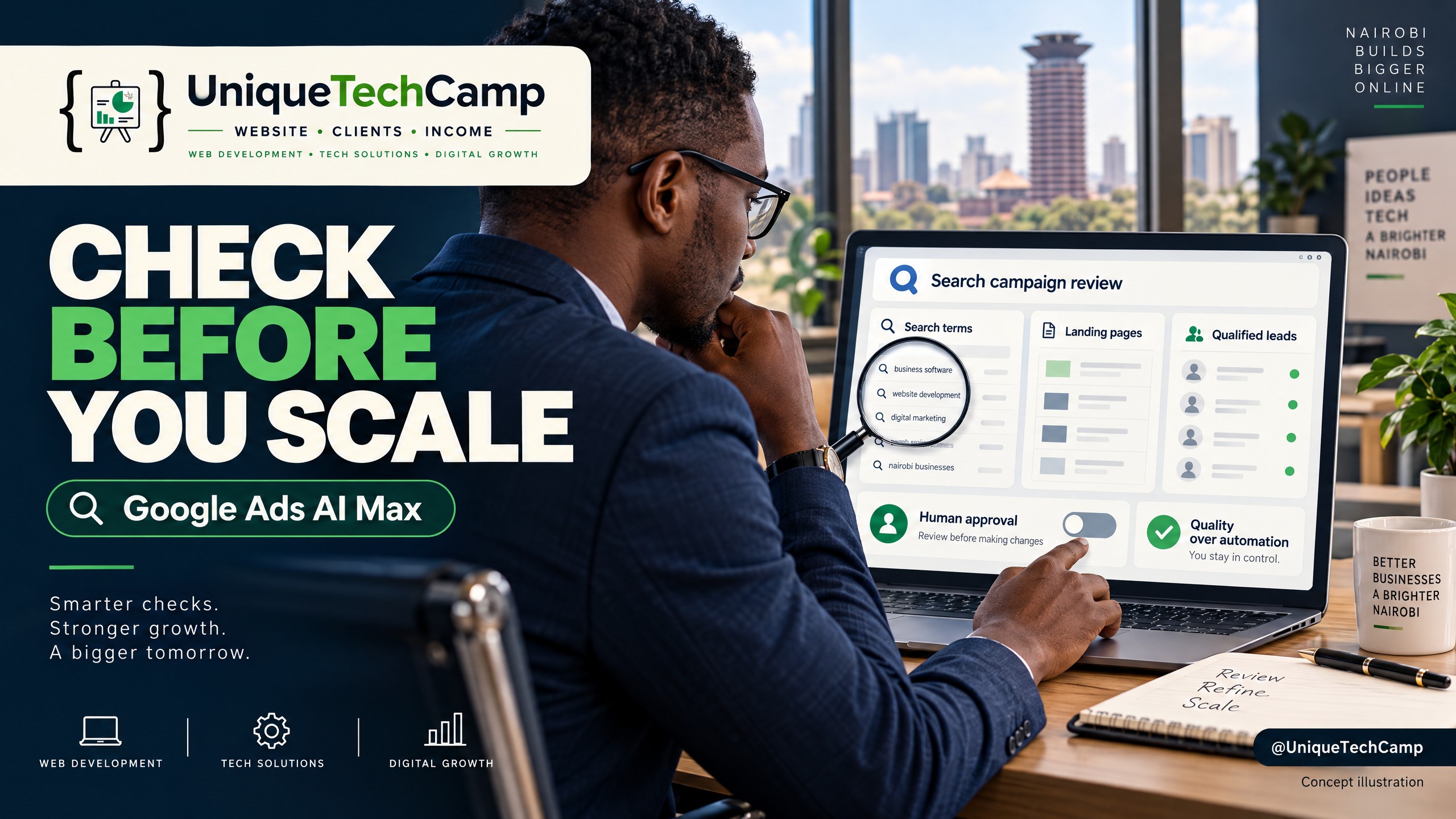
Visual note: This is an AI-generated concept illustration, not an authentic Google Ads dashboard or actual campaign results.
A Nairobi commercial cleaning firm does not need more clicks in the abstract. It needs enquiries from people who can actually commission office cleaning, understand the service area and respond to a quote. Google Ads AI Max may help a Search campaign explore more relevant demand, but it is not a magic “more leads” button and it is not a new campaign type. For a small business, the sensible question is whether its expanded matching and generated ad assets can be tested without losing control of brand, landing pages, spend or lead quality.
This guide sets out a bounded pilot for Kenyan SMEs. It is about operating a human-reviewed Search campaign, not promising earnings or replacing commercial judgement. Google introduced AI Max for Search campaigns on 6 May 2025 in its official Ads & Commerce Blog announcement , so this is a practical guide to an established feature, not a new-launch announcement. Availability and account options can still vary, so check the live account rather than assuming every control is present.
The problem: more reach can make a weak funnel noisier
Imagine a Nairobi cleaning firm serving offices in Westlands, Kilimani and the CBD. Its existing Search campaign has carefully written ads and a landing page with a phone number, quote form, service area and response promise. The owner wants more qualified commercial enquiries, but the team has limited time to inspect search terms. Broadening coverage could uncover useful wording such as “weekly office cleaners Nairobi”, yet it could also attract domestic cleaning, job seekers, one-off bargain requests or searches outside the service area.
The risk is not only wasted spend. If an automated system sends a person to an irrelevant page, rewrites a claim too freely or learns from a shallow “form submitted” event, the dashboard can look busy while the sales pipeline gets worse. A lead is not automatically a qualified lead, and a conversion count is not proof of profit. A pilot must therefore define what may change, what must not change and who checks the evidence.
AI Max is best treated as an optimisation layer inside an existing Search campaign. Google’s setup documentation explicitly says it is not a new campaign type. That distinction matters: the pilot begins with a suitable Search campaign, a real landing page and dependable conversion signals; it does not start by inventing a new channel strategy.
What AI Max actually does today
Google’s official explanation of how AI Max for Search campaigns works describes two main areas: search term matching and asset optimisation. Search term matching can use broad-match, asset-based and landing-page-based technology to expand beyond existing keywords. The documentation says it can use current keywords, creative and URLs to find relevant searches, while the search-terms report adds AI Max and source information for some expanded matches.
Asset optimisation includes text customisation and Final URL expansion. Text customisation can use existing ads, landing-page copy and assets, with generative AI, to create ad copy tailored to a search. Final URL expansion can send traffic to a query-relevant, themed URL on the advertiser’s domain when Google predicts that it may perform better. It is not permission to send traffic to every page: URL inclusions and exclusions remain important controls. Google notes that Final URL expansion requires text customisation and that pinned Responsive Search Ad assets may not be respected when a more relevant URL is selected.
The same documentation lists locations of interest, brand inclusions and brand exclusions, URL inclusions, URL exclusions and expanded reporting. Brand exclusions are a campaign-level control; brand inclusions can be set at campaign or ad-group level. URL exclusions are campaign-level, while URL inclusions are ad-group level. Those boundaries are useful safeguards for the cleaning firm: exclude a recruitment page or pricing page that is not ready, and check service-area targeting separately through location controls. Do not rely on a reviewer to catch every unsuitable destination after the fact.
Do not generalise the launch announcement’s early performance claims to a Kenyan account. Results depend on demand, auction context, creative, conversion quality, location settings, budget and implementation. AI Max can also be ineffective when a campaign is limited by budget, according to the current help documentation. It does not create demand, fix an unconvincing offer or guarantee return on investment.
Eligibility, defaults and account uncertainty
The current Google Ads setup guide for AI Max says new Search campaigns have the AI Max feature turned on by default in its documented setup flow. For an existing Search campaign, an advertiser can opt in through campaign settings and select the features. The guide also says search term matching, Final URL expansion and text customisation require conversion-based Smart Bidding strategies to function effectively. That is a practical eligibility and readiness condition, not a promise that every account will expose identical menus.
The same guide documents text customisation and Final URL expansion as enabled by default when asset optimisation is selected, with Final URL expansion depending on text customisation. Search term matching is on by default at the ad-group level when AI Max is turned on, but it can be toggled off there. Google’s wording describes the current product flow, not a permanent guarantee of access in every country, account history or campaign configuration. Legacy settings, bidding strategy, shared budgets and other account conditions can affect what you can select.
Before touching the campaign, the owner should record the account’s country, currency, campaign type, network targeting, bidding strategy, conversion actions, location settings and visible AI Max controls. Screenshot or export the pre-pilot settings. If the feature is absent, do not imitate it with an unverified workaround; ask the account’s authorised administrator or Google’s current support documentation what applies.
Pricing is an auction cost, not an AI Max fee
AI Max is not sold here as a fixed subscription or per-lead price. Google Ads charges arise from the advertising auction and the campaign’s billing arrangement, not from a guaranteed AI Max return. Google’s official Ads pricing guidance explains auction bidding and advertiser bidding preferences. The official Google Ads billing guidance on average daily budgets and overdelivery says a campaign may spend up to twice its average daily budget on a given day to respond to traffic fluctuations, while monthly charges will not exceed 30.4 times that average daily budget. Served cost can exceed limits temporarily, but billed cost is constrained by the documented limits.
That means an owner-approved spend cap should be expressed and monitored as an average daily budget and a monthly account plan, not as a rigid promise that every day will stop at the same number. Before changing a budget, check the linked guide’s spending-limit and budget-change rules. Keep payment settings, account-level limits and change history under the owner’s control. AI Max does not turn an auction into a fixed-fee placement, and no sensible pilot can quote an ROI before it has reliable cost and qualified-outcome data.
A controlled pilot for the Nairobi cleaning firm
Use one existing Search campaign with a clearly bounded service and location. Keep an unchanged baseline or use Google’s documented experiment flow where the campaign is eligible. Do not mix this test with a new website, new offer, new call-handling process and new attribution model; too many changes make the result uninterpretable.
- Define the business outcome. Write the decision in advance: a useful enquiry must identify a commercial premises, a Nairobi service need, a reachable contact and a plausible buying timeframe. Separate raw form submissions, calls, qualified leads and won work. Record exclusions such as domestic-only requests, employment enquiries and out-of-area requests.
- Audit the input. Check the landing page, service-area wording, phone number, form fields, consent copy, response process and mobile experience. Remove or exclude pages that should not receive paid traffic. Confirm that the existing ad claims are accurate and that the owner approves every service promise.
- Check readiness and defaults. Confirm the Search campaign and conversion-based Smart Bidding condition described in Google’s setup guidance. Record whether search term matching, text customisation and Final URL expansion are on. Decide whether brand inclusions or exclusions, URL inclusions, URL exclusions and locations of interest are appropriate. Keep a written reason for every setting.
- Choose a test design. Google’s AI Max experiments documentation describes a control arm with AI Max off and a trial arm with it on within the existing Search campaign. It also says the flow can configure experiment dates and granular controls. Setup limitations include Display Network targeting, shared budgets, portfolio bidding strategies, bidding exploration and active experiments, among others. If the account fails those conditions, do not call a before-and-after comparison a controlled experiment.
- Give the reviewer a short brief. Use this sample: “Allow only commercially relevant searches for office and commercial cleaning in the approved Nairobi service area. Preserve truthful service claims and approved brand language. Inspect every new search theme, headline, description and destination. Reject domestic, jobs, training, free, irrelevant product and out-of-area intent. Reject any landing page that lacks the intended quote path. Record the reason and the action taken.”
- Review before scaling. During the early pilot, inspect search terms, match source, headlines, URLs, locations, calls and form records on a fixed schedule. Add negative keywords or exclusions only when the evidence supports them. Check the generated asset beside the approved page, not in isolation. If text customisation invents an operating hour, guarantee or service, remove the offending asset or disable the relevant automation, then correct the source material.
- Protect the spend decision. Set the owner-approved average daily budget, document the account’s monthly plan and monitor billed cost rather than assuming a daily hard stop. Do not raise spend because impressions rose. A scale decision needs stable qualified-lead evidence, acceptable sales follow-up and no material increase in irrelevant enquiries.
- Finish with a written decision. Apply, extend, constrain or stop. Preserve the experiment result, search-term examples, rejected assets, landing-page destinations, qualified-lead counts and owner approval. If a setting is applied, note exactly which control changed and when.
A team that wants to connect review queues, CRM hand-offs and campaign evidence can ask UniqueTechCamp’s AI Solutions Desk to map the operating process. The useful intervention is not blind automation: it is a traceable path from approved offer to reviewed ad to sales outcome.
Measurement: wait for the real funnel
Start with a baseline period and a predeclared comparison. Track impressions, clicks, spend, search themes, landing pages, calls, form submissions, response time, qualified leads and eventually accepted opportunities. Segment by location, device, brand/non-brand intent and service type where the data supports it. Compare like with like; do not claim causation from a busy week or a single large enquiry.
For lead quality, use Google Ads’ qualified-lead and converted-lead guidance . Google distinguishes a qualified lead that has been further qualified offline from a converted lead that reaches a defined later step, often outside Google Ads. Import or associate the stages your business can actually verify. A cleaning firm might define a qualified lead as a commercial enquiry that passes its service-area and need checks, while a converted lead could be a signed agreement; the business must choose its own defensible definitions.
Record conversion delay. The click, form, qualification call and signed contract may happen on different dates. Read the Google guidance on high-quality leads and conversion delay before interpreting a recent pilot. A short reporting window can undercount later stages, and Smart Bidding needs time to learn from the signal you choose. Do not turn an early click-through-rate lift into an ROI statement.
Useful review questions include: Did relevant commercial intent expand? Did irrelevant intent rise? Were generated assets accurate? Did Final URL expansion improve the journey or expose weak pages? Did qualified-lead rate, response time and sales acceptance move in the same direction? What did the owner reject? Those answers are more valuable than a single platform score.
Limits and responsible use
AI Max does not know whether a prospective customer is genuinely ready, whether a cleaner can fulfil a site safely, or whether an owner’s internal promise is operationally achievable. Automated copy and matching can be plausible but wrong. Landing-page expansion can reveal information architecture problems rather than solve them. Location intent is not identical to physical presence, and brand controls are not a substitute for reviewing search terms.
This article does not provide legal or medical advice. Check advertising policies, privacy obligations, consent wording, contracts and sector-specific requirements with an appropriately qualified professional. Keep an authorised human accountable for claims, spend and customer treatment.
Frequently asked questions
Is AI Max a replacement for keywords or a new campaign type?
No. Google documents it as a suite or optimisation layer within Search campaigns. It can use broad-match, asset-based and landing-page-based technology to expand matching, but the campaign still needs a sound offer, relevant inputs and deliberate controls. Treat it as a testable layer, not a replacement for strategy.
Can I switch off the parts I do not trust?
The current documentation describes controls for search term matching, text customisation and Final URL expansion, plus URL, brand and location controls. Search term matching can be controlled at ad-group level; asset settings are campaign-level. The available controls depend on the account and campaign, so verify the live settings and record what is actually active.
Does Google Ads charge a separate AI Max fee?
The sources describe AI Max as a feature within Search campaigns, not a fixed AI Max subscription. Auction costs and billing follow the account’s Google Ads setup and budget rules. Use the official average-daily-budget and overdelivery guidance, keep the owner in charge of payment access and do not present an estimated spend as a guaranteed daily ceiling.
How long should a Kenyan SME wait before judging it?
There is no universal number of days. Wait long enough to observe the campaign’s conversion delay and enough qualified outcomes to make the comparison meaningful, while monitoring search terms and spend throughout. A test that measures only clicks in its first few days cannot answer whether lead quality improved.
Conclusion
Google Ads AI Max is established, configurable Search-campaign technology, not a guaranteed route to revenue. For a Nairobi SME, the practical opportunity is a disciplined pilot: confirm eligibility, document defaults, protect landing pages and brand boundaries, use the experiment structure where available, watch auction billing and feed the system qualified-lead evidence. Scale only when the owner can explain what changed, what improved and what was rejected.
Need this built for your business?
If your team needs a human-reviewed pilot, measurement design or CRM hand-off, start with UniqueTechCamp’s AI Solutions Desk . Owners can also book an appointment or review Lead Generation Campaigns before approving a build.
Deploy An Autonomous AI Lead Gen System Today
We engineer high-converting web applications with integrated 24/7 WhatsApp qualification bots and multi-channel follow-up drips.
Related Strategy Articles

Gemini Small-Business Tools: A Safe Growth Pilot for Kenyan SMEs
Google's Gemini business page brings brand, finance and app tools together. A cautious pilot for Kenyan SMEs, with privacy and review checks.

Google Docs Captions and Cross-References for Kenyan SMEs
Use Google Docs captions, cross-references and caption tables to keep Kenyan SME reports and tender documents easier to navigate after edits.

ChatGPT for Sales: A Human-Reviewed CRM Pilot for Kenyan SMEs
OpenAI's new ChatGPT for Sales adds sales workflows. Learn how Kenyan SMEs can pilot CRM connections with human review, privacy checks and clear measures.

UniqueTechCamp Desk
Online • Reply < 5 mins