
ElevenLabs Realtime Mini vs Max: Kenya SME Cost Guide
A practical Kenya-focused guide to choosing ElevenLabs Realtime Mini or Max, separating platform, token and telephony costs, and testing human fallback safely.
UniqueTechCamp Editorial
Digital Services Team • UniqueTechCamp Engineering Unit
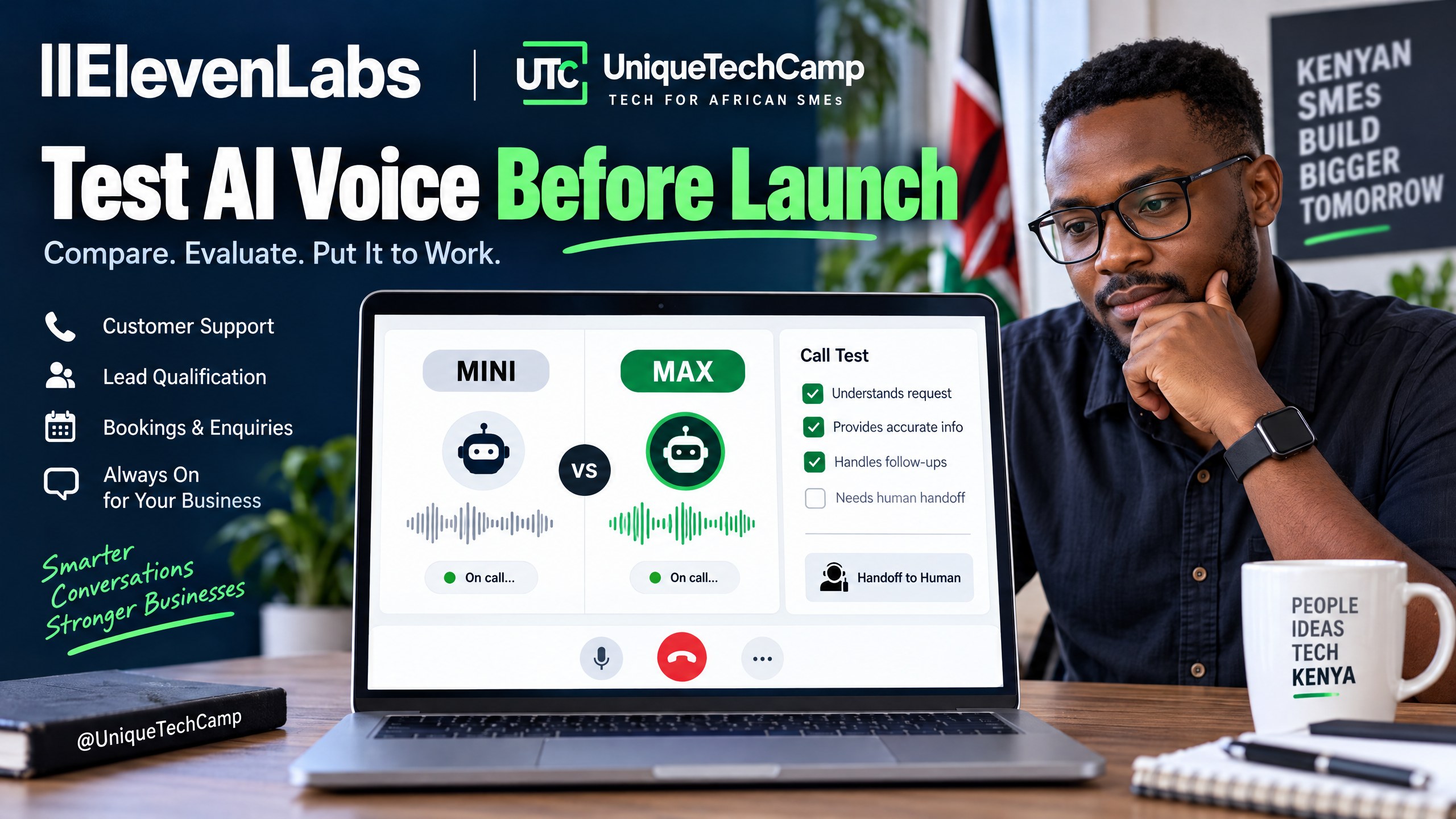
A Kenyan SME evaluating a voice agent does not need another generic “AI receptionist” promise. It needs a bounded decision: which model handles the actual conversation, what will be billed, how will a person take over, and what happens when the network, language setting, tool call or provider fails? ElevenLabs’ Realtime v1 Mini and v1 Max are useful precisely because they make that choice explicit.
The timing matters. The official ElevenLabs Realtime launch announcement is dated 20 October 2026, not 11 November. ElevenLabs describes Realtime as an audio-in/audio-out speech-to-speech system available through ElevenAgents and the Realtime API. The positioning is: Mini is the default, lower-cost option for natural conversations; Max is designed to reason before responding when instructions are complex or tools must be used in sequence.
This guide is for an owner, operations lead or technical partner at a Kenyan SME deciding whether to run a small pilot. UniqueTechCamp approaches that kind of AI workflow as a measured systems project, not a promise of automatic revenue. Validate local availability and language support. Define the job, establish a baseline, compare Mini and Max on the same calls, separate every cost layer, and keep a human fallback ready.
The problem is not “which model sounds best?”
Voice-agent projects often fail before model quality is measured. A business buys a subscription, connects a phone number and discovers that the real workflow also needs a telephony provider, an external large-language-model charge, a knowledge source, tool permissions, transfer logic and someone to review failed calls. A short, friendly demo can hide a poor result on interruptions, ambiguous requests or multi-step actions.
A better question is: what level of reasoning does this conversation require, and what is the cost of being wrong? A caller asking for opening hours or the status of one known booking may fit Mini. A caller asking the agent to compare options, check several systems, apply a policy and then transfer with context may justify Max. Neither choice removes the need for authentication, tool safeguards, monitoring or a person who can intervene.
The company’s Realtime product page says the product can be deployed through phone, web widget, WhatsApp and contact-centre integrations, and advertises 90+ languages. Those are product-level claims, not proof that a specific Kenyan number, voice, accent or language combination is available in your account. Verify the actual selector, voice catalogue, channel and provider before publishing a promise.
What Mini and Max actually change
The official Realtime model documentation says Mini is the default Realtime model and recommends starting there for most voice use cases. It is positioned for low latency and lower cost, including natural conversations, assistants, tutors and interactive characters. That makes it a sensible baseline for a narrow service workflow with clear answers and limited tool use.
Max is positioned for complex instructions and multi-step tool use. It reasons before responding, so it may be a better candidate where the agent must gather information, decide what to do next and complete several calls reliably. “Better candidate” is not the same as “always correct”: a Max agent can still receive incomplete data, misunderstand a caller, time out or take an unsafe action if its tools and permissions are poorly designed.
There are also boundaries. Realtime models are voice-oriented, not a drop-in choice for a text-only agent. Keep Custom mode where the design depends on a custom LLM, Amazon Bedrock, a specific speech stack or transfers to and from agents in Custom mode. The documentation says Max requires a token limit of at least 1,024 or no limit, and is unavailable in ElevenLabs’ India and Singapore data-residency environments. Rollout is gradual, so a workspace may not yet show the Voice mode selector.
The launch post cites Artificial Analysis comparisons. These are not Kenyan field results. Run your own calls under your network, telephony and tool conditions instead of treating leaderboard scores as customer outcomes.
Choose the deployment route separately. ElevenAgents provides operational features such as channels and a knowledge base. The standalone Realtime API runs separately and uses WebSocket, not WebRTC; an existing WebRTC integration needs adaptation. Changing an endpoint does not automatically bring the platform’s channels or safeguards into a custom application. Ask which usage layers apply to your chosen configuration rather than adding every possible provider charge together.
How to separate the bill before you choose
Do not put “ElevenLabs cost” in one spreadsheet cell. There are at least four different cost layers, and the public pages do not expose every model-token number in one simple plan table.
First is the ElevenAgents subscription. The current ElevenAgents pricing page displays USD monthly plans before taxes, levies and duties: Free at $0/month with 15 included call minutes and 4 concurrent calls; Starter at $6/month after a displayed $1 first month, with 75 included minutes and 6 concurrent calls; Creator at $22/month after a displayed $11 first month, with 275 included minutes and 10 concurrent calls; Pro at $99/month with 1,238 included minutes and 20 concurrent calls; Scale at $299/month with 3,738 included minutes, 30 concurrent calls and 3 workspace seats; and Business at $990/month with 12,375 included minutes, 40 concurrent calls and 10 workspace seats. Enterprise is custom-priced.
Second is platform usage billing. The same page lists the allowance under “Included Call”, then $0.080 per additional call minute, $0.003 per text message and $0.160 burst pricing per minute. Read the column labels carefully: a text-message rate is not a voice overage rate. Confirm your plan’s additional-minute eligibility and current account rate card; introductory prices are not recurring prices.
Third is Realtime model usage. The Realtime documentation says a Realtime agent is charged the standard ElevenAgents per-minute rate plus input, cached-input and output tokens at the Realtime model’s rates. The public pricing view used for this guide did not expose separate numeric Mini and Max token rates, so do not invent them or fold them into a made-up per-call total. Before approving a pilot budget, record the live Mini and Max token rates shown in the relevant account or pricing view, and export actual token usage from the test.
Fourth is the outside provider layer. ElevenLabs says external LLM and telephony-provider charges are usage-based and vary by provider or model. If you use Twilio, its Kenya voice pricing page currently lists local-number rental at $16/month, inbound local calls at $0.0239/min, outbound Kenya calls at $0.3779/min and outbound Kenya mobile calls at $0.3933/min. These are Twilio charges in addition to ElevenAgents platform and model charges, and they can change. Your final model must also account for any external LLM, recording, storage, integration or tax line that your selected architecture introduces.
Do not convert those figures into a promised monthly total without your traffic pattern. A business with short inbound calls, a high share of included minutes and no external LLM may have a different bill from a business with long outbound mobile calls, Max reasoning, repeated tool calls and a separate integration stack. Use a scenario sheet with call count, duration, direction, destination, model, token usage, subscription, included minutes, overage, telephony and taxes as separate columns. UniqueTechCamp’s AI workflow desk can help turn that sheet into an implementation decision.
A practical decision test: Mini first, Max where the workflow proves it
Start with Mini when the job is narrow, the answer is mostly retrieval, the caller can be routed through a small set of intents, and a human can handle exceptions. Typical examples include collecting a name and callback number, answering a controlled set of service questions, checking one status field or taking a structured enquiry. The goal is not to make Mini clever; it is to make the workflow predictable.
Move a test case to Max when the call genuinely requires multiple dependent steps. Examples include checking availability, applying a business rule, collecting missing information, presenting a choice, recording confirmation and then escalating. Max is especially worth testing when a wrong tool order or incomplete handoff costs more than the additional model usage. Keep tool permissions narrow: reasoning quality is not authorisation to refund, delete, change a booking or disclose private information.
Use the same prompt, knowledge base, voice, interruption settings, tools and test calls for both models. Change only the model unless the product documentation requires a mode-specific setting. Record task outcomes, not just whether it felt natural.
An eight-step pilot workflow for a Kenyan SME
1. Write the one job the agent is allowed to do
Describe one outcome in a sentence, such as “capture a qualified service enquiry and schedule a callback request”. List what is explicitly out of scope. If the agent cannot complete an action safely, it should say so and offer a human route rather than improvise.
2. Build a small, controlled test set
Prepare at least 30 calls across routine, ambiguous, interrupted and out-of-scope scenarios. Include different speaking speeds and realistic background conditions, but do not claim the result represents all Kenyan callers. Keep a test script and mark which calls are allowed to invoke each tool.
3. Establish a Mini baseline
Run every test on Mini before changing the model. Capture time to first audio, interruption recovery, task completion, tool errors, transfer attempts, total call minutes and token usage. Also record whether the caller had to repeat information and whether the final outcome was correct.
4. Run the identical set on Max
Repeat the same calls with Max and the same operating limits. Check whether extra reasoning improves multi-step completion enough to justify the added model-token cost. If Max is not visible in the account, record that as an availability constraint rather than silently substituting another model.
5. Score the failure modes, not just the average
Set a pass rule before reviewing the results. For example, require 27 of 30 calls to complete the defined outcome, zero unauthorised actions, and a human route for every declared exception. Adjust those thresholds to the risk of your workflow; they are a pilot control, not a vendor benchmark.
6. Build the cost sheet from exports
For each call, join subscription allocation, platform minutes, input tokens, cached-input tokens, output tokens, telephony direction and destination. Keep Mini and Max rows separate. Use the live account rate for model tokens and label each currency and billing period; do not estimate a total from the subscription alone.
7. Test the human handoff
ElevenLabs’ transfer-to-number documentation describes a phone-only system tool, with conference transfer as the default, blind transfer and SIP REFER options. Test the exact route you plan to use. Conference or blind warm-transfer behaviour and post-dial digits require the native Twilio integration; SIP REFER depends on SIP transfer support and does not provide a warm-transfer message. Keep transfer metadata short: the documentation states a 256-byte limit after dynamic-variable substitution.
8. Decide, document and monitor
Choose Mini, Max or a bounded split by intent. Record the model, prompt version, tools, language setting, provider, rates, escalation rules and approval owner. After launch, sample failed calls and re-run the same test set when a prompt, voice, provider, tool or pricing assumption changes. A fallback plan that is never tested is only a diagram.
Language, infrastructure and failure handling
English is the default language in ElevenLabs’ language guidance . Adding languages switches the agent to its multilingual model, and the “All” option configures 31 languages. Language selection is fixed for the duration of a call, although a language-detection tool can choose a caller’s preferred language at the start. The evidence reviewed for this article does not explicitly list Swahili in the relevant extract. Therefore, verify your account’s language selector and voice catalogue before claiming Swahili support; this guide makes no such claim.
Kenya reachability also has two separate questions: can the selected telephony provider route the call, and does ElevenLabs offer the number and integration path your design needs? The Twilio Kenya voice guidelines indicate domestic and international inbound/outbound reachability is available, use the +254 dialing code and support DTMF. The same guidance says emergency-services calls are not supported. That makes a voice agent unsuitable as an emergency service, and your greeting and escalation design should not imply otherwise.
Plan for the common failures: no answer from a tool, stale knowledge, dropped audio, a caller who changes topic, a request outside policy, or a transfer that does not complete. The agent should disclose its limits in plain language, collect only the minimum information needed for a callback, avoid repeating sensitive details aloud, and offer a safe alternative. For high-impact decisions, seek qualified professional advice; this article is operational technology guidance, not legal or medical advice.
Four questions owners should ask
Is Max always the better model for a customer-facing agent?
No. Max is positioned for complex instructions and multi-step tool use, while Mini is the default for most voice use cases. Choose based on the cost and risk of the actual workflow, then compare both on the same calls. A narrow, well-designed Mini flow can be safer than a broad Max flow with excessive permissions.
Can I budget a fixed price from the ElevenLabs subscription page?
Not safely. The subscription and included minutes are only one layer. Add the displayed platform-minute rules, live Realtime input/cached-input/output token rates, telephony, external LLM charges and applicable taxes or duties. Keep the rates and billing basis dated because provider pricing can change.
Can I promise English–Swahili phone service in Kenya?
Not from the evidence used here. ElevenLabs advertises 90+ languages, but the reviewed language extract does not explicitly list Swahili. Confirm the account’s language selector, voice catalogue, telephony route and fixed-per-call language behaviour before making a promise.
What should happen when the agent cannot finish the task?
Define an escalation condition before launch: an explicit human request, a complex judgement, a tool failure, missing information or an out-of-scope request. Test the phone transfer path, tell the caller what will happen, and log the outcome without exposing unnecessary sensitive data. The agent should fail safely rather than invent an answer.
Conclusion
For most Kenyan SME pilots, start with Mini because it gives you a lower-cost baseline for a narrow, measurable voice workflow. Test Max where the workflow demonstrably needs multi-step reasoning or reliable tool sequencing. Budget subscription, platform minutes, Realtime input/cached-input/output tokens, telephony and external LLM usage as separate lines. Verify language, number and residency options in your account. Then make human transfer a tested acceptance criterion, not a hopeful feature.
UniqueTechCamp can help scope the workflow and guardrails without turning a model choice into an earnings promise.
Need this built for your business?
UniqueTechCamp’s AI Solutions Desk can help you define a bounded voice-agent pilot, compare Mini and Max using your own workflow evidence and document fallback controls. Book an appointment if you want to review the test plan, or explore the matching instant AI voice inbound receptionist service after the requirements and handoff path are clear.
Deploy An Autonomous AI Lead Gen System Today
We engineer high-converting web applications with integrated 24/7 WhatsApp qualification bots and multi-channel follow-up drips.
Related Strategy Articles

CrowdStrike AI Kill Switch: SME Team Reviewing an Agent Safety Dashboard
A practical SME playbook for reviewing CrowdStrike’s AI Kill Switch, testing agent containment safely, measuring trade-offs and checking Kenya eligibility.

Microsoft Agent 365 Business Analytics: An SME Readiness and Value-Validation Guide
Microsoft Agent 365 Business Analytics is in Frontier preview. Here is how Kenyan and East African SMEs can validate access, usage cost, value, privacy and readiness before buying licences for a dashboard.
Canva AI Controls: SME Design Review and Human Approval on a Laptop
A practical Canva AI Controls workflow for Kenyan and global SMEs: control settings, human review, asset provenance, measurements, costs and limitations.

UniqueTechCamp Desk
Online • Reply < 5 mins