
Delight Midas: A Customer-Journey Testing Pilot for Kenyan SMEs
Explore Delight Midas with a practical Kenyan SME pilot: test booking journeys, review changes, check rollout access and budget before going live.
UniqueTechCamp
Digital Solutions Team • UniqueTechCamp Engineering Unit
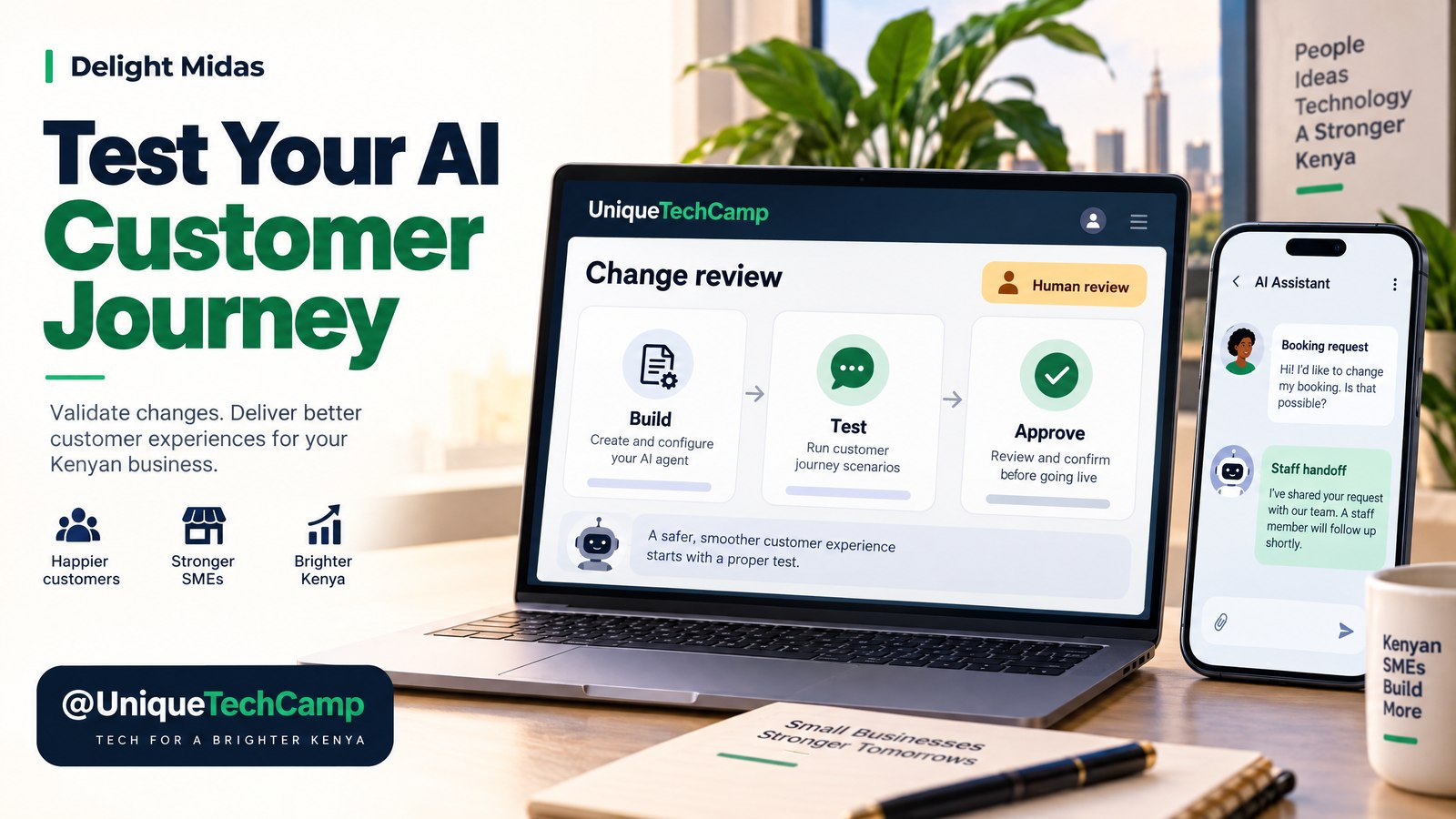
Delight Midas ↗ is a new way for business teams to build, test and improve a customer-facing AI agent through conversation. For a Kenyan business owner, the useful question is not whether another chatbot sounds impressive. It is whether your team can change a booking rule, inspect the consequences and approve the right behaviour before customers encounter it.
Delight.ai announced Midas alongside its Customer Agent on 9 November 2026 ↗. The company describes a build, test, improve and analyse cycle, with people controlling what goes live. Access is rolling out in stages, however, and the reviewed launch pages do not publish a Midas price. Treat this as a product worth evaluating, not an immediately available Kenyan implementation or a promised increase in sales.
What is new, and why should an owner care?
The launch brings together two different roles. Delight Customer Agent ↗ is the customer-facing system, intended to work across shopping, booking, support and retention. Midas is the management layer through which a team describes how that agent should behave and reviews proposed changes.
According to the official Midas introduction ↗, it turns business material into Actionbooks: the step-by-step instructions an agent follows. It maps processes as flowcharts, tests proposed behaviour with simulated customers, supports manual testing and compares versions. The company says a release needs an approved plan, passing tests and an authorised person's approval.
That is potentially useful when the people who understand a policy cannot easily change the software implementing it. A customer-service lead might notice that callers misunderstand a delivery boundary. An operations manager might need to change appointment availability. The opportunity is a shorter route from an observed problem to a reviewed improvement. The responsibility for the policy, its tests and the final decision still belongs to the business.
Start with one journey, not an all-in-one transformation
Consider a hypothetical Nairobi home-services company. Enquiries arrive through its website and WhatsApp. A customer asks about an installation, explains the location, requests an appointment and later asks to move it. The failure is often not the first answer. It is the gap between that answer, a real booking and a staff member knowing what was agreed.
A sensible pilot would cover only one service enquiry through to a confirmed or human-reviewed appointment. It would not also automate refunds, collect payments and launch promotional follow-ups. Those are separate journeys with different permissions, evidence and risks.
Write the pilot's outcome in operational language: a customer receives an accurate answer, supplies only necessary details and either gets a verified booking or a clear handoff. The steps below are an evaluation blueprint, not a claim that this vendor already provides your Kenyan calendar, payment or customer-record integrations without additional work.
Check access and the complete cost before building
The official Midas page says access is being introduced to customers in stages. Ask whether your organisation can actually trial the features shown, which plan includes them and whether the demonstration can use your proposed process. A polished launch video is not confirmation that your account has production access.
The reviewed launch and feature pages do not give a public Midas rate card. Use the official sales and pricing-enquiry route ↗ for a written proposal. Do not assume a trial is free, borrow another product's advertised price or convert an unknown subscription into a local estimate.
Request separate lines for platform access, usage allowances, channel charges, integration work, setup, testing, training and ongoing support. Ask what counts as a billable conversation or action, how unsuccessful attempts are treated, what happens above an allowance and how you leave with your records. Confirm billing currency, applicable taxes and exchange-rate exposure. Staff review time is also a real cost, even when it does not appear on the vendor's invoice.
Step 1: Give the agent a short, approved operating brief
Before asking Midas to build anything, prepare the source material that a new employee would need. Include the service description, service area, operating hours, booking rules, cancellation policy and a named escalation contact. Date each document and identify its owner. Remove old offers and resolve contradictions rather than expecting AI to choose the commercially convenient answer.
Define the difference between an enquiry, a requested slot and a confirmed appointment. A request should become confirmed only when the booking system supplies the evidence your business requires. If a lookup fails, the agent should explain the next step rather than invent availability. Decide whether it may change an existing booking or must hand that request to staff.
Also specify what it must not promise. For example, it should not guarantee a technician's arrival before dispatch accepts the job, invent a service price or say a payment succeeded because someone typed that it did. These are proposed business acceptance rules; verify that the chosen product and integrations can enforce them.
Step 2: Review the process before reviewing the wording
Midas says it can ask questions when the supplied guidance leaves gaps and display the resulting Actionbook as a flowchart. Use that review to look for missing decisions. What happens outside the service area? Who handles a request after working hours? Which system decides whether an appointment remains available?
Read each branch as a customer journey, not as attractive software documentation. A polite response can still be wrong if it ends without a booking reference, an escalation owner or a clear expectation. Ask staff who actually answer enquiries to inspect the process alongside whoever maintains the systems.
Keep the first version deliberately narrow. An owner should be able to explain the permitted actions and the stop conditions without reading a long prompt. If the process needs constant exceptions, simplify the service rule before expanding the automation.
Step 3: Test normal requests and expensive misunderstandings
The vendor's simulations are a useful starting point, not proof of complete coverage. Build a small acceptance pack from common enquiries and previous mistakes, using fictional customer details. For each case, record the customer's message, the relevant policy, the expected action and the evidence that would make it pass.
An ordinary booking
Ask for a service within the approved area during normal hours. Check that the agent gathers the required details, consults the appropriate source and distinguishes a proposed slot from a confirmed booking. A friendly final message is insufficient if nothing was written to the booking system.
A request outside the rules
Try an unsupported location or an unavailable service. The correct result may be a refusal or staff review, not a conversion. Check that the agent does not quietly broaden your coverage to satisfy the customer or promise that an exception has already been approved.
A failure, a change and a conversation carried forward
Test an unavailable calendar, a customer changing the request halfway through and someone returning about an earlier appointment. Look for honest failure messages, an intact record of what changed and a sensible identity check before personal booking details appear. If you test two channels, confirm the identity-linking behaviour rather than assuming that matching names identify the same person.
A message that should stop follow-up
Include a request for a human and a request to stop promotional contact. Inspect the resulting record and staff notification, not just the acknowledgement. Your team should be able to tell who now owns the case and which future messages are permitted. Do not use a real customer's sensitive conversation as convenient test material.
For this kind of pilot, UniqueTechCamp ↗ can help scope the customer journey, integration requirements and acceptance checklist. The useful deliverable is a process your team can explain and verify, not simply a chatbot placed on a page.
Step 4: Approve a version, not a general promise
Midas describes separate Development work, saved versions and approval rights. Ask the vendor to demonstrate those controls using a harmless policy change. Compare the proposed Actionbook with the live version, read the test results and check that the live behaviour remains unchanged until approval.
Keep editing and approval responsibilities explicit. A colleague who understands a promotion may propose a change, while the operations owner confirms that the business can fulfil it. Technical staff should review any changed integration or data access. Do not assume a conversational interface removes the need for those decisions.
Record the approved version, reviewer, supporting test cases and release time. Confirm the actual recovery procedure before launch: retaining versions does not by itself prove that one-click rollback exists. Ask what can be restored, what happens to already-created bookings and how staff take over if a release causes confusion.
Step 5: Measure completed work and the cost of corrections
Define success before a limited live pilot. For a booking journey, useful measures include requests reaching a verified booking, requests correctly handed to staff, incorrect confirmations, repeated questions and staff corrections. Count completed outcomes rather than treating every conversation as a sale.
Keep denominators visible. Distinguish all conversations from eligible service enquiries, and booking requests from confirmed jobs. Record why an enquiry did not progress: unavailable capacity, unsupported location, missing information or a technical failure. Otherwise, the agent may receive credit or blame for conditions it cannot change.
Compare with a relevant baseline and account for differences in opening hours, promotions and demand. Vendor demonstrations and case studies are not forecasts for your business. Track staff time spent reviewing, repairing and escalating alongside any time saved answering routine questions.
Midas says it can connect conversation analysis to proposed improvements. Review those suggestions as hypotheses. If customers often ask about delivery, clearer terms may help, but adding a discount is a commercial decision. Repeat the same build, test and approval cycle for each meaningful change instead of allowing an attractive chart to justify an unreviewed policy.
Keep Kenyan data, channel and payment questions explicit
Delight's launch describes chat, voice, SMS, email and WhatsApp. That does not establish your specific account's channel setup, local telephone arrangements, language performance or integration readiness. Test the wording your customers actually use, including mixed-language messages, and keep a human route for misunderstandings.
Nor does a general reference to payment-system APIs confirm a ready-made M-Pesa connection. If payments are proposed later, separately verify the integration, confirmation source, duplicate handling and reconciliation process. An initial booking pilot can leave payment entirely outside the agent's authority.
Before supplying personal data, review processing terms, hosting and transfer arrangements, retention, deletion, access controls and the handling of test records. The Kenyan regulator's data-protection legislation page ↗ is a starting point for qualified review, not a checklist that automatically makes a deployment compliant. Use synthetic data first and obtain appropriate advice for your circumstances.
Frequently asked questions
Is Midas a new standalone chatbot?
No. Delight describes Midas as an agent within its platform that builds and improves the customer-facing Delight Customer Agent. The distinction matters when evaluating access, integration effort and price: do not assume it is a separate low-cost tool that can manage any existing chatbot.
Can a Kenyan business start using every feature immediately?
Do not assume so. The official feature page describes a staged customer rollout. Ask for account eligibility, the included features and a demonstration using your process. Verify local channel and system requirements before committing to a launch date.
Does a passing simulation mean the agent is ready for customers?
Not by itself. Simulations test selected situations against supplied rules. Add staff-written cases, manually try difficult conversations and inspect the records created in connected systems. A wrong policy can produce consistently wrong answers that still look convincing.
Will Midas publish improvements without staff approval?
The vendor says changes require authorised approval, and the live version stays unchanged during review. Demonstrate that behaviour in your account, assign approvers and retain the evidence for each release. Business owners should still verify that the chosen policy is accurate and commercially acceptable.
Conclusion: buy a testable operating process
The practical significance of the Midas launch is a proposed connection between business knowledge, simulated tests and controlled releases. For a Kenyan SME, the best next step is a bounded evaluation: one journey, a clear policy, verifiable outcomes and an honest account of cost and limitations. Expand only when the evidence supports it, not because the demonstration makes a whole customer lifecycle look effortless.
Need this built for your business?
Business owners can discuss a scoped AI customer-journey pilot with UniqueTechCamp's AI Solutions Desk ↗, book a consultation ↗ and review the workflow automation service ↗. Bring your current enquiry process, approved policies, connected tools and the failures you want a pilot to prevent.
Deploy An Autonomous AI Lead Gen System Today
We engineer high-converting web applications with integrated 24/7 WhatsApp qualification bots and multi-channel follow-up drips.
Related Strategy Articles

CrowdStrike AI Kill Switch: SME Team Reviewing an Agent Safety Dashboard
A practical SME playbook for reviewing CrowdStrike’s AI Kill Switch, testing agent containment safely, measuring trade-offs and checking Kenya eligibility.

Microsoft Agent 365 Business Analytics: An SME Readiness and Value-Validation Guide
Microsoft Agent 365 Business Analytics is in Frontier preview. Here is how Kenyan and East African SMEs can validate access, usage cost, value, privacy and readiness before buying licences for a dashboard.

Canva AI Controls: SME Design Review and Human Approval on a Laptop
A practical Canva AI Controls workflow for Kenyan and global SMEs: control settings, human review, asset provenance, measurements, costs and limitations.

UniqueTechCamp Desk
Online • Reply < 5 mins