
Cohere North Crunchbase: A Kenyan B2B Research Pilot
Assess Cohere North Crunchbase for Kenyan B2B research: licences, SSO, source checks, forecast limits, realistic costs and a human-reviewed pilot.
UniqueTechCamp
Digital Solutions Team • UniqueTechCamp Engineering Unit
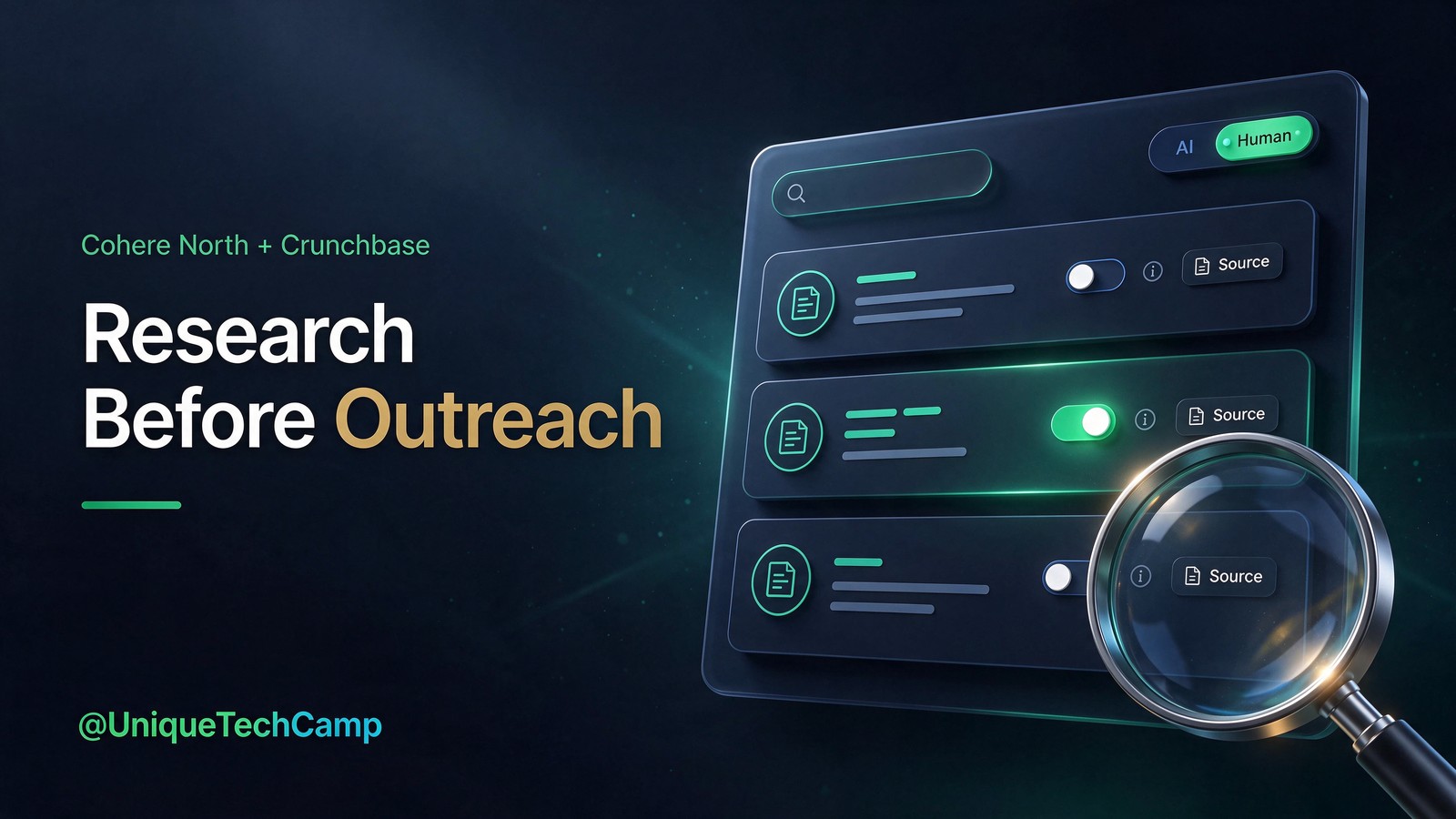
For Kenyan and East African B2B service SMEs, the useful question is not simply which startup raised money. It is whether a company is showing a credible reason to buy from you.
Fundraising is visible, exciting and easy to repeat in a sales meeting. It is not the same thing as procurement readiness. A newly funded company may be hiring, changing priorities, retaining an incumbent supplier or postponing every non-essential decision. Conversely, a growing company may be commercially interesting without a fresh funding announcement. That distinction matters when a small consultancy, software implementer, recruiter, agency or specialist professional-services firm has limited research time and cannot afford a noisy pipeline.
That is the practical lens for Cohere North Crunchbase ↗: a new research connection that can put private-market signals beside a business’s own internal knowledge. Used carefully, it could help a Kenyan B2B seller decide which accounts deserve human attention. Used carelessly, it could turn a probability into a promise, or a company record into an assumption about a person’s willingness to buy.
What changed on 17 November 2026?
On 17 November 2026, Cohere announced the Crunchbase Connector in North ↗. The announcement says the connector brings data on more than five million company profiles, funding and M&A histories, competitors and growth signals into North workflows. It is designed for questions, analyses and documents that combine Crunchbase data with an organisation’s internal knowledge.
For teams doing market mapping, the change is less about gaining a magic list of buyers and more about bringing an external research source into an enterprise AI workspace. North can use the connected information with agents and automations; its product page describes agents, reusable skills, libraries, applications and workflow automation as parts of the platform. The result might be a research brief, a target-account view, a risk analysis or a document that a colleague then checks and improves.
The access conditions are important. The connector is available from the launch date to North customers with an active Crunchbase licence and SSO enabled, and an administrator must enable it in the organisation’s connector settings. It is bring-your-own-licence: the announcement does not say that a North subscription includes Crunchbase access. Cohere links to Crunchbase Pro for readers who do not have a licence, but that link is not proof that Pro is always sufficient for every organisation, connector feature or entitlement. Confirm compatibility, permitted use and account scope with both vendors before budgeting around it.
Why the distinction between signals and buyers matters
A Kenyan service SME often sells through trust, timing and a specific business problem. A funding event can be a useful research clue: perhaps the company is entering a new market, building a team, formalising operations or looking for specialist support. It can help you form a better question. It cannot establish budget, decision-maker access, procurement status or a buying deadline.
Crunchbase’s predictions documentation describes funding, exit, growth, layoff, closure and remain-private outputs. These are forecasts, not reported events. For example, a forecast probability relating to a future funding outcome has a reference date and, where available, timing intervals; it should not be presented as “this company will raise” or “this company has budget”. The documentation also warns that the overall probability has no fixed horizon and should not be reconstructed by adding time-series values.
The same discipline applies to money. A reported funding round is an observed record as represented by the source. An estimated valuation is a modelled or estimated figure, not a reported valuation. Keep those labels distinct in every client-facing brief. North’s announcement says figures come with citations, predictive outputs are identified as forecasts and estimated valuations are distinguished from reported ones. That is useful control, but a citation still needs a human reviewer who understands the question being answered.
A realistic 20-account Kenyan research pilot
For a small B2B team, start with a bounded pilot rather than connecting every possible workflow. Select 20 accounts that already fit your service thesis: for example, Kenyan or East African startups and growth companies in sectors where you have delivery experience, references or a credible point of view. Do not define the list only by recent fundraising. Include accounts selected from existing referrals, sector knowledge, inbound enquiries and current market observation.
- Write the account hypothesis. For each account, record the problem you believe you solve, the likely business trigger and the evidence that would make a conversation useful. This prevents the tool from becoming an excuse to browse.
- Confirm eligibility. Check that the organisation is within your intended geography, sector and service scope. A company profile is not automatically a qualified account, and a listed company is not automatically a suitable buyer.
- Connect lawfully and narrowly. Confirm the active Crunchbase licence, North access, SSO and administrator approval. Ask whether the intended users and uses are covered by the applicable entitlements. Do not assume that a connector grants every field or every permission.
- Ask for a structured research brief. Request company identity, sector, locations where relevant, reported funding or M&A history, competitors and growth signals, each with source evidence and a clear date. Ask the agent to separate reported facts, forecasts, estimates and unanswered questions.
- Cross-check the current website. Review the company’s own website, product pages, careers information and public contact routes. A current site can correct an old description, clarify the offer and reveal whether the business actually resembles your service hypothesis.
- Use internal knowledge. Add your approved case studies, service boundaries, delivery capacity and exclusion criteria. North’s value is the combination of external research with internal context, not external data in isolation.
- Run an owner review. A founder or account owner should decide whether the brief is commercially sensible. Ask: what evidence supports fit, what is inferred, what is missing, and what would make a respectful first conversation relevant?
- Deduplicate the CRM. Match the result against existing accounts, subsidiaries, previous conversations and open opportunities. Keep one agreed record where possible, and document uncertain matches rather than creating duplicates.
- Choose a human next step. The output may justify a referral request, a tailored insight, a permission-based email or no outreach at all. The pilot should not autonomously contact people or convert a forecast into a campaign.
- Review the cohort. After the 20 accounts, compare accepted briefs, research time, useful corrections and qualified conversations with your existing process. Decide whether the workflow deserves expansion only after reviewing quality and risk.
At each step, keep a source-evidence register. A simple row can contain account name, field, value, source URL or citation, source date, classification (reported, forecast or estimated), reviewer and action. This makes the pilot auditable and teaches the team how much confidence each claim deserves. It also makes it easier to remove stale or disputed information.
Where a Kenyan B2B service SME could use it
Imagine a Nairobi-based finance-operations consultancy that supports venture-backed and expanding companies. A North brief might place a reported funding history alongside the firm’s own onboarding checklist, sector experience and delivery capacity. The consultant can then ask whether the account has a plausible operational problem, whether the service is relevant and what evidence is still needed. That is better than sending the same “congratulations on your round” message to every company.
A technology implementation partner could use competitor and growth information to prepare a market map, then compare it with its existing CRM. A recruitment specialist could investigate whether growth signals align with the roles it actually fills, while treating a growth forecast as a prioritisation clue rather than proof of vacancies. A research or strategy boutique could produce a cited sector memo for a client, clearly marking which parts are observed and which are modelled.
These are commercial possibilities, not promises. The connector does not guarantee Kenyan entity coverage, a complete view of East African companies or a route to every relevant contact. It does not mean all companies in the database are buyers. It does not grant permission to harvest personal data, reveal all contacts or bypass a company’s preferred communication channel. The article’s suggested workflow deliberately focuses on account research and human judgement, not autonomous outreach.
For a team exploring this kind of process, UniqueTechCamp ↗ can be a useful place to frame an AI knowledge-workflow assessment. That is an assessment conversation, not a claim of partnership with Cohere or Crunchbase and not a statement that any particular licence is available.
Costs: what to put in the quote
Cohere’s official North pricing ↗ page says North has custom enterprise pricing. The Crunchbase Connector announcement separately requires a Crunchbase licence. Therefore, a sensible pilot budget should ask for a quote rather than copy an invented plan price.
List the cost components separately:
- North’s quoted enterprise subscription, deployment and support terms;
- the appropriate Crunchbase licence or package, including connector and user entitlements;
- any SSO, identity, security or administrator work required in your environment;
- CRM, document-store or internal-knowledge integration and deduplication work;
- staff time for prompt design, source review, corrections, training and governance; and
- your existing tools baseline, so the pilot is compared with today’s research and CRM process rather than treated as a cost-free replacement.
Ask sales to confirm what is included, what is metered, which users can access which data, how citations are displayed, and whether your proposed workflow is permitted. A low-friction demo does not settle production security, retention, procurement or data-processing questions. Nor does a North licence automatically settle Crunchbase entitlement compatibility.
Measure research quality, not imagined revenue
The strongest pilot measures accepted research briefs, time spent reaching a reviewable brief, correction rate, duplicate-account rate, evidence completeness and the number of qualified conversations. It can also record how often a human reviewer rejects an account because the fit is weak or the evidence is stale. Those are operational signals your owner can inspect.
Revenue may eventually matter, but a 20-account sample cannot honestly prove a revenue guarantee. A conversation may be qualified even when it does not convert; a sale may have multiple causes unrelated to the connector. Treat any prediction of future conversion, funding or growth as a forecast and label it as such. The purpose of the pilot is to improve decisions, not to manufacture certainty.
Limitations, privacy and governance
Private-market data can be incomplete, delayed, differently named or difficult to match across subsidiaries. Coverage of Kenyan entities and East African companies may vary. Forecasts are time-sensitive models, not facts. Reported figures can also require context. A current website cross-check and an owner review are therefore minimum controls, not optional polish.
Before using the workflow, obtain qualified legal and privacy advice appropriate to your organisation and jurisdictions. Check licence terms, permitted purposes, retention, access controls, SSO, audit records, data processing, confidentiality and consent requirements. Avoid personal-data harvesting. Use company-level research unless there is a lawful, necessary and properly governed reason to process personal information. Keep a record of who reviewed each brief and how corrections are handled.
Frequently asked questions
Does Cohere North Crunchbase provide a list of Kenyan buyers?
No. It provides access to a connected research source for eligible North customers, subject to licence and entitlement controls. The availability of a company profile does not establish Kenyan coverage, buyer intent, budget or contact permission. Use it to form and test account hypotheses.
Is Crunchbase Pro always enough for the connector?
Do not assume so. Cohere’s announcement links readers without a licence to Crunchbase Pro, but your organisation must confirm the correct Crunchbase package, permissions and compatibility for the intended North users and workflow. North itself is listed with custom enterprise pricing.
Can an agent automatically email prospects?
The announcement discusses North workflows and outreach-related possibilities, but this pilot should not use autonomous outreach. Keep a human in the loop, verify the company and relevance, use approved channels, respect consent and opt-out requirements, and obtain appropriate advice before processing personal data.
How should we describe a predicted funding event?
Call it a Crunchbase forecast and include its reference date and citation. Do not rewrite it as a completed funding round or as evidence of available budget. Keep a reported round, a forecast probability and an estimated valuation in separate fields and sentences.
Conclusion: a sharper research habit, not a shortcut
Cohere North Crunchbase is most relevant to Kenyan and East African B2B service SMEs when it improves the quality and repeatability of account research. The sensible starting point is a 20-account pilot with eligibility checks, cited evidence, current-website cross-checks, CRM deduplication and owner review. Keep fundraising separate from readiness to buy; keep forecasts separate from reported events; and keep estimated valuations separate from reported valuations.
That approach turns a new connector into a disciplined commercial experiment. It does not promise complete coverage, automatic contacts or guaranteed sales. It gives a small team a way to ask better questions, decide where human attention belongs and stop when the evidence is weak.
Need this built for your business?
Start with a UniqueTechCamp AI Solutions Desk ↗ knowledge-workflow assessment. You can book an appointment ↗ to map the 20-account pilot, evidence register, review controls and CRM process, or explore the AI document-processing service ↗ for intelligent document search. This is a knowledge-workflow assessment, not a Cohere or Crunchbase partnership claim and not confirmation of licence availability.
Sources and caveats: The launch facts in this article are based on Cohere’s 17 November 2026 announcement ↗, Cohere North ↗ and Crunchbase’s predictions documentation ↗. Pricing is described only as custom enterprise pricing for North; no unsupported plan prices are stated. Forecasts, coverage, freshness, licensing, privacy and commercial outcomes require verification for the specific organisation and use case.
Deploy An Autonomous AI Lead Gen System Today
We engineer high-converting web applications with integrated 24/7 WhatsApp qualification bots and multi-channel follow-up drips.
Related Strategy Articles

CrowdStrike AI Kill Switch: SME Team Reviewing an Agent Safety Dashboard
A practical SME playbook for reviewing CrowdStrike’s AI Kill Switch, testing agent containment safely, measuring trade-offs and checking Kenya eligibility.

Microsoft Agent 365 Business Analytics: An SME Readiness and Value-Validation Guide
Microsoft Agent 365 Business Analytics is in Frontier preview. Here is how Kenyan and East African SMEs can validate access, usage cost, value, privacy and readiness before buying licences for a dashboard.

Canva AI Controls: SME Design Review and Human Approval on a Laptop
A practical Canva AI Controls workflow for Kenyan and global SMEs: control settings, human review, asset provenance, measurements, costs and limitations.
UniqueTechCamp Desk
Online • Reply < 5 mins