
Cloudflare AI Search: A Costed Website Search Pilot in Kenya
A costed Kenya pilot for Cloudflare AI Search: test fixed website queries, source accuracy, stock limits, usage costs and a clear go/no-go decision.
UniqueTechCamp Editorial
Lead Systems Architect • UniqueTechCamp Engineering Unit
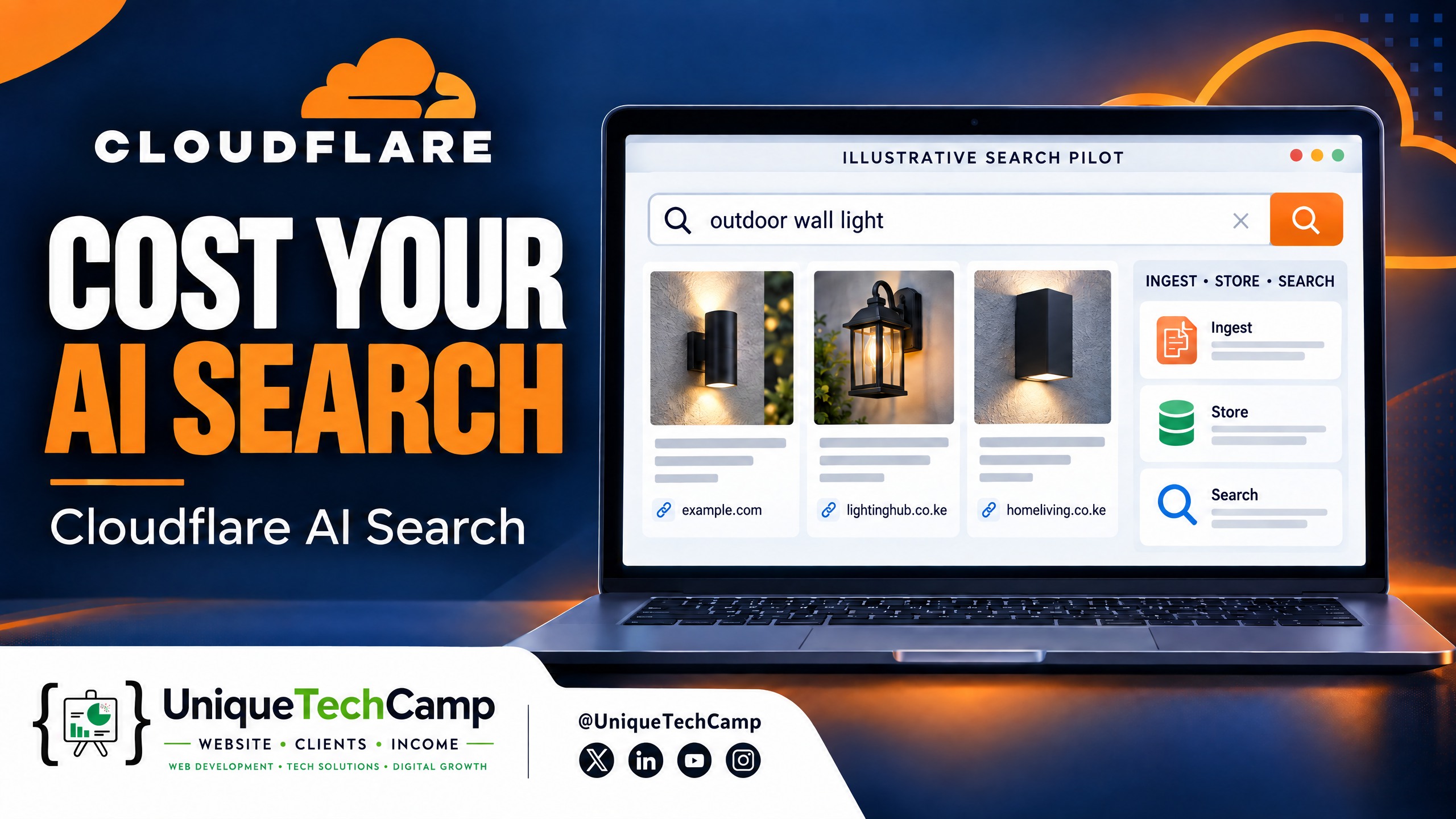
A customer visits a Kenyan business website looking for one practical answer: Is a particular product available, which service covers their area, what does a package include, or how can they book? Instead, they find an old PDF, a menu with no search, a product page with inconsistent wording or a general contact form. They leave, call the office or send a WhatsApp message that staff must answer from memory.
That is a website-discovery problem, not automatically a chatbot problem. A useful pilot makes public information easier to find while keeping the business responsible for current prices, stock, delivery promises and exceptions.
Cloudflare AI Search is a managed search option that can index a website corpus and return retrieved chunks through a Workers binding, REST API or MCP. A generation model can optionally turn those chunks into an answer. The distinction matters: retrieval finds passages; answer generation summarises them; neither step proves that a product is in live stock or that a quote is still valid.
For a Kenyan retailer, clinic administration team, school, contractor or professional firm, the sensible starting point is a small public-corpus pilot. Use approved pages and documents, compare the existing search with the candidate experience using the same fixed queries, record the source behind every answer and price the actual usage. The outcome should be a decision, not a promise of better conversion.
The customer problem: finding the right page is not the same as getting a live answer
Website search often fails in ways that ordinary traffic reports hide. A customer may search for “school fees for January intake” and receive an old article. Someone may enter a product code and get a loosely related category page. A visitor may ask whether delivery reaches Kisumu and see a generic nationwide statement that does not list exclusions. A service page may say “from” without explaining the conditions behind the price.
These are different failure types. A relevant source can be outdated, a fluent answer can cite the wrong product, and an index cannot know what has sold since. A pilot must separate those questions.
The proposed use case is bounded discovery from approved public content: help a visitor locate a service, product, policy, location, contact route or documented feature. The search experience should show or link the supporting source. Questions requiring a current stock ledger, a personalised quotation, clinical judgement, legal advice, payment confirmation or an exception decision should go to the business’s existing human or transactional system.
The UniqueTechCamp AI Solutions Desk can help map the website content, search interface and staff handoff without presenting retrieval as autonomous support.
What changed, and what is available now?
Cloudflare announced AI Search general availability on 1 October 2026, and its changelog records that GA date. The 1 November 2026 change is billing activation, not a fresh product launch. The official limits and pricing documentation was updated on 30 October 2026, so an implementation plan should recheck it and the account dashboard before approval.
The Cloudflare AI Search GA announcement describes the managed product, while the official GA changelog confirms the dated release status. The AI Search overview describes continuous indexing, metadata filtering, hybrid search, image and OCR support, and access through a Workers binding, REST API or MCP. Those are available surfaces, not a result benchmarked for a Kenyan website.
The current limits and pricing documentation says AI Search is available on Workers Free and Paid. Each account includes 5 million ingestion tokens, 10 GB-month of storage, 1,000 semantic queries and 1,000 full-text queries per month. Above those allowances, the published rates are US$0.75 per million base-ingestion tokens, an additional US$0.50 per million image-processing tokens, US$2.00 per GB-month of storage, US$0.75 per 1,000 semantic, vector or hybrid queries, and US$0.10 per 1,000 full-text queries.
Image processing uses the same 5-million-token ingestion pool; it is not a second allowance. Workers AI embedding and reranking are included. Generation, query rewriting and external model use can create separate costs. Do not assume a free allowance removes integration, review or maintenance work.
Budget at account level, not from one page’s usage. Apply the included allowances before the published rates, treating ingestion as a shared pool rather than separate text and image allowances. Keep generation, rewriting, engineering and staff review on separate budget lines. These rates are not a guaranteed invoice; check the actual account and plan.
A costed seven-step workflow for a small public-corpus pilot
Choose one public website area rather than every historical asset. Assign a content owner and developer, and decide in advance what evidence means proceed, pause or stop.
1. Choose the customer task and the approved corpus
Start with one customer task that can be answered from public, approved content. A retailer might choose “find a product by name or exact code and understand its published availability information”. A school might choose “find the current programme, intake and documented fee route”. A service firm might choose “find the right service page, coverage area and enquiry action”.
List the pages, PDFs, product records and images that may be indexed. Exclude old campaigns, drafts, duplicates and private records. Record each source’s owner, review date and update process; a pilot is not a licence to make an unmaintained website appear authoritative.
Keep the corpus small enough for a person to inspect. A free website crawl is limited to 500 pages per day. Workers Free also has limits including 100 instances per account and 100,000 files per instance; larger Paid allowances are not a reason to begin with a large archive.
2. Prepare content, codes and freshness rules
Before indexing, fix the basics that search cannot repair. Give each product or service a stable title, URL, category, identifier and reviewed date. Put exact codes in text, and distinguish a published price, enquiry-only amount, “available to enquire about” and “in stock now”.
Write a freshness rule for each content type. This does not make the index live; it defines what staff update and what the interface says when a current transactional check is unavailable.
For files, plain-text and code files and OCR-enabled PDFs can be up to 10 MiB, while PDFs without OCR and other formats remain subject to a 4 MiB limit. OCR text counts for ingestion and image processing. Test important scans and retain the source link for human verification.
3. Connect the smallest viable search surface
Use the least complicated interface. AI Search can be accessed through a Workers binding, REST API or MCP. Start with one catalogue page, retrieved passages and source links; keep generation off until retrieval has a baseline.
If the pilot uses Cloudflare’s website data source, read the official website data-source documentation before promising an integration. The website domain must be onboarded to the same Cloudflare account; owning the site alone is not enough. A sitemap is the default discovery method, with discover crawl as an alternative, and the website source is optional alongside AI Search’s built-in storage. This is a planned integration for an eligible, owned site—not a universal search widget that can be attached to any domain.
When limiting indexed paths, follow Cloudflare’s full-URL matching rules rather than assuming a path-only pattern will work. Do not disable a site-wide WAF or bot protection to make crawling work; inspect the crawler response and consider only a narrowly scoped, reviewed exception.
New instances default to hybrid search, which mixes keyword and semantic retrieval. Exact identifiers still deserve a specific test because semantic similarity can favour a related product over the exact code. If the corpus contains meaningful images, a native multimodal retrieval design requires an image-capable embedding model. With a text-only model, the system searches a generated image caption instead; that is not equivalent to matching the image itself.
Confirm the selected model, instance configuration, crawl method and account billing behaviour in the real environment. Generation and query rewriting are optional and may add external costs.
4. Build a fixed query set and a baseline
Before showing a candidate experience to customers, make a fixed query set. Keep it versioned and use the same queries against the current website search and the candidate. Include ordinary wording, synonyms, misspellings, an exact product code, a discontinued or absent code, a no-match question, a service-area question, a current-price question and an intentionally out-of-scope request.
For each query, record the expected source, acceptable alternatives, answer permission and handoff. An exact code should return its matching record or clearly say no match; it must not substitute a nearby code. A no-match query needs a useful route, not an invented product.
Use English queries by default, and add Kiswahili queries only where the business owns and approves equivalent Kiswahili content. Treat those cases as a separate test set; do not imply guaranteed Kiswahili performance merely because a query is accepted or an answer is fluent.
Query count is a measurement choice, not a promised number. Repeat the fixed cases after content or configuration changes. Sessions may contain several queries or reformulations; report query events and sessions separately.
UniqueTechCamp’s AI search scoping desk can help define this pilot’s approved corpus, source-link interface, staff handoff and usage reporting before rollout.
5. Review retrieval, answers and live-state boundaries separately
Score three layers independently: source relevance, correctness and currentness, then whether an optional answer faithfully reflects it without unsupported claims.
A fluent answer is not a pass. Require the correct, current source, preserved conditions and a route to the original page. For exact codes, require an exact match or explicit no-match. For stock, require a live catalogue or staff check; an indexed “in stock” phrase is historical.
Record retrieval and generation failures separately; a correct page that cannot establish live stock marks a transactional boundary, not a reason to sound more confident.
6. Add human ownership, privacy and maintenance controls
Name the content owner for prices, PDFs and corpus approval, the developer for integration and reindexing, and the staff route for quotes, delivery exceptions, payment checks and personalised recommendations.
Keep the first corpus public and minimise logs. Do not place customer records, unpublished prices or private order data into it. Review account access, retention, processing arrangements and data-location requirements with procurement or legal advisers; do not infer a Kenyan local-currency quote or Kenya-specific data residency.
Plan for reindexing: new content, corrections and overlapping chunks can change usage. Final chunked tokens include repeated overlap, so reindexing is a cost event to measure.
7. Run the go/no-go review and document the next build
Review the scorecard, freshness, no-match and exact-code behaviour, handoffs, usage and maintenance time. Decide: limited production, pause for correction, or stop because cost and burden outweigh discovery value.
A go decision should state the corpus, query types, handoff, freshness rule, billing owner, reindex trigger and review date. A pause should identify missing evidence, such as poor exact-code matching or an absent stock system.
Do not turn a pilot pass into a revenue forecast. For commercial impact, define a later comparison period and track search use, source clicks and qualified enquiries with a stated attribution method.
Measurement and limitations
Use a scorecard with query ID, expected and retrieved source, source age, relevance, correctness, answer fidelity, exact-code and no-match results, handoff and reviewer notes. Mark each case pass, review or fail: pass requires a relevant, current, sourced result within the permitted boundary; fail includes a wrong source, invented answer or old statement presented as live stock.
Compare the candidate with the existing search using identical queries and review rules. Record content, index, model, rewriting and generation changes between rounds.
Continuous indexing does not mean every stock change is reflected immediately. Retrieval depends on corpus, chunking, metadata, model and query; OCR can be incomplete, image embeddings need the right model, hybrid search does not guarantee exact matching, and generated answers can omit conditions.
The published allowances and rates do not describe the full business case. Add content, review, monitoring, interface, generation or query-rewrite, engineering and live-catalogue costs. The independent PPC Land billing report adds billing-date context, not an accuracy benchmark.
Frequently asked questions
Is Cloudflare AI Search a chatbot for customer support?
Not necessarily. It is a managed search capability that can retrieve chunks from an indexed corpus and can optionally support answer generation. A website can use it as a sourced discovery layer without creating a general chatbot. Keep support, complaints, payments, quotations and sensitive or personalised decisions with the appropriate human or transactional workflow.
Will it know whether a product is in stock in Kenya?
Not from indexing alone. An indexed page can describe a product or an earlier stock statement, but current stock requires a live, trusted source and a defined update path. If the pilot cannot connect that source, label the result as public information and route availability confirmation to staff rather than presenting it as live inventory.
What happens when someone searches for an exact product code that is absent?
The fixed-query test should require an explicit no-match or a carefully labelled related result. The experience must not silently replace an absent code with a similar product. Store the query and result for review, and give the customer a useful next step such as browsing the category or contacting the business.
Are the included allowances enough for a small pilot?
They may cover a small public corpus, but measure first. The account includes 5 million ingestion tokens, 10 GB-month storage, 1,000 semantic queries and 1,000 full-text queries each month. Reindexing, image processing, generation, external models and staff time can change the total; check the actual billing configuration.
Should a Kenyan business start with image search and generated answers?
Usually not. Start with approved text, source links, exact codes and no-match cases. Add image retrieval or generation only when the task requires it and the team can measure the complexity.
Conclusion
Cloudflare AI Search is worth considering as a bounded website-discovery pilot, especially when a business has a public catalogue that customers struggle to navigate. The practical opportunity is not to claim that an AI answer knows the business. It is to test whether the right approved source can be found, shown and maintained at a cost the owner accepts.
The timing should be stated accurately: AI Search reached general availability on 1 October 2026, while usage-based billing begins on 1 November 2026. Start with a small public corpus, fixed queries, exact-code and no-match cases, a separate review of retrieval and generation, and a firm boundary around live stock. Then make an explicit go, pause or no-go decision from observed evidence.
Need this built for your business?
If your team wants to turn a public catalogue into a measured search pilot, contact the UniqueTechCamp AI Solutions Desk . You can book a consultation or review the e-commerce storefront scoping service when product discovery, catalogue ownership and a future transaction flow need to be considered together.
Deploy An Autonomous AI Lead Gen System Today
We engineer high-converting web applications with integrated 24/7 WhatsApp qualification bots and multi-channel follow-up drips.
Related Strategy Articles

CrowdStrike AI Kill Switch: SME Team Reviewing an Agent Safety Dashboard
A practical SME playbook for reviewing CrowdStrike’s AI Kill Switch, testing agent containment safely, measuring trade-offs and checking Kenya eligibility.

Microsoft Agent 365 Business Analytics: An SME Readiness and Value-Validation Guide
Microsoft Agent 365 Business Analytics is in Frontier preview. Here is how Kenyan and East African SMEs can validate access, usage cost, value, privacy and readiness before buying licences for a dashboard.
Canva AI Controls: SME Design Review and Human Approval on a Laptop
A practical Canva AI Controls workflow for Kenyan and global SMEs: control settings, human review, asset provenance, measurements, costs and limitations.

UniqueTechCamp Desk
Online • Reply < 5 mins