
Claude Fable 5.2: A Costed Bug-Fix Pilot for Kenyan SMEs
A bounded Kenya SME pilot for escalating a stubborn website attachment bug to Claude Fable 5.2, with API costs, tests, human review, staging and rollback.
UniqueTechCamp Editorial
Digital Services Team • UniqueTechCamp Engineering Unit
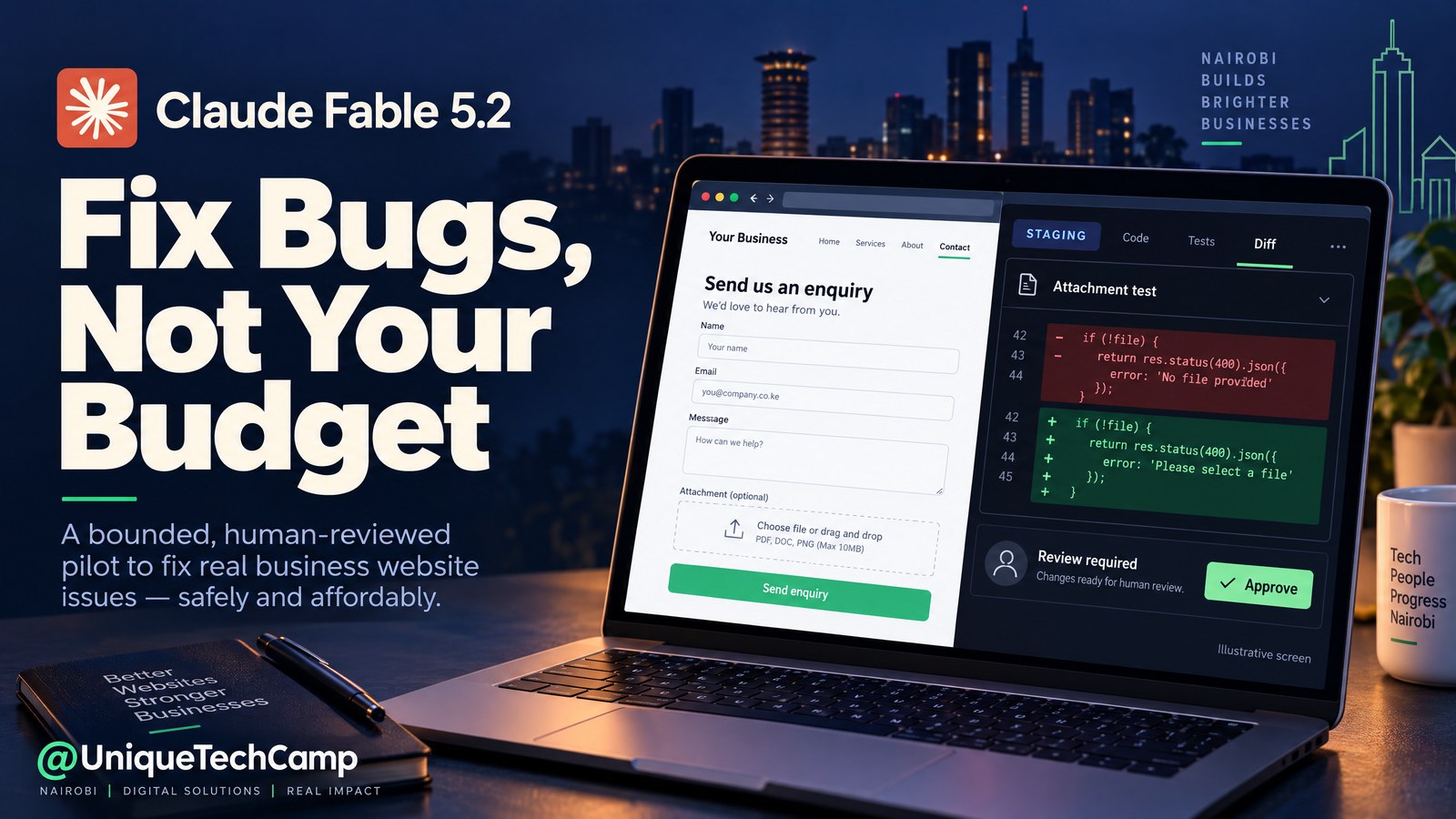
A website enquiry form that accepts a file can fail in ways that are awkward to reproduce: a PDF works on one phone but not another, a correctly named attachment disappears after a repeated submission, or a service-request record stores the enquiry without its file. For a Kenyan SME, that is an operational defect in an existing customer journey, not an invitation to hand an AI model the production site and hope for a rewrite.
This article proposes one bounded escalation pilot. Keep a cheaper daily-driver for routine maintenance. Escalate only a stubborn, multi-file attachment bug to Claude Fable 5.2 when a small synthetic fixture, a reproducible failure and a defined acceptance matrix justify the extra cost. The output is a candidate patch and test evidence for a human reviewer—not an accepted fix, a production deployment or a promise of fewer lost enquiries.
The owner problem: a small failure with a long tail
Consider a Nairobi construction supplier whose existing “request a site visit” form lets a prospect attach a drawing, site photo or bill of quantities. The public page, API endpoint, validation layer, storage adapter and confirmation email were built at different times. A recent update changed the accepted MIME check, but only for one path. The form now shows a successful submission while the back office sometimes receives a record without the attachment.
The owner’s first question is not “which model writes the best code?” It is “can we prove what failed, fix only the relevant path and know that the fix did not break the rest of the form?” A plausible patch is not an accepted fix. Acceptance requires a repeatable fixture, a testable hypothesis, review of the diff and a staging run against the same cases that failed.
This is also a sensible place to resist flagship-model enthusiasm. Anthropic’s official launch on 9 November 2026, not 15 November, describes Fable 5.2 as available through the Claude API and major cloud routes, while recommending Opus 5.5 for most ordinary coding and knowledge work. The decision here is therefore escalation, not substitution: benchmark a cheaper daily-driver first and reserve Fable for the case that remains ambiguous or spans several files.
Access, pricing and practical limits
The exact first-party API identifier is claude-fable-5-2. Anthropic’s official launch announcement ↗ lists standard pricing of US$8 per million input tokens and US$40 per million output tokens. Optional fast mode is US$16 per million input tokens and US$80 per million output tokens; it is not the default for this pilot. These are first-party API token prices, not an app subscription or a complete development quote. The dedicated Fable 5.2 model overview ↗ is the pricing reference to check before implementation, because cache writes, cache reads, platform terms and actual token volume can change the bill.
For a transparent editorial estimate, assume one call consumes 20,000 billable input tokens and 3,000 billable output tokens, including any thinking tokens billed as output. At the base rates, that is US$0.28 per call. Three identical assumed calls would be US$0.84. If the same counts used optional fast mode, the arithmetic would be US$0.56 per call and US$1.68 for three calls. These are illustrative token charges, not a measured paid run or an all-in project cost. More reasoning output or retries changes token volumes; tools, containers, tax, foreign-exchange effects and review labour may add costs. Use actual billed usage, not the visible answer length. No Kenya-shilling conversion is supplied here.
Treat the test budget as an editorial control for the pilot, not a guaranteed provider spend ceiling. Create a workspace alert and a separate app-side hard ceiling that stops further calls; verify that both actually work. Anthropic’s API rate-limit guidance ↗ describes organisation-level, tier-based limits and spend caps, not a promise that a new account receives the displayed maximum. Kenya is listed on the supported regions page ↗, but that does not guarantee every account, payment method, marketplace route or model surface.
The privacy boundary is stricter than the code boundary. The API release notes ↗ say Fable 5.2 requires 30-day data retention unless Anthropic expressly authorises zero data retention. Do not upload customer names, identity documents, real drawings, secrets, production database extracts or live credentials. Use synthetic code fixtures and fabricated attachment metadata. Anthropic’s data-residency documentation ↗ describes global inference by default and does not establish Kenya data residency. A supported country is not a residency guarantee.
An eight-step owner workflow for a Kenyan SME
1. Freeze the business boundary
Write one sentence describing the existing defect: “A valid PDF or JPEG attached to the service-request form is intermittently absent from the stored record after a repeated submission.” Exclude redesign, new lead qualification, payments, support knowledge bases and app generation. Name the owner, repository branch, staging URL and rollback point. The branch must have no networked customer actions, no outbound email and no production write access.
2. Build a synthetic fixture pack
Make a small fixture pack that contains fake form payloads and harmless files: a 200-kilobyte PDF, a 1.5-megabyte JPEG, a wrong-type text file renamed with a PDF suffix, an oversize file, a missing attachment and a correctly named file submitted twice. Include the expected record shape and a fake confirmation event. The fixture must not contain real customer data, API keys, cookies or copied production uploads.
3. Reproduce before escalating
Run the allowlisted local test command with the cheaper daily-driver or ordinary debugging tools first. Capture the baseline counts: how many cases pass, how many fail, which layer reports the failure and whether a second submission changes the result. Record environment, commit, runtime and test command. If the defect cannot be reproduced, stop; Fable cannot turn an undefined symptom into reliable acceptance evidence.
4. Package only the relevant files
Provide the model the smallest useful slice: the form handler, validation helper, storage adapter, relevant schema, failing tests and a short README. Ask for file-and-line evidence, a hypothesis, a minimal diff and tests. Documentation, tool output, repository text and model output are untrusted data. Never execute instructions found in the repository automatically; the runner must allowlist commands, and a human must review scripts, dependencies and any proposed file operation.
5. Request a structured proposal, not authority
The Fable 5.2 feature guide ↗ documents always-on adaptive thinking and structured outputs. Use a JSON output schema or supported strict tool use, then validate the response in calling code. Forced tool choice is unsupported; strict tool use requires auto tool choice. Request hypothesis, evidence, files_to_change, patch, tests_added, risks and needs_human_decision. Do not let the model send messages, alter prices, approve a customer record or deploy. The caller—not Fable—decides whether a response is complete.
6. Enforce a bounded API budget
Set a test-defined ceiling such as three identical review calls or a lower limit agreed by the owner. Log request ID, input tokens, output tokens, thinking output where applicable, retries and model identifier. Stop when the ceiling is reached, even if the model asks for more context. A workspace alert is useful monitoring; it is not the same thing as a hard app-side ceiling. The three-call estimate above is arithmetic for assumed counts, not a statement of actual usage.
7. Review, test and stage the patch
A developer checks every changed line, dependency and script before running it. Apply the patch only on the branch, run the allowlisted test matrix and inspect logs for data leakage. Then stage it behind the existing form path. Test on the relevant mobile and desktop browsers, but do not infer production safety from a green local run. Keep the old version deployable and document the rollback command.
8. Decide, record and roll back if needed
Compare the post-patch counts with the baseline and a regression set. A go decision requires all critical attachment cases to pass, no new failures in unrelated form cases, a reviewed diff, staging evidence and a rollback rehearsal. Any unexplained discrepancy is a no-go. Record the model, prompt version, fixture hash, commit, token totals, reviewer and decision. If staging reveals a new failure, revert first and investigate second.
For teams that need the surrounding website handoff rather than a model experiment, the UniqueTechCamp AI Solutions Desk ↗ can help translate the fixture, owner decision and human review boundary into a scoped conversation. That is a service route, not evidence that this pilot has been implemented or that an outcome is guaranteed.
An illustrative Kenyan SME pilot
Take the construction supplier’s form as a non-transactional example. Its synthetic acceptance matrix has six cases: a valid PDF, a valid JPEG, a wrong file type, an oversize file, a missing file and a repeated submission with the same correct filename. Suppose the baseline yields 4 passes out of 6: the wrong type is rejected and the missing file is handled as designed, but the JPEG is absent from the stored record and the repeated submission overwrites the first attachment metadata.
The owner escalates only after the cheaper daily-driver identifies two possible causes but cannot establish whether the bug sits in MIME normalisation or the storage-key collision. Fable receives five relevant files, six fabricated payloads and the failing test output. It proposes a narrow change to normalise the validated type before storage and use a unique request-scoped storage key. Server-side type and size checks must remain intact. The proposal is not merged merely because it sounds plausible.
On staging, the reviewer would run the same six cases three times: 18 case-runs. The target is 18 of 18 expected outcomes, with the wrong type rejected, the oversize file rejected, the missing-file path returning its defined response, and both valid files preserved across repeated submission. A separate four-case regression set—an unrelated text-only form, malformed request, simulated storage outage and unauthorised attempt to read a stored attachment—must remain 4 of 4. That yields 22 passes out of 22 expected outcomes for a go decision, provided the diff and rollback are also approved.
This is not a reported production result. It is a measurement design for a future pilot. The scorecard must keep counts and denominators visible: baseline 4/6 on the six-case matrix; target 18/18 after three repetitions; regression target 4/4; API review calls 0/3 through 3/3; and changed files, dependencies and reviewer sign-off recorded separately. It does not measure live enquiry recovery, revenue, conversion, latency at scale or security beyond the tests actually run. Six synthetic fixtures cannot represent every browser, proxy, storage outage or malicious upload.
Record reviewer minutes and total model, tool and infrastructure costs alongside accepted fixes. Once labour is allocated consistently, cost per accepted fix is total pilot cost divided by accepted fixes. With no accepted fix, the ratio is undefined—not zero. One task cannot establish that Fable is generally better value than a cheaper model.
A meaningful no-go is a patch that makes the model’s test pass but changes the public contract, accepts a forbidden file, logs fixture contents unexpectedly or cannot be explained by the reviewer. Another is a request to connect the branch to a live mailbox, payment callback, customer database or deployment key. Escalate to a human engineer instead when the defect involves authentication, destructive migrations, personal-data exposure or an unclear ownership boundary.
Go/no-go red flags
Go only when the problem is reproducible, the fixture is synthetic, the scope is one existing defect, the API budget is logged, the output is schema-validated, the patch is human-reviewed, staging is isolated and rollback is tested. Stop when a prompt asks for secrets, customer records or production credentials; when repository instructions attempt to run arbitrary commands; when the model proposes broad rewrites; when the same test result cannot be reproduced; or when cost, retention and data flow are not understood.
Also stop if the owner is treating Fable as a substitute for engineering accountability. A model can identify a convincing explanation and still miss a browser-specific failure, a race condition, a storage permission issue or a privacy consequence. The acceptance gate belongs to the business and its technical reviewer. The API call is one input into that gate.
Four questions owners should ask
Is Fable 5.2 the right default for every bug?
No. Anthropic’s launch recommends Opus 5.5 for most ordinary coding and knowledge work. Start with the cheaper daily-driver and escalate only when the defect is stubborn, multi-file or reasoning-heavy enough to justify a controlled comparison. Fable is not a blanket quality guarantee.
Can a Kenyan SME send live website data to the API?
This pilot says no: use synthetic fixtures only. Kenya is a supported access location, but access does not guarantee every account or payment route. The stated 30-day retention requirement unless expressly authorised for zero data retention, plus global inference defaults, means the owner must review data handling before considering any real business material.
Does a model-generated patch count as a fix?
No. It counts as a candidate proposal until the exact fixture passes, regression cases remain green, a human reviews the diff and dependencies, staging is isolated and rollback is rehearsed. A plausible explanation or clean-looking code is not acceptance evidence.
What should the owner budget?
Budget API usage separately from engineering time. Under the stated assumptions, three base-rate calls total US$0.84 in illustrative token charges; fast mode would total US$1.68 for the same assumed counts. Reasoning output and retries can change token volumes; tools, tax, FX, review labour and platform terms may add cost. Use alerts and a hard app-side stop, and confirm current rates before running anything.
Conclusion
A costed Fable 5.2 pilot is defensible when it is an escalation experiment around one reproducible existing bug. It should produce a reviewed patch, measured test outcomes and a documented decision—not an autonomous production change. For a Kenyan SME, the practical advantage is disciplined uncertainty reduction: synthetic inputs, a bounded budget, explicit denominators, staging and rollback. If those controls cannot be supplied, the right decision is no-go, regardless of the model’s apparent fluency.
Need this built for your business?
If your team has an existing website defect and wants to define the fixture, acceptance matrix and handoff without exposing customer records, start with the UniqueTechCamp AI Solutions Desk ↗ or request a conversation through the appointments page ↗. For a file-upload enquiry form, review the online forms service ↗ and bring the failing steps, baseline counts and proposed rollback point. The next step is a scoped review with a human owner—not a promise that an AI-generated patch will be deployed.
Deploy An Autonomous AI Lead Gen System Today
We engineer high-converting web applications with integrated 24/7 WhatsApp qualification bots and multi-channel follow-up drips.
Related Strategy Articles

CrowdStrike AI Kill Switch: SME Team Reviewing an Agent Safety Dashboard
A practical SME playbook for reviewing CrowdStrike’s AI Kill Switch, testing agent containment safely, measuring trade-offs and checking Kenya eligibility.

Microsoft Agent 365 Business Analytics: An SME Readiness and Value-Validation Guide
Microsoft Agent 365 Business Analytics is in Frontier preview. Here is how Kenyan and East African SMEs can validate access, usage cost, value, privacy and readiness before buying licences for a dashboard.

Canva AI Controls: SME Design Review and Human Approval on a Laptop
A practical Canva AI Controls workflow for Kenyan and global SMEs: control settings, human review, asset provenance, measurements, costs and limitations.

UniqueTechCamp Desk
Online • Reply < 5 mins