
ChatGPT Wallet: A Kenyan SME Checkout Readiness Guide
A Kenyan SME checklist for ChatGPT Wallet readiness: approval, tokenised payments, order confirmation, risk controls and measurement limits.
UniqueTechCamp Editorial
Digital Services Team • UniqueTechCamp Engineering Unit
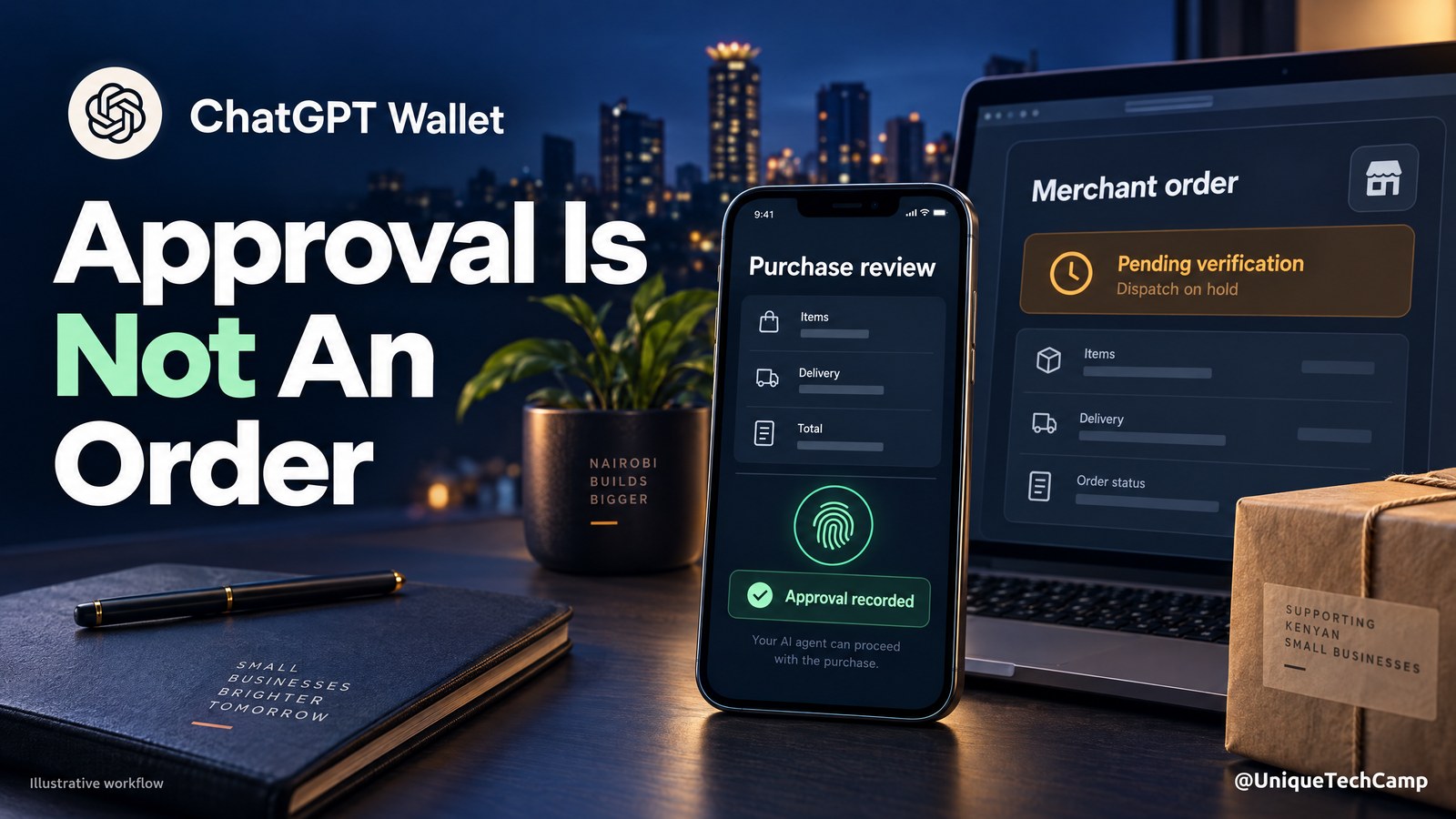
ChatGPT Wallet changes the question a merchant should ask about agentic checkout. It is not simply “Can an agent click the pay button?” The useful question is whether your business can distinguish a customer’s purchase approval from a payment-provider result and from an order your team has actually accepted and can fulfil.
OpenAI announced ChatGPT Wallet on 13 November 2026. At launch, it described Wallet through dots for ChatGPT Pro users aged 18 and over in the United States with eligible US-issued cards. That is not evidence that Kenyan consumers can enrol, nor that a Kenyan merchant or payment service provider (PSP) can accept Wallet. Treat this article as a checkout-readiness guide for Kenyan SMEs, not a Kenya availability announcement.
The business problem: three events that must not be confused
A normal web checkout already has several hand-offs. Wallet makes the boundary especially important because a user can approve a particular purchase before your website, PSP, issuer or fulfilment team has accepted it.
First comes purchase approval. The eligible user reviews the merchant, items, quantity, total or maximum price, known charges, card and any recurring-payment terms, then completes a security check such as Face ID or a fingerprint. Wallet records that user authorisation. The approval is about the specific purchase the user reviewed.
Second comes the payment-provider result. After approval, a payment network can provide a tokenised credential containing card details for the checkout rather than exposing the customer’s actual card details to the business or agent. The merchant’s checkout and its PSP still need to process that credential. An issuer or risk system may decline, hold or challenge it.
Third comes merchant order and fulfilment readiness. Your system must decide whether an order was accepted, assign an order reference, reserve stock, send a merchant confirmation and hand the job to fulfilment. OpenAI’s help guidance is explicit that “Ready to check out” means approval is complete, not that the merchant has placed the order. After a timeout, pending charge or unclear screen, a customer should check the merchant confirmation or receipt before retrying.
Those are operational distinctions, not semantics. If an SME treats approval as an accepted order, it can duplicate orders, release stock without a confirmed payment, or tell a customer that a refund is coming when the merchant has not accepted anything. A tokenised card credential is not a promise that a Kenyan PSP, issuer, fraud engine or delivery workflow will accept the transaction.
Access, pricing and practical limits
The OpenAI Wallet announcement describes an approval record, a payment token that substitutes for the user’s card details, and compatibility with existing checkout pages. The Wallet help article gives more specific current eligibility: US Pro users aged 18 or over, resident in the US with a US billing address and an eligible US-issued American Express, Chase, Mastercard or Visa card. It also says Wallet works in conversations with a dot, not in Chat, Work or standalone Codex threads.
For a Kenyan merchant, the safe interpretation is narrow. OpenAI says an ordinary existing website checkout does not require a Wallet-specific integration, but the checkout must still process the tokenised credential and the surrounding payment and risk systems must allow a legitimate agent purchase. The Accept payments guide says your business handles the order, fulfilment, customer support and fraud decisions. The ChatGPT Wallet Terms identify the selling merchant as merchant of record and state that Wallet is not a bank account, stored balance or credit facility. The separate product-feed submission guide describes catalogue onboarding; that is not a prerequisite for an ordinary existing checkout.
No official source reviewed for this guide confirms Kenyan consumer enrolment, Kenyan-issued-card eligibility, a particular Kenyan PSP’s Wallet acceptance or a Kenya-specific rollout. A Kenyan merchant may have an ordinary card checkout and still fail a Wallet attempt. Conversely, a test that passes in one environment does not establish support for every issuer, card network, browser, currency or risk configuration.
Pricing needs the same discipline. The cited announcement, help article, terms and merchant guides do not publish a numeric Wallet-specific merchant fee, commission, surcharge or subscription price for accepting Wallet. Do not call Wallet “free”, and do not borrow a fee from another Instant Checkout or product-feed story. Existing card, PSP, network, conversion, issuer or other charges remain governed by the relevant agreements. Budget for your own engineering, monitoring, support, reconciliation and controlled testing without inventing a Wallet fee.
An eight-step owner workflow for a Kenyan SME
This workflow is an editorial recommendation, not an official OpenAI capability or success promise. Use a staging environment wherever your provider permits it, and ask your PSP and risk partners what they actually support.
1. Define the order state machine
Separate any customer-reported approval from your own order states: cart created, payment submitted, provider authorised, merchant order accepted, fulfilment queued, dispatched, cancelled, refunded and disputed. An ordinary checkout may not receive Wallet’s internal approval event or log. Give each merchant state an owner and an allowed next state. “Customer approved” must not automatically become “order accepted”.
2. Capture an unambiguous order summary
Make the page and internal payload agree on merchant identity, SKU or service, quantity, variant, delivery location, taxes, shipping, total and order reference. If a price can change, require the current total to be reviewed again. Recurring billing, deposits or authorisation holds need separate, conspicuous terms and an explicit customer agreement.
3. Confirm token and PSP handling
Ask your PSP, acquirer and risk provider whether their current integration can handle the relevant tokenised card credential, currency, 3-D Secure or step-up path, settlement and webhook statuses. Get answers in writing for test and production environments. Do not infer acceptance from a generic card logo or from an OpenAI partner list.
4. Inspect bot and edge controls safely
Review CDN, firewall, WAF, CAPTCHA, rate limits, device fingerprinting and bot rules. OpenAI’s commerce playbook discusses verified agent access and signed requests. Verify signed requests with the provider where that mechanism is available. Never blanket-disable fraud controls, trust a user-agent string by itself, or add an allow rule that bypasses authentication, velocity limits or payment review.
5. Build idempotent order confirmation
Use a unique checkout or merchant order reference and make retries safe. Accept a provider callback only after authenticating and validating it, then compare amount, currency, status and reference. A browser redirect, screenshot, conversation message or initial authorisation is not sufficient evidence for fulfilment. If the result is pending, hold the order and show the customer how to contact support.
6. Preserve the merchant receipt trail
Send a receipt or confirmation only when your own acceptance rule is satisfied. Retain merchant order references, provider event IDs, timestamps, state changes and only the approval context your integration legitimately supplies. Do not assume access to Wallet’s private approval log, or collect security codes or biometric data. Explain that the merchant handles cancellations, returns and refunds. A declined, pending, disputed or unrecognised card charge belongs with the card issuer; an order-status question belongs with the merchant.
7. Test exceptions with a named owner
On staging, test duplicate submission, timeout after approval, declined token, delayed webhook, amount mismatch, unavailable stock, changed delivery fee, customer cancellation and an interrupted conversation. Assign a person to each exception. The expected result is not “the agent always succeeds”; it is a safe, visible state with no unauthorised fulfilment and a usable support path.
8. Approve a narrow go/no-go decision
Document the tested environment, merchant, PSP, issuer/card conditions, currency, device, date, result and open risks. Go only for the exact path your provider supports, with monitoring and rollback. No-go if you cannot prove order confirmation, reconcile payment to the correct order, explain pending states, or keep fraud and security controls intact.
Worked example: a Kenyan retailer without a real transaction
Consider Mtaa Home Store, an illustrative Nairobi retailer selling a KES 8,450 kitchen appliance basket including delivery. This is a worked example only: no transaction has taken place, no Wallet availability is implied, and the amount is not a market price or quotation.
The owner first records the basket, delivery zone, stock reservation rule and order reference. The customer-facing approval summary shows the merchant, appliance, quantity, delivery charge and KES 8,450 total. The owner’s acceptance rule is: matching authenticated provider result, exact amount and currency, one unused order reference, and stock available.
In staging, the team simulates four outcomes: accepted payment with a matching webhook; a provider decline; a timeout after apparent approval; and a duplicate retry. Only the first moves to “merchant order accepted”. The timeout remains “payment status pending—do not retry until support checks the reference”. The duplicate is rejected as already processed. Staff receive a test receipt containing the order reference and status rather than a vague “paid” message.
The retailer then asks its PSP whether tokenised credentials, the intended currency and agent-origin traffic are supported. If the PSP cannot confirm, the result is not a failed Kenyan Wallet launch; it is an unresolved readiness question. The team can still improve ordinary checkout reliability without claiming that Wallet will work.
At UniqueTechCamp’s AI Solutions Desk , a team could turn this example into a test matrix and hand-off map, but that would be implementation planning—not certification of Wallet acceptance.
A seven-day test and measurement scorecard
The following is an editorial test plan, not an official Wallet benchmark. A seven-day window can expose workflow defects; it cannot prove national availability, long-term conversion, profitability or issuer coverage. Use synthetic or authorised staging tests where real provider rules and customer consent require it. Do not make a real payment merely to create a marketing statistic.
Use a previously recorded seven-day ordinary-checkout baseline: attempts, completed merchant orders, provider declines, pending cases, duplicates, support contacts, fulfilment exceptions and reconciliation mismatches. If none exists, collect it first; that extends the exercise beyond one week. During the readiness week, run narrow permitted tests with unchanged definitions, recording the date, device, browser, currency, PSP, issuer conditions and whether each run was simulated.
A useful scorecard has these columns: attempts; approvals observed; provider-authorised results; merchant-accepted orders; confirmation receipts sent; pending or unclear cases; duplicates prevented; amount mismatches; stock or delivery exceptions; median time from provider result to order state; and human support escalations. Record approvals only where an eligible, consenting test participant can demonstrate them; otherwise mark them “not observable”. Report counts and denominators, not just a success percentage. Seven days is too short for a meaningful estimate of rare fraud, chargebacks, seasonal demand or every eligible card type.
Recommended success criteria are: every accepted test has one traceable order reference; no approval alone triggers fulfilment; mismatched amount or currency is blocked; duplicate retry is idempotent; pending status is visible; authenticated provider evidence is stored; receipts use the merchant’s acceptance state; and a named human can resolve an unclear result. These are editorial controls, not official Wallet requirements.
Go, no-go and red flags
A cautious go means the PSP has confirmed the tested path, the merchant can reconcile an authenticated result, risk controls remain active, fulfilment starts only after acceptance, and support staff know how to handle pending, declined and disputed cases. It means “go for this limited test or supported path”, not “Wallet works everywhere”.
A no-go means the PSP or issuer position is unknown, the checkout cannot distinguish approval from order acceptance, webhooks are unauthenticated, retries create duplicate orders, or the team cannot explain where the customer should go for a refund or charge dispute.
Red flags include a request to disable the WAF or CAPTCHA globally; an instruction to trust any claimed agent user-agent; a screenshot treated as proof of payment; a customer asked to share a card PIN; a one-purchase credential reused for an unrelated order, or renewal billing without the customer’s agreed recurring terms; a “free” Wallet claim without an official source; or a plan to advertise Kenyan availability before it is confirmed.
Four questions owners should ask
Can Kenyan customers use ChatGPT Wallet now?
The cited official eligibility statement is for US Pro users aged 18 or over who reside in the United States, have a US billing address and use an eligible US-issued card. No source reviewed here confirms Kenyan consumer enrolment or a Kenyan-issued-card route. Do not market Wallet as available to Kenyan consumers on this evidence.
Does a Kenyan shop need a special Wallet plugin?
OpenAI’s payment guidance says an existing website checkout does not need Wallet-specific integration. That does not guarantee acceptance. The shop still needs a checkout and PSP that can handle the tokenised credential, risk review, agent traffic and relevant geographic and issuer conditions. Ask the providers; do not infer support from an ordinary card checkout.
If the customer approves, can we dispatch immediately?
No. Approval records the customer’s authorisation of a specific purchase. Your merchant system must receive and validate its own payment evidence, decide whether to accept the order, confirm stock and issue a merchant receipt before fulfilment. After a timeout or unclear result, check order status rather than blindly retrying.
What fee should we budget for Wallet?
The official materials reviewed do not publish a numeric Wallet-specific merchant fee. Do not call it free or import a fee from another OpenAI commerce product. Budget for ordinary PSP and card arrangements as applicable, plus engineering, monitoring, reconciliation, support and staging work. Obtain current commercial terms directly from your providers.
Conclusion
ChatGPT Wallet’s practical business test is an evidence handshake: the user approves a defined purchase, the payment stack returns a trustworthy result, and the merchant independently confirms an order it can fulfil. For a Kenyan SME, the sensible next step is readiness work—state definitions, PSP questions, signed-request verification, safe bot controls, idempotent callbacks, receipts and a small scorecard—not a claim that Wallet has launched in Kenya. This article is operational guidance, not financial or legal advice. Confirm current product, provider and regulatory conditions with the relevant parties.
Need this built for your business?
If your team needs a checkout, order-confirmation or payment-integration review, start with the UniqueTechCamp AI Solutions Desk , request a conversation through appointments , or review the payment integration service . Bring one checkout URL or staging flow, your PSP details, order states, receipt examples and the exceptions your staff currently handle. The goal is a scoped test and a clear owner workflow—not a promise of Wallet availability or earnings.
Deploy An Autonomous AI Lead Gen System Today
We engineer high-converting web applications with integrated 24/7 WhatsApp qualification bots and multi-channel follow-up drips.
Related Strategy Articles

Gemini Small-Business Tools: A Safe Growth Pilot for Kenyan SMEs
Google's Gemini business page brings brand, finance and app tools together. A cautious pilot for Kenyan SMEs, with privacy and review checks.

Google Docs Captions and Cross-References for Kenyan SMEs
Use Google Docs captions, cross-references and caption tables to keep Kenyan SME reports and tender documents easier to navigate after edits.

ChatGPT for Sales: A Human-Reviewed CRM Pilot for Kenyan SMEs
OpenAI's new ChatGPT for Sales adds sales workflows. Learn how Kenyan SMEs can pilot CRM connections with human review, privacy checks and clear measures.

UniqueTechCamp Desk
Online • Reply < 5 mins