Businesses in ChatGPT: A Kenyan SME Profile Checklist
Kenya-focused checklist for Businesses in ChatGPT eligibility, facts, verification and safe measurement of aggregate visibility for SMEs.
UniqueTechCamp Editorial
Digital Services Team • UniqueTechCamp Engineering Unit
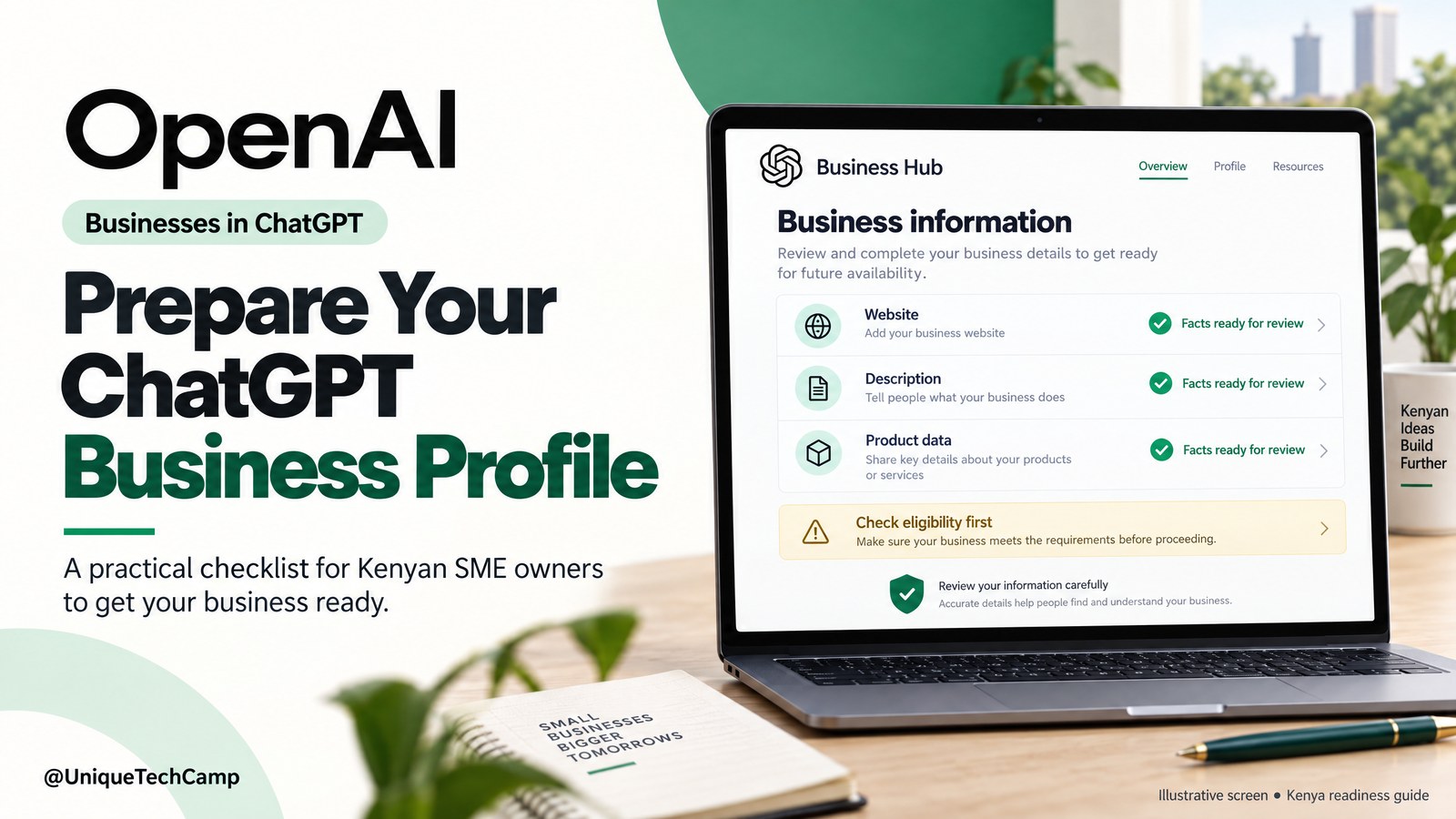
OpenAI’s 10 November 2026 launch announcement makes Businesses in ChatGPT easy to misunderstand. It is not simply another advertising placement, a guaranteed search-ranking channel or a replacement for a website. It is a Business Hub workflow through which an authorised business representative may be able to claim an existing business profile, submit accurate details, connect product information and view aggregate insights about how that business appears in ChatGPT.
There is an important Kenya-specific limit to understand before anyone prepares a sales pitch. Kenyan local shops and restaurants are not eligible for a new listing under the current help guidance; local stores and restaurants can currently claim only an existing US listing. Business Agents are described as available to eligible e-commerce and online-service businesses in the US with a website. ChatGPT being available in Kenya does not automatically make every Business Hub feature available to every Kenyan business.
That makes readiness more useful than hype. This checklist is for a fictional example, Mwangaza Office Supplies, an online Kenyan business used only to illustrate the process. It is not a client case study and contains no claimed visibility or revenue result. A reader who is not eligible can still prepare authoritative public facts, product or service information and a clear website; no account claim or purchase is required for that preparation.
What Businesses in ChatGPT is — and is not
OpenAI’s official Businesses in ChatGPT overview describes a profile, product feeds, Business Agents and insights as related parts of the product. A profile may include a website, description, category, logo, delivery policy, return policy and an optional cover photo. OpenAI says it reviews and publishes changes, and that updates can take time. ChatGPT may continue to use other sources, so submitting a correction is not the same as controlling every answer.
The separate Business Hub setup guide says claim verification may use a business phone, business email, website-domain DNS TXT record or Shopify, depending on what is offered. After a claim is approved, Persona identity verification is required before publishing information changes, connecting a product feed, viewing insights or creating an eligible agent. Persona may request government identification, business-registration information and proof that the person is authorised to act for the business.
Treat that identity step carefully. Sensitive identity documents should be submitted only through the official verification flow, not to a consultant, a chat conversation or an unofficial upload form. This article is operational guidance, not legal advice; ask a qualified adviser about your business’s privacy, data-retention and authorisation obligations.
A product seller may connect a Shopify feed or upload a CSV feed that follows OpenAI’s product-feed specification. A feed can communicate prices and availability, but it does not publish an agent or guarantee that ChatGPT recommends products. The current Business Agent experience explains products and policies and links to the business website; it cannot complete purchases, bookings or order checks in the agent chat.
Do not confuse Business Hub with the paid ChatGPT Business workspace. The official ChatGPT Business overview currently lists Standard seats at US$25 per user per month, billed monthly or US$20 per user per month, billed annually, with a minimum of two seats; those are workspace prices, not a fee for claiming a Business Hub profile. Prices may vary by country and currency, and API usage is billed separately. The setup guidance does not state a separate profile-claim fee. Do not infer that claiming is free or that buying a workspace is required.
The Kenya eligibility gate comes first
The supported-countries guidance establishes that people in Kenya can access ChatGPT. It does not establish automatic eligibility for every business feature. OpenAI says availability depends on business location, business type and supported verification.
For a Nairobi café, neighbourhood restaurant, salon or physical retail shop, do not promise that a new Kenyan local listing can be created. The current help guidance says local stores and restaurants can claim only an existing US listing. For a Kenyan online business, the cautious path is to check whether the business appears in Business Hub and whether OpenAI offers a supported verification method for that specific listing. Do not promise a Business Agent simply because the organisation sells online.
A sensible owner separates three questions:
- Is the business real, accurately represented and authorised to be claimed?
- Is an existing listing visible, and does the offered verification method match the business’s evidence?
- Does the specific business receive an eligible agent option, or only profile and information features?
If the answer to the second or third question is no, stop at preparation. Keep the public website current, publish consistent business facts and organise product or service data. That work can improve operational accuracy without implying that a feature will be unlocked.
A practical workflow for a Kenyan SME
1. Build a facts pack before opening Business Hub
Nominate one owner and gather a short facts pack: the exact trading name, registered name where relevant, website URL, business email, phone, physical or service-area description, category, operating hours, delivery coverage, returns policy and a current logo. Add registration evidence and a note naming the person authorised to represent the organisation. For products, include SKU, title, variant, price, currency, stock or availability, delivery information and the page where a customer can verify the item. For services, include service names, locations served, booking or enquiry route, typical response expectations and exclusions.
Use the website as the source of truth. Mwangaza Office Supplies might discover that its social bio says “delivery nationwide” while its checkout page excludes several counties. Resolve that difference before claiming anything. A facts pack is valuable even if the business later fails the eligibility gate: it gives staff a controlled reference for website updates and customer enquiries.
2. Apply the location and business-type eligibility gate
Now check the official help guidance against the actual business. Record the business country, business type, whether it is online or local, and whether Business Hub shows an existing listing. For a Kenyan local shop or restaurant, mark a new local listing as not currently eligible under the stated guidance. Do not turn the existence of a physical address into an agent promise.
For a Kenyan online business, record what is actually displayed: listing found or not found, verification methods offered, profile features visible and agent option visible or absent. Take a dated internal screenshot only if your privacy and security policy permits it; never circulate identity documents with the screenshot. If the listing is absent or the route is unavailable, move to the preparation branch rather than repeatedly trying random accounts.
3. Use only the authorised verification route
If an eligible listing appears, the authorised representative should select only the method offered by OpenAI: phone, business email, DNS TXT or Shopify where applicable. The domain method requires access to the organisation’s DNS administration, not a promise from a marketing supplier. The email method requires a controlled business inbox. Shopify evidence should belong to the business and match the claimed trading identity.
Keep a record of who initiated the claim, which evidence was used and when a review was requested. Do not ask an agency to impersonate the owner, purchase an unrelated workspace or upload a director’s identity document to a shared drive. Verification can fail because names, domains, addresses or business records do not align. Treat a pending review as pending, not as approval.
4. Complete Persona verification with the right person
After claim approval, Persona identity verification is a gate before the business can publish profile changes, connect a feed, view insights or create an eligible agent. The representative should compare the business name, address, registration information and authorisation evidence before submitting. If the legal structure is complex, decide who has authority before starting rather than forwarding documents between staff.
Submit sensitive identity documents only in the official Persona flow reached from the Business Hub process. Do not send a government ID to a consultant, to this article’s publisher or to a ChatGPT conversation. Minimise copies and access, follow the organisation’s privacy controls and obtain professional legal advice for questions about Kenyan data-protection duties. Passing identity verification does not prove that an agent is available in Kenya.
5. Prepare the profile and product or service data
Once the account shows the relevant capabilities, prepare concise edits: a factual description, correct category, website, logo, cover image, delivery policy and returns policy. Avoid stuffing keywords or claiming awards, locations or stock that the business cannot support. Keep each important claim visible on the public website so a reader can verify it outside ChatGPT.
Pause for owner review before publishing. The setup help documents a material limitation: only unpublished draft profiles can be deleted; OpenAI Support cannot delete, unpublish or hide a published profile as part of setup or ownership requests. That is not a legal interpretation, but it means a published edit should not be treated as having a simple undo button. Confirm the facts, authority and wording before submission.
A product seller should reconcile the feed with the live catalogue. For independent website AI and automation context, see the UniqueTechCamp AI Solutions Desk ; that route is not a Business Hub access path. Check price, currency, availability, variants and destination pages, then test a small sample for stale or contradictory information. A service business should do the equivalent with coverage, hours, fees where published, booking steps and exclusions. A feed communicates data; it does not guarantee product recommendations. OpenAI may review and publish changes, and updates may take time.
6. Treat the agent option as a separate eligibility decision
Do not bundle a profile claim and a Business Agent into one deliverable. OpenAI’s current guidance says Business Agents are for eligible e-commerce and online-service businesses in the US with a website, while local stores and restaurants can currently claim only an existing US listing. A Kenyan business should not plan an agent launch unless OpenAI’s eligibility guidance changes and its own account is approved.
If an agent option does appear, review common product and policy questions before publishing. Check that answers link to the website, do not invent stock or delivery commitments and route uncertain questions to a person. Remember that agent chat cannot complete a purchase, booking or order check. A human or approved website flow still owns payment, fulfilment, appointment capacity and exceptions.
7. Create an enquiry handoff, not a bot fantasy
A profile view or agent mention is not a sales process. Decide where a genuine visitor goes: a product page, service page, enquiry form, phone line, WhatsApp route or booking request. Put an owner on that destination and define what happens when the question concerns a custom quote, unavailable item, delivery boundary, refund, accessibility need or sensitive issue.
For Mwangaza Office Supplies, an enquiry handoff could capture the product page, quantity, delivery county, desired timing and contact permission, then assign the request to a named sales owner. The website should show the current stock and payment route; staff should confirm exceptions. Never ask the agent to claim that an order has been checked when it has not. Use the AI assistant route only as an independent website AI or automation option; it does not unlock a US-only Business Agent or guarantee profile verification.
8. Measure a 28-day aggregate window responsibly
OpenAI describes insights over the preceding 28 days, including aggregate mentions, website clicks and discovery topics. For online businesses, a mention means ChatGPT references the business website; for local businesses, it counts when ChatGPT shows a result for that location, even without a click. Brand-name-only mentions do not count for the online definition. Metrics may be blank because of thresholds, reporting delay or unavailability; blank does not necessarily mean zero.
Review the aggregate window at a set cadence and record the date, business status, profile changes, website clicks and discovery topics. Do not request or imply access to individual prompts, consumer conversations or private agent chats. Compare the insight with the business’s own enquiry and website records, but do not attribute a sale to ChatGPT without a defined source method. There is no promise here of increased visibility, leads, revenue or recommendation frequency.
Four questions owners should ask
Can a Kenyan restaurant create a new local listing?
Not on the evidence available for this checklist. The current OpenAI help guidance says local stores and restaurants can currently claim only an existing US listing. A Kenyan restaurant should prepare accurate public information and check the official Business Hub route, but should not be sold a guaranteed new Kenyan listing or agent setup.
Does being online make a Kenyan business eligible for a Business Agent?
No. The current guidance describes eligible e-commerce and online-service businesses in the US with a website. A Kenyan online business must check its actual Business Hub listing, offered verification and feature availability. A consultant should say “where eligible” and record what the official flow shows rather than infer eligibility from the business model.
Is profile claiming the same as buying ChatGPT Business?
No. Business Hub profile claiming and the paid ChatGPT Business workspace are separate concepts. The workspace overview lists seat prices and a two-seat minimum, but those figures are not evidence of a profile-claim fee. Do not present a workspace as required for claiming. If APIs are used, API billing is separate.
Can the agent take an order or booking in chat?
No. The current agent experience can explain products or policies and link to the business website, but it cannot complete purchases, bookings or order checks in the agent chat. Design the website, staff queue and payment or booking system as the controlled handoff, and test exceptions with a human owner.
Conclusion
Businesses in ChatGPT is best approached as a conditional profile-readiness and verification exercise, not a shortcut to visibility. Start with a facts pack, test the Kenya-specific eligibility gate, use only the authorised claim path, complete Persona through its official flow and separate profile features from any agent option. Then keep the website and product or service information consistent, assign a real enquiry owner and read 28-day insights as aggregate signals rather than individual intent.
The safest outcome for an ineligible reader is still useful: a clean public facts pack, accurate website pages, reconciled product or service data and a documented customer handoff. Those assets remain valuable without a profile claim, a paid workspace or an agent promise.
Need this built for your business?
Business owners who want an independent review of an AI or automation workflow can use the UniqueTechCamp AI Solutions Desk to discuss a website-based assistant and its human handoff. For a scoped conversation, request an appointment . To explore an implementation route, see the OpenAI integration service . These are independent website AI-integration services: they do not unlock a US-only Business Agent, guarantee profile verification or promise visibility, leads or sales.
Deploy An Autonomous AI Lead Gen System Today
We engineer high-converting web applications with integrated 24/7 WhatsApp qualification bots and multi-channel follow-up drips.
Related Strategy Articles
Gemini Small-Business Tools: A Safe Growth Pilot for Kenyan SMEs
Google's Gemini business page brings brand, finance and app tools together. A cautious pilot for Kenyan SMEs, with privacy and review checks.
Google Docs Captions and Cross-References for Kenyan SMEs
Use Google Docs captions, cross-references and caption tables to keep Kenyan SME reports and tender documents easier to navigate after edits.

ChatGPT for Sales: A Human-Reviewed CRM Pilot for Kenyan SMEs
OpenAI's new ChatGPT for Sales adds sales workflows. Learn how Kenyan SMEs can pilot CRM connections with human review, privacy checks and clear measures.
UniqueTechCamp Desk
Online • Reply < 5 mins