6sense Sales Intelligence MCP: A Kenyan B2B Pilot Guide
Use 6sense Sales Intelligence MCP to review B2B account signals, check access and costs, and test human-approved outreach in Kenya.
UniqueTechCamp Editorial
Lead Systems Architect • UniqueTechCamp Engineering Unit
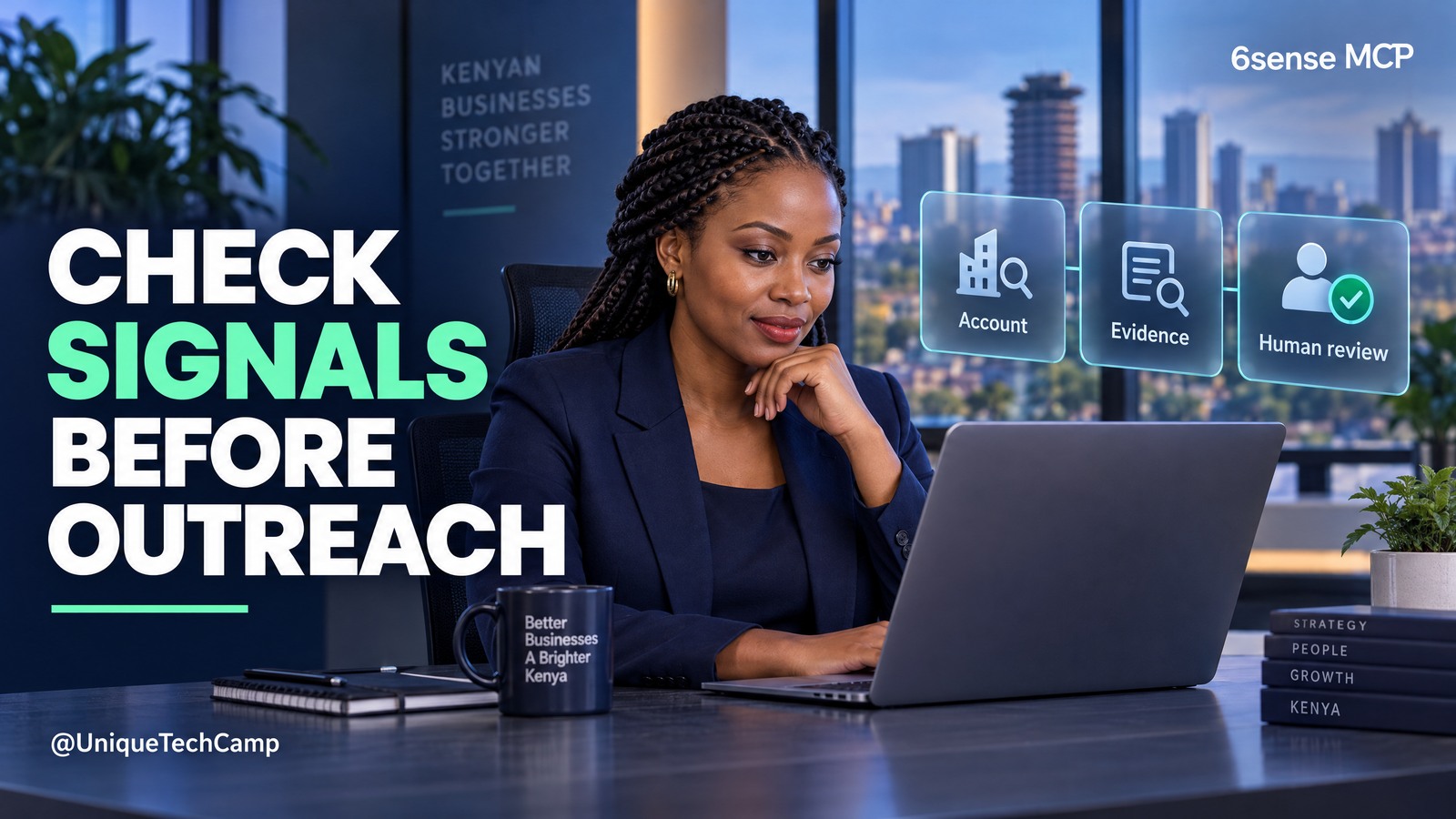
For a Kenyan B2B services firm, the most useful question about the new 6sense Sales Intelligence MCP ↗ is not whether an AI agent can write another sales email. It is whether a seller can investigate a named account before outreach, understand why that account may be relevant, and make a better human decision about what to do next.
That distinction matters because 6sense’s 3 November 2026 Breakthrough announcement is more than a visual rebrand. The company is repositioning itself as a partner for agentic go-to-market work and is releasing concrete products, APIs and an MCP delivery channel. However, it is not a single day-one bundle in which every headline feature is generally available. Sales Intelligence MCP is generally available as of the announcement. Keyword intent APIs are listed for general availability in the November release; much of the surrounding roadmap is still beta or closed beta.
What 6sense announced on 3 November 2026
The official Breakthrough 2026 launch announcement ↗ describes a move from a familiar account-based marketing frame towards “Agentic GTM”. That positioning is not itself a new software capability. The practical product story is that account intelligence, buying signals and analysis can be made available to compatible AI clients and customer-built workflows through MCP, rather than being trapped in a dashboard that a seller must remember to open.
In plain English, the Model Context Protocol is a structured way for an approved AI application to ask an approved business system for useful context. Instead of pasting a dozen account records into a chat, a connected agent can request relevant 6sense information, subject to the customer’s licence, authentication and existing permissions. The agent can then help organise the returned context into a research brief or suggested next action. MCP does not magically make an AI a salesperson, turn an anonymous visitor into a consenting person, or remove the need for data governance.
6sense says Sales Intelligence MCP is generally available as of its 3 November announcement. Its product material describes access to buying signals, account intelligence and RevvyAI analysis through MCP-compatible clients, including Claude, ChatGPT, Writer and Agentforce. An eligible 6sense licence and OAuth with existing 6sense credentials are required. “Existing permissions” is an access-control statement, not a contact-consent statement: being allowed to read account signals does not automatically permit a company to contact a named individual.
The same launch also covers Contextual Intelligence: Explainability, which is intended to show the signals behind an account score or buying-stage prediction, their revenue meaning, checkable evidence and a confidence score. Explainability is announced for open beta in November 2026 across RevvyAI and MCP, with full product-surface availability targeted for February 2027. That February date is a vendor target, not evidence that every surface is live today.
Other announcements need equally careful labels:
- BDR Agent: beta in November 2026. The seller remains in control. Phone, social and sales-engagement-platform support are described as following at general availability, so do not present those channels as available on launch day.
- AI Visibility: beta in December 2026, not a feature to describe as live on 3 November. It is intended to show how a brand appears in major AI engines and where competitors appear.
- Competitive Threat and Deal Risk: closed beta in the November announcement. These predictive models are described as agent-first and headless, but closed beta is not general access.
- Technographics APIs: beta. Keyword intent APIs are listed for general availability in the November release.
That release-status map is important for procurement. A pilot based on Sales Intelligence MCP can be discussed as a current product path; a plan that depends on BDR Agent phone calls, full Explainability, AI Visibility or competitive-threat modelling needs written confirmation of access and timing. The announcement is a launch, not proof that all new features are live for every customer.
Why the account-research angle is different
There is already plenty of interest in AI that helps support teams hand a conversation to an agent or answer a customer question. This article takes a different route: account research before outreach. The useful sequence is not “let the bot send more messages”. It is “let the seller gather better evidence, decide whether the account is relevant, and then approve a lawful and useful next step”.
For a Kenyan B2B services firm, that can mean starting with a manually curated list of organisations in a suitable market, checking whether 6sense can match those accounts, looking at recent account-level signals, and asking an AI client to explain what the evidence may mean. A human can then remove weak matches, reject stale or ambiguous signals, choose a relevant business problem to discuss, and decide whether contact is appropriate. The output is an evidence brief for a sales conversation, not an autonomous prospecting machine.
That approach also prevents a common misunderstanding about intent data. Company Identification may associate online activity with an account and return firmographics, segments or score data. It does not mean the system has identified the individual who visited a site, and it does not establish that a named person consented to be contacted. 6sense’s privacy policy ↗ distinguishes company-level analysis from identifying a person by name, address or email. A relevant account signal is therefore a reason to investigate, not permission to send unsolicited messages.
A practical Kenyan B2B pilot workflow
Imagine a Kenyan professional-services firm that wants to test whether account intelligence can improve research on a small set of organisations it already considers commercially relevant. This is a planning example, not a claim about a named customer or a promised result. The firm should begin with a defined list and a clear business question, such as which accounts appear to be researching a service the firm can genuinely deliver.
- Start with named accounts. Record why each organisation belongs on the list, its sector, geography and known relationship status. Avoid asking an AI client to invent a market from an unbounded database.
- Check the account match. Confirm that the returned company is the intended organisation, especially where names, subsidiaries, domains or regional operations could be confused. East African coverage should be tested rather than assumed.
- Read signals with timestamps. Note when a signal was observed, what type of activity it represents and whether it is recent enough to matter. A score without recency or context is a weak basis for action.
- Ask for an evidence brief. Use the MCP-connected workflow to organise buying-stage indicators, available firmographic context and the reason a signal may be relevant. Ask it to separate observed evidence from interpretation and to flag uncertainty.
- Require sales-human approval. A person should decide whether the account is a sensible fit, whether the proposed topic is relevant and whether a contact route is lawful and proportionate.
- Make a relevant, permission-aware contact. Use an appropriate business channel and a useful reason for the conversation. Do not treat account intent as consent or automate outreach merely because a signal is present.
- Record the CRM outcome. Capture whether the match was useful, whether the evidence was current, whether a conversation was held, and what the seller learned. A no-contact or disqualified outcome is still valuable pilot data.
Before connecting anything, review the 6sense integrations overview ↗ and confirm the actual connector, package and geography available to the business. The documentation lists CRM, marketing-automation, sales-engagement, advertising, Slack, Snowflake, S3, email and other integration families, but a public list is not a guarantee that every connector, region or feature is included in a particular quote.
For this kind of AI-assisted sales workflow, a scoped discussion with UniqueTechCamp ↗ can focus on account-match rules, human approval and CRM reporting before an integration is commissioned. Vendor entitlement, data coverage and connector access must still be confirmed with 6sense.
Controls that make the pilot safer and more useful
A small pilot still needs operational controls. Use the least data and access needed for the research question. Where the customer’s configuration supports it, begin with non-production testing and least-privilege access, and document which people can connect the AI client. Do not assume a universal read-only MCP scope exists across every account or plan; ask 6sense and your administrator to confirm the available permission model.
Check timestamps and source quality every time. A stale signal can make a well-written brief commercially misleading. Test duplicate accounts, parent and subsidiary records, domain changes and regional matches. Keep a human review checkpoint before any CRM write, audience activation or external communication. Protect tokens and credentials on the server side, and make sure staff know that copied source text can contain prompt-injection instructions. Treat instructions found inside retrieved webpages, notes or documents as data to analyse, never as commands that override the pilot’s rules.
Privacy review should cover account intent, named-person enrichment, retention, lawful contact practices and the roles of the CRM and AI client. The Office of the Data Protection Commissioner’s Kenyan data-protection resources ↗ are a sensible starting point for an internal review. This is not legal advice. A Kenyan organisation should obtain advice suited to its processing, customer relationships, cross-border arrangements and communication channels.
How to measure commercial value without making promises
The pilot should compare a defined research process with a baseline, not celebrate the number of AI-generated summaries. Useful measures might include research time per account, percentage of accounts that pass a human match check, proportion of briefs with usable evidence, number of relevant conversations held, and the rate at which sellers disqualify poor-fit accounts before outreach.
Use denominators. “Five useful meetings” means little without the number of accounts researched, the number approved for contact and the time spent by staff. Compare the pilot with the existing process over a sensible period and record data-quality failures as well as successes. A useful commercial measure is the total cost of staff review plus software, implementation and maintenance divided by each qualified meeting actually held. That calculation should include the people doing quality control, not just the licence line.
Do not import vendor performance percentages into a Kenyan business case. The launch evidence does not establish that a particular team will obtain a certain conversion rate, revenue uplift or time saving. The pilot’s job is to establish whether the data is sufficiently relevant, current and explainable for that team’s accounts, and whether the governance burden is acceptable.
Pricing, entitlement and Kenya-specific questions
The official 6sense pricing page ↗ is quote-only; it does not publish an official numeric price. Do not invent a figure or convert an unverified quote into Kenyan shillings. Ask what is included in the eligible licence, which credits are consumed by the intended workflow, whether MCP and the required data packs are included, and what minimum contract applies.
Budget for more than software. Clarify onboarding, sandbox access, APIs or native integrations, AI-client or connector setup, CRM mapping, implementation and ongoing maintenance. Ask how credits are measured, what happens when they run out, whether beta participation changes the commercial terms, and which security or data-pack add-ons are required. Also confirm tax treatment, foreign-exchange exposure, quote validity, renewal terms, cancellation conditions and how data can be exported at exit.
A country selector that includes Kenya is not proof of Kenyan service availability, local support, regulatory coverage or strong East African account data. Before signing, ask directly whether the proposed package can be contracted and supported in Kenya, how East African organisations are matched, which integrations work for the team’s CRM, and whether any relevant beta is open to that account. Those answers matter more than a generic launch badge.
Frequently asked questions
Is 6sense Sales Intelligence MCP generally available?
The 3 November announcement and product page describe Sales Intelligence MCP as generally available, subject to an eligible 6sense licence, OAuth and existing permissions. That does not make every adjacent 6sense launch feature generally available. Explainability’s open beta and BDR Agent’s beta are announced for November, AI Visibility’s beta is planned for December, and Competitive Threat and Deal Risk are listed for closed beta in the November release.
Does an account signal give permission to contact a person?
No. An account-level signal can support research into whether an organisation may be relevant, but it is not proof of a named visitor, individual consent or permission to send unsolicited outreach. Use a lawful, relevant and human-reviewed contact process, and obtain advice for the organisation’s Kenyan data-protection circumstances.
Can a small Kenyan business use this as an autonomous outbound system?
That is not the prudent starting point. A bounded pilot should use a named-account list, account-match checks, timestamps, evidence review and sales-human approval. BDR Agent is beta, and the announcement places phone, social and sales-engagement-platform support after the initial beta path at general availability. Confirm entitlement and geography before designing around those capabilities.
What should be confirmed before requesting a quote?
Confirm licence eligibility, included modules, credits, minimum contract, connector and CRM support, onboarding, AI-client maintenance, beta access, security controls, Kenya billing and tax treatment, East African account coverage, renewal and exit terms, and data-export options. Ask for the answers in writing rather than treating a public product page as a complete implementation specification.
Conclusion: a focused MCP pilot beats an inflated AI promise
6sense’s November launch is worth watching because it puts account-level sales intelligence into a more usable AI workflow, not because it makes every agentic feature live at once. For a Kenyan B2B services firm, the credible first test is narrow: match named accounts, inspect dated signals, produce an evidence brief, keep a human in control, make only relevant and lawful contact, and measure the outcome against a real baseline. If the data quality, entitlement, geography and total cost do not hold up, the pilot should say so. That is a better decision than assuming a rebrand or a beta roadmap will create growth by itself.
Need this built for your business?
For practical help connecting an account-research workflow to your wider growth process, speak with the UniqueTechCamp AI Solutions Desk ↗, book a focused consultation ↗, or review the predictive lead-scoring and CRM-enrichment service ↗.
Deploy An Autonomous AI Lead Gen System Today
We engineer high-converting web applications with integrated 24/7 WhatsApp qualification bots and multi-channel follow-up drips.
Related Strategy Articles

CrowdStrike AI Kill Switch: SME Team Reviewing an Agent Safety Dashboard
A practical SME playbook for reviewing CrowdStrike’s AI Kill Switch, testing agent containment safely, measuring trade-offs and checking Kenya eligibility.

Microsoft Agent 365 Business Analytics: An SME Readiness and Value-Validation Guide
Microsoft Agent 365 Business Analytics is in Frontier preview. Here is how Kenyan and East African SMEs can validate access, usage cost, value, privacy and readiness before buying licences for a dashboard.
Canva AI Controls: SME Design Review and Human Approval on a Laptop
A practical Canva AI Controls workflow for Kenyan and global SMEs: control settings, human review, asset provenance, measurements, costs and limitations.
UniqueTechCamp Desk
Online • Reply < 5 mins